

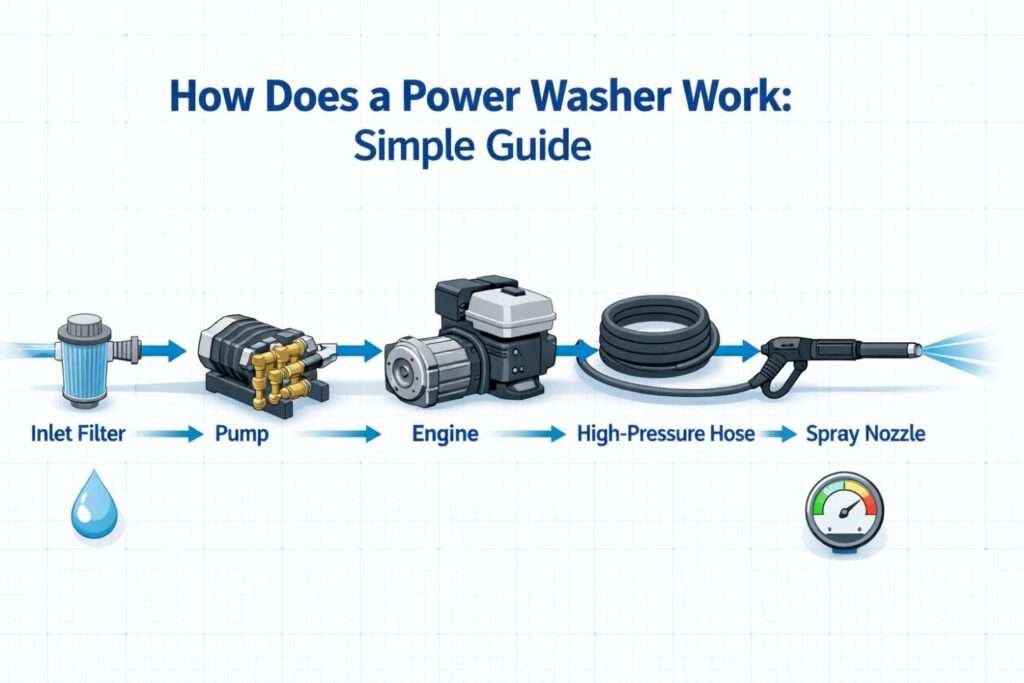
A power washer works by using a motor or engine to drive a pump that squeezes water into a high-pressure stream. The water enters through an inlet filter, the pump increases pressure, and the trigger gun releases that pressure through a small nozzle to create a strong spray. Some power washers also heat the water to lift grease faster. Pressure is cutting power, and flow is rinse power.
What a power washer is (in plain words)
A power washer is a pressure washer that can also heat water. Hot water helps break up oily and sticky grime faster, like washing dishes with warm water instead of cold.

A pressure washer uses cold water but still cleans well when you use the right nozzle, distance, and technique. If you want a simple definition, start with what pressure cleaning is.
Power washer vs pressure washer
| Feature | Pressure washer | Power washer |
| Water temperature | Usually cold | Can heat water |
| Best for | Dirt, dust, mud, light algae | Grease, oil, heavy grime |
| Main “power” source | Pump pressure + flow | Pump pressure + flow + heat |
| Risk level | Can still injure and damage surfaces | Same risks, plus burn risk with hot water |
How a power washer works step by step (the simple flow)
A power washer works by pushing normal tap water through a pump so it comes out as a fast, focused jet. That is why it can remove dirt that a garden hose cannot.

Step 1: Water source and inlet filter
Water starts at your tap or tank, then passes through a small filter that stops grit. Clean water matters because grit can damage the pump.
Step 2: Pump and what it really does
The pump does not “create water”; it squeezes and speeds it up. A pump turns steady tap water into a strong stream by increasing pressure and controlling flow.
Step 3: Engine or motor (electric vs petrol)
An electric motor runs quieter and is suitable for small jobs. A petrol engine often runs strongly for long outdoor jobs, but it needs more care and fuel.
Step 4: Unloader valve and bypass (why it matters)
The unloader controls pressure when you release the trigger. It sends water back through a bypass so the machine does not overload and blow a seal.
Step 5: Hose, gun, trigger, nozzle (how the jet is shaped)
The hose carries pressure to the gun. The nozzle is the “shape maker” that turns a stream into a fan or a tight jet.
Step 6: Optional heating coil (power washer)
A power washer can heat water using a burner and coil, which helps lift grease. Heat adds cleaning speed, but you still need a safe distance and the right nozzle.
Step 7: Detergent injector (downstream vs upstream, simple)
Many units pull soap after the pump (downstream), so the pump sees clean water. Some systems inject before the pump (upstream), which requires care and the correct products.
If you want a visual map of parts, use this guide on key components of a power washer.
Mental model: pressure is force, flow is rinse power.
The 2 numbers that control cleaning: PSI and flow (GPM or LPM)
PSI and flow rate team up to make cleaning effective. PSI, or pounds per square inch, measures how hard the water hits—like a strong push on dirt. Flow, in gallons per minute (GPM) or liters per minute (LPM), measures how much water flows—like a big rinse to wash away loosened grime. Think of PSI as a hammer breaking ice, flow as a bucket flushing shards. Higher PSI cuts deep stains, but can cause too much damage to surfaces. Higher flow speeds up jobs on large areas. Distance from the nozzle and its angle matter as much as PSI—get closer for more force, but test first. Learn about PSI flow rates for power washing.

Think of it like this: PSI is like a finger poking dirt, flow is like a bucket washing dirt away. You usually need both for fast results.
Mini table: PSI vs flow
| If you increase… | You get more… | What it helps with |
| PSI | Cutting power | Stuck dirt, paint flakes, hard buildup |
| Flow (GPM/LPM) | Rinsing power | Faster cleaning, better flushing, less streaking |
Nozzle colors and spray angles (what they do)
Nozzles control how wide the spray is, and that controls how aggressive it feels. Most sets use common colors, but brands can vary, so check your manual.

- 0° (often red): very tight jet, high risk of damage and injury
- 15° (often yellow): strong cleaning on hard surfaces, still risky
- 25° (often green): general cleaning, safer for many jobs
- 40° (often white): gentle rinse, good for delicate surfaces
- Soap tip (often black, very wide): low pressure for detergent
A narrow tip can pierce skin and inject contaminants, so treat it like a cutting tool. A national guide on high-pressure jetting lists “water jet piercing the skin” as a key hazard.
If you want to choose tips the pro way, use How to choose nozzles and lances.
How to use a pressure washer (beginner safe workflow)
A pressure washer works best when you set up safely, start gently, and only increase power when you must. This prevents damage and gives a cleaner finish.

Step-by-step
Step 1: Prep the area
Clear trip hazards, move items, and cover fragile things. Place the machine on a flat surface so it cannot tip, which is a common safety point in beginner guides.
Step 2: Choose the right nozzle and setting.
Start with a wider fan tip (like 25° or 40°). Only move to a tighter tip if the dirt does not shift.
Step 3: Connect hoses and check the fittings
Tighten the garden hose at the inlet and the high-pressure hose at the outlet. Leaks waste pressure and can cause hose whip.
Step 4: Flush the air before you spray
Let water run through the system briefly before you fire at a surface. This helps avoid pulsing and sputtering, and it is a common setup step in how-to guides.
Step 5: Test on a hidden spot
Test for 5–10 seconds to check the surface reaction. This protects wood, soft stone, paint, and old mortar.
Step 6: Clean top to bottom, with steady passes
Hold the wand with two hands and move in smooth, overlapping strokes. Start at the top so dirty water does not streak down later.
Step 7: Apply detergent correctly, then rinse
Apply detergent with the soap tip and keep it wet for the label dwell time. Rinse before it dries, and rinse from top to bottom.
Step 8: Shut down safely and store.
Turn off, shut the water, squeeze the trigger to release pressure, then disconnect. Follow a simple after-care routine like this post-cleaning checklist.
Step 9: If you only remember 3 things
- Start with a wide nozzle and low pressure.
- Keep distance and keep moving.
- Test first, and never aim at people or pets.
For a ready-made setup routine, use this power washer setup checklist and the standard pressure cleaning workflow.
What PSI should you use on common surfaces?
You should use the lowest pressure that gets the job done. Surface age, cracks, paint, and seals matter more than a “perfect PSI number.”

Conservative starting guide (always test first)
| Surface | Start range | Nozzle tip | Key warning |
| Car paint | 900–1500 PSI | 40° | Keep distance, avoid decals and chips |
| Timber deck | 500–1200 PSI | 40° | Too close can fur wood fast |
| Concrete driveway | 2000–3000 PSI | 25° | Avoid blasting cracks and joints |
| Brick and mortar | 1200–2000 PSI | 25°–40° | Old mortar can blow out |
| Pavers | 1200–2500 PSI | 25° | Do not strip joint sand |
| Windows | Avoid high pressure | 40° (low only) | Risk of seal damage or breakage |
Always test first and watch how the surface reacts. If you want surface-by-surface rules, start with common surfaces for pressure cleaning and read about basic surface risks.
Safety and PPE (must be practical, not generic)
Pressure washing can injure you fast, so treat it like a power tool. Regulators warn about skin piercing, injection injuries, flying debris, hose whip, and electric shock as real risks in high-pressure jetting work.

Main hazards to watch
- Injection injury: the jet can enter the skin and carry dirty water into the tissue
- Flying debris: grit and stones can hit the eyes and face
- Slips and falls: wet concrete turns slick fast
- Electric shock: water and power leads do not mix
- Noise: petrol units and hard surfaces amplify sound
- Chemicals: detergents can burn skin and eyes
A medical review explains that high-pressure injection injuries can happen in a moment, often after a slip or mistake, and they need urgent care.
PPE checklist (simple and effective)
- Eye protection (sealed glasses or goggles)
- Hearing protection (especially petrol units)
- Gloves with grip (and chemical resistance if using detergents)
- Covered shoes or boots with non-slip soles
- Long pants and long sleeves
- A face shield for messy, high-splash jobs
A common safety message in waterjetting research is that basic gear may not fully protect against jet impact, so distance and control matter as much as PPE.
Stop-work triggers (pause and reset)
- You cannot keep a stable footing.
- You feel kickback pulling your arms off-line.
- The surface starts to shred, etch, or peel.
- The hose coupling leaks, whips, or moves.
- Water gets near live power, lights, or outlets.
- You cannot control runoff.
Workplace duties differ by country, but the basic idea stays the same: do a hazard check, choose the correct PPE, and train people to use it properly. OSHA’s PPE rules describe hazard assessment and proper PPE selection as core requirements.
For practical DIY safety habits, read pressure washing safety basics and WHS basics for pressure cleaning.
Common mistakes and how to avoid them
Most pressure washer damage comes from getting too close too fast. Start wide, step back, and increase slowly.

Experience: what shows up again and again
In day-to-day pressure cleaning jobs, the same three mistakes show up.
Mistake 1: You start with a 0° tip.
Fix: Start with 40° or 25° and only tighten if needed.
Mistake 2: You hold the jet in one spot.
Fix: Keep moving in smooth passes and overlap slightly.
Mistake 3: You let the detergent dry.
Fix: Work in small sections and rinse before it dries, especially in the sun.
If you use detergents often, keep it simple and safe with pressure washing chemicals and a clear pre-clean routine, like how to prepare your property.
Maintenance basics
Good maintenance keeps pressure steady and stops costly pump problems. A clogged filter or nozzle can also cause pulsing and poor cleaning.

Simple maintenance habits
- Flush clean water through the unit after soap.
- Clean the inlet filter and nozzle tips.
- Check hoses and O-rings for wear.
- Depressurize before storage.
- Follow the manual for oil changes on petrol units.
When to DIY vs when to hire a pro
DIY works when the job is low-risk, and you can control the area. Hire a pro when the job adds height, fragile surfaces, or high safety risk.

DIY is usually fine when
- You clean a driveway, small deck, or patio.
- You can test first and work slowly.
- You can keep people away from the spray zone.
Hire a pro when
- You work at height or near power lines.
- You clean old brick, roofs, or delicate coatings.
- You deal with heavy grease, unknown chemicals, or large runoff.
If you need professional help, you can book high-pressure cleaning services for a safer, faster result.
Conclusion
A power washer works by using a pump to turn normal water into a high-pressure jet, and some models add heat for faster grease removal. Use the right nozzle, keep a safe distance, and clean with steady passes for the best finish. Start gently, test first, and raise pressure only when you must. Wear PPE and stop if control slips, because injury can happen fast. When the job is high-risk or delicate, hiring a Professional cleaner is the smart choice.
FAQs (Frequently Asked Questions)
What is the difference between power washing and pressure washing?
Power washing uses heated water, while pressure washing usually uses cold water. Heat helps break grease faster, but the same safety rules apply.
Can a pressure washer damage concrete?
Yes, a pressure washer can etch concrete if you use a tight nozzle too close or hold it in one place. Start with a wider tip, keep moving, and test first.
What nozzle should I use for most jobs?
A 25° or 40° nozzle is a safe starting point for most home cleaning. Use a tighter nozzle only when the dirt does not move.
How far should the nozzle be from the surface?
Start farther back and move closer only if needed. A common safe range is about an arm’s length, then adjust after a test patch.
Do I need soap to pressure wash?
You do not always need soap, but it helps with oily grime and algae. Apply soap with a low-pressure soap tip and rinse before it dries.
Can I use hot water in a pressure washer?
Use hot water only if your machine is built for it. A power washer heats water safely, while many cold-water units are not designed for hot input.
What PSI is safe for washing a car?
Lower PSI is safer for paint and trim. Start around 900–1500 PSI with a 40° nozzle, keep distance, and avoid close blasting.
Why does my pressure washer pulse or surge?
Pulsing often comes from air in the line, a clogged nozzle, a blocked inlet filter, or a weak water supply. Flush air out, clean the filter, and check the flow.
How do I stop streaks after pressure washing?
Streaks usually happen when dirty water runs down a dry surface. Work top to bottom, rinse well, and do not let the detergent dry.
Can I pressure wash windows or roofs?
Avoid high pressure on windows and roofs because you can damage seals, coatings, and materials. Use gentle settings, or use a safer soft-wash method when needed.


