

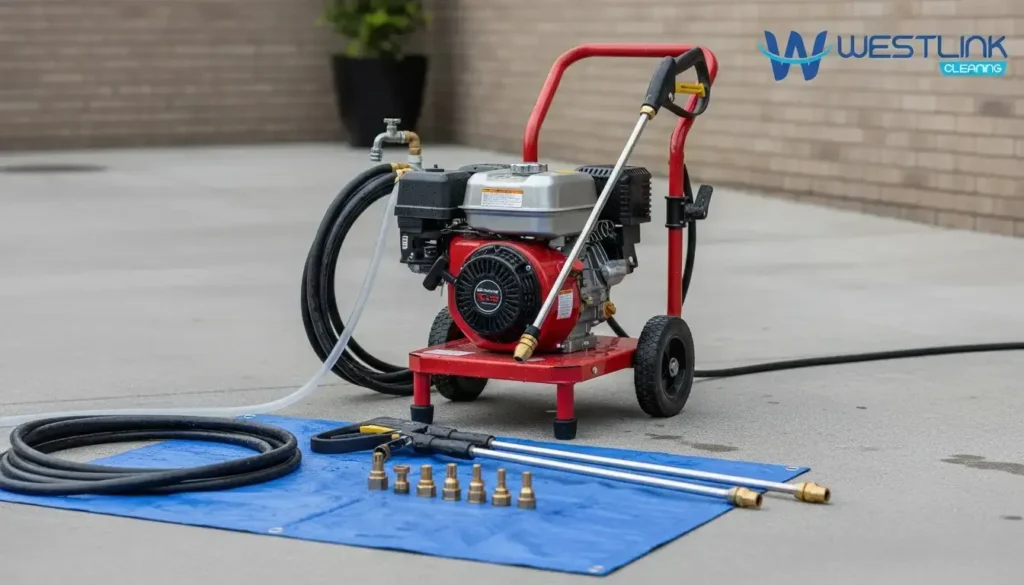
Choose the nozzle by surface type, coating sensitivity, soil level, and your machine’s PSI and GPM. Then choose the lance by reach, working angle, and control. Start with a wider fan pattern, use the black nozzle for detergent, and only move to a narrower or rotating tip if the surface clearly allows it.
Choosing nozzles and lances for power washing is not just about colour or convenience. The right setup depends on how much force the surface can handle, how much water your machine delivers, how concentrated the spray should be, and how well you can control the nozzle at a safe working distance. That is why it helps to understand how pressure cleaning works before you decide which tip or wand setup to use. The same pressure washer can need a very different setup for concrete, vehicles, painted surfaces, decks, siding, masonry, and machinery.
What Do Nozzles and Lances Actually Control?
A nozzle controls spray pattern, force concentration, and flow restriction, while a lance controls reach, standoff distance, and handling.
The nozzle decides how the water leaves the machine. It determines whether the spray hits the surface as a narrow jet, medium fan, wide fan, rotating stream, or low-pressure detergent flow. That choice changes how deep the water cuts, how widely it covers, and how risky it is on delicate finishes.
The lance, also called a wand, determines how you position that nozzle. It affects reach, body posture, distance from the surface, and directional control. Even the correct nozzle can perform badly if the lance is too short, too long, or tiring to hold.
How Does Spray Angle Change Cleaning Force, Coverage, and Risk?

Spray angle changes how concentrated the water force is on the surface. A tighter spray cleans deeper, while a wider spray spreads force over a larger area and usually lowers damage risk.
Spray angle changes how concentrated the water force is on the surface. A tighter spray cleans deeper, while a wider spray spreads force over a larger area and usually lowers damage risk.
A narrow spray pattern puts more force into a smaller zone. That makes it useful for stubborn buildup, heavy grime, and harder materials. The trade-off is that it can also gouge soft timber, lift paint, damage seals, and mark delicate surfaces much faster.
A wider spray pattern spreads the same flow across more surface area. That usually makes it safer for painted surfaces, glass, vehicles, siding, coated materials, and any surface you are unsure about. It may clean more slowly, but it gives you a much better safety margin. For delicate finishes, it is also worth understanding what soft washing is because some surfaces respond better to lower pressure and cleaning solutions than direct force.
What Do the Common Pressure Washer Nozzle Colours and Angles Mean?

The standard colour system usually means red 0°, yellow 15°, green 25°, white 40°, and black low-pressure soap.
These colours help identify the common role of each tip, but they do not replace proper selection. You still need to consider nozzle size, machine output, surface type, and soil level.
| Nozzle | Typical Angle | Main Use | Main Value | Main Risk |
| Red | 0° | Very hard, localised buildup | Maximum concentration | Highest damage risk |
| Yellow | 15° | Heavy dirt on durable surfaces | Strong cutting action | Too aggressive for many finishes |
| Green | 25° | General cleaning | Balanced force and coverage | Can still mark softer surfaces |
| White | 40° | Delicate cleaning and rinsing | Safer, wider fan | Slower on heavy deposits |
| Black | Low pressure | Detergent application | Chemical draw | Not for force cleaning |
When Should You Avoid a 0° Tip?
Avoid a 0° tip unless the surface is very hard, unpainted, and the job truly needs pinpoint force.
A red tip is not a general cleaning tip. It is a specialist option for very stubborn deposits on very durable materials. On many everyday surfaces, it is simply too aggressive.
For most residential and mixed-finish work, starting with a 0° tip is a mistake. A safer method is to begin with a wider fan, test a hidden area, and only move to a narrower tip if the surface clearly tolerates it.
Why Does Nozzle Size Matter as Much as Spray Angle?
Nozzle size affects machine loading and flow balance, while spray angle affects how the water is spread on the surface. You need both rights.
Two nozzles can have different spray angles but still need the same size if the machine output is the same. The angle changes the surface effect. The size changes how the machine performs.
If the nozzle is too small, it can restrict flow too much and stress the system. If the nozzle is too large, working pressure drops and cleaning performance becomes weak. That is why colour alone is never enough for correct selection.
How Do PSI and GPM Change the Right Choice?
PSI affects stripping force, while GPM affects rinsing volume and cleaning speed.
PSI determines how strongly the water hits the surface. GPM determines how much water reaches the surface. In practice, a machine with strong PSI but low GPM can hit hard in a narrow area, while a machine with higher GPM can rinse loosened dirt faster and clean larger areas more efficiently.
Nozzle choice must fit both values. A tip that suits the pressure but not the flow is still the wrong tip.
Which Nozzle Should You Start With for Different Surfaces?

Start with the least aggressive practical fan pattern for the surface, then increase concentration only if the material and soil level clearly allow it.
Hard mineral surfaces usually handle more force than painted timber, glass, siding, plastic trim, or finished metal, so your starting point should always reflect surface strength and finish sensitivity. For outdoor home surfaces such as paths, driveways, walls, decks, and paved areas, this is the same thinking used in residential pressure cleaning, where the goal is not just stronger pressure but the right pressure for the material.
| Surface Group | Safer Starting Logic | Why |
| Concrete, brick, pavers, masonry | Start with a medium fan, then narrow only if needed | Harder surfaces usually tolerate more concentration |
| Timber, decks, painted trim | Start with a wide fan and steady movement | Soft fibres and coatings mark easily |
| Vehicles, siding, windows | Start wide with more distance and angle control | Paint, seals, and glass are damage-sensitive |
| Delicate or unknown surfaces | Start with the widest practical pattern | Reduces risk while you assess surface response |
Which Nozzle Works Best for Concrete, Brick, Pavers, and Masonry?
Concrete, brick, pavers, and masonry often suit a 25° nozzle, and in some heavy-soil cases a 15° tip may be appropriate.
These surfaces usually tolerate more concentrated spray, which helps remove built-up grime, algae, dirt, and residue more effectively. Decorative finishes, weak mortar joints, weathered surfaces, and sealed areas still need extra care because not every hard surface responds the same way.
Which Nozzle Works Best for Timber, Decks, and Painted Surfaces?
Timber, decking, and painted surfaces usually need a 40° tip or a cautious 25° used from greater distance.
These materials are more likely to scar, fuzz, stripe, or lose coating if the spray is too concentrated. On these surfaces, control matters more than force, so steady movement and proper distance are more important than faster cutting power. In many cases, it also helps to compare soft washing vs pressure washing vs power washing before choosing a tip, because the safest method may involve lower pressure rather than a wider nozzle alone.
Which Nozzle Works Best for Vehicles, Siding, Windows, and Delicate Surfaces?
Vehicles, siding, windows, and other delicate surfaces usually need a wide fan pattern, more distance, and careful wand angle.
These materials are more vulnerable to paint damage, water intrusion, seal stress, and glass risk if the spray is too direct. For these jobs, the goal is safe cleaning and controlled rinsing, not maximum pressure concentration.
Which Nozzle Works Best for Machinery and Heavy Soil?
Machinery and heavy soil often need more concentrated cleaning, but the best tip still depends on which parts are durable and which parts are sensitive.
Mud, grease, and compacted debris on strong metal sections may justify a 25° or 15° tip. Painted covers, labels, seals, wiring areas, and more delicate components usually need a wider spray and better control.
When Should You Use the Black Soap Nozzle?

Use the black nozzle when you need low-pressure detergent draw, not when you need cutting force.
The black tip is a chemical-stage tool, not a high-pressure cleaning tool. It is used to apply detergent to the surface so the cleaning solution can break down soil before rinsing or follow-up cleaning.
After applying detergent, you switch to a suitable rinse or cleaning nozzle. The black tip is not designed to remove stubborn buildup by force.
Should You Use a Variable Nozzle or a Rotating Nozzle?
Use a variable nozzle when you need flexibility during the job, and use a rotating nozzle when you need stronger impact on hard surfaces.
A variable nozzle is useful when you want to adjust spray angle or pressure level without constant tip changes. It can make workflow easier when one job includes several cleaning stages.
A rotating nozzle is different. It delivers concentrated impact in a rotating pattern, which can clean very aggressively on hard surfaces. It is not a universal upgrade. It should only be used when the machine meets the required pressure range and the surface is strong enough to tolerate the extra impact.
Which Lance Type Matches Which Job?

Choose the lance by reach, body position, and control. The correct lance solves a handling problem, not a force problem.
Short lances improve close control. Longer straight lances help with standard reach. Telescopic lances solve height problems so the operator can work from the ground instead of overreaching.
| Lance Type | Best Use Case | Main Value | Main Trade-Off |
| Short lance | Vehicles, close-detail work, tight areas | Better close control | Less reach |
| Long straight lance | Standard flatwork and slightly offset areas | More reach without full telescoping | More leverage on wrists and shoulders |
| Telescopic lance | Facades, windows, high walls, solar panels | Ground-based reach and safer posture | More weight and fatigue over time |
When Is a Short Lance Better?
A short lance is better when the work needs close control and precise movement.
Vehicle panels, detailed areas, edges, and confined spaces usually benefit from a shorter setup because it is easier to guide and easier to hold at a stable distance.
When Is a Longer Straight Lance Better?
A longer straight lance is better when the work needs moderate extra reach without the weight and complexity of telescoping equipment.
It can help maintain safer distance on flatwork, walls, and slightly offset surfaces. The trade-off is that it changes leverage and can become more tiring over longer jobs.
When Is a Telescopic Lance the Right Tool?
A telescopic lance is the right tool when height is the main challenge.
If the problem is cleaning higher walls, windows, facades, or similar elevated areas, a telescopic lance makes more sense than trying to compensate with poor posture or excessive stretching. It solves reach and working-angle problems. It does not replace correct nozzle selection.
How Should You Test a Surface Before Full Cleaning?

Test a small hidden area first with the least aggressive practical setup, then increase force only if the surface response is safe.
Use this sequence:
- Identify whether the substrate is painted, sealed, glazed, delicate, weathered, or cracked.
- Identify the soil type, such as mud, algae, grease, oxidation, or loose debris.
- Confirm your machine’s PSI and GPM.
- Select the least aggressive practical nozzle.
- Hold the wand at an angle instead of spraying straight into the surface.
- Test a small hidden area first.
- Inspect for etching, fibre lift, paint loss, streaking, or water intrusion.
- Increase force only if needed.
- Keep strokes moving and overlapping.
- Shut the system down before changing nozzles or lances.
A test patch is especially important on painted surfaces, aged finishes, timber, delicate cladding, windows, and any material you are unsure about.
What Safety Risks Come from the Wrong Nozzle or Lance?
The wrong nozzle or lance increases injury risk, property-damage risk, fatigue risk, and loss-of-control risk.
Pressure washing is a controlled-force task, not simply a high-force task. The wrong setup can increase the risk of splashback, flying debris, eye injury, electric shock, water intrusion, manual strain, and surface damage. Related content also covers these practical issues, including the basic risks of pressure cleaning for people and surfaces, especially when the operator starts too aggressively or uses the wrong angle on a sensitive finish. Safe Work Australia also provides guidance on managing risks from high-pressure water jetting, which supports hazard identification, risk control, and safer work procedures before pressure cleaning begins.
A nozzle that is too aggressive can damage the surface in seconds. A lance that is too awkward can cause poor aim, poor posture, and unstable handling. Both problems become more serious when the job is long, elevated, or physically tiring.
Why Do Splashback, Overspray, and Fatigue Matter?
They matter because cleaning quality depends on controlled force.
Splashback can send grit, dirty water, and debris back toward the operator. Overspray can affect nearby surfaces, seals, windows, electrical areas, plants, and bystanders. Fatigue can change the wand angle and the working distance even when the correct tip is installed.
That is why reach tools, body position, and workload matter just as much as the nozzle itself on longer jobs. Runoff also needs control. The NSW EPA says washing runoff should be kept out of stormwater drains and wash-down activity should be managed in suitable areas, which is why site drainage, containment, and wastewater control matter on larger cleaning jobs. See the EPA guidance on the drain is just for rain.
What Mistakes Cause Damage Most Often?
Most damage comes from force errors before it comes from equipment failure.
The most common mistakes are:
- starting too aggressively
- working too close to the surface
- choosing by colour alone
- ignoring nozzle size
- using a cleaning tip when the job needs the black soap nozzle
- spraying directly into siding joints or seals
- washing windows too aggressively
- trying to solve a reach problem with a harsher tip instead of the correct lance
In most cases, surface damage happens because the operator increased force before confirming surface tolerance.
How Do You Spot Wear and Troubleshoot Weak Performance?
Weak cleaning, distorted spray, poor detergent draw, or pulsation can point to nozzle wear, blockage, or mismatch.
Start troubleshooting with the nozzle, flow path, and water supply before assuming the pump is at fault. A worn, blocked, or wrongly sized tip can change performance a lot.
Common causes of weak performance include:
- clogged nozzle
- worn nozzle
- blocked inlet screen
- insufficient water supply
- excessive hose length
- nozzle mismatch
- detergent system blockage
- wrong nozzle fitted for soap draw
If the machine feels weak, always check the simplest flow-related issues first.
What Is the Fastest Decision Framework for Beginners?
For beginners, start wide, test first, and only narrow the fan if the surface clearly allows it.
Use this quick framework:
- Unknown, delicate, painted, or finished surface: start with 40°.
- General exterior dirt on durable surfaces: try 25° after a safe test.
- Heavy grime on hard surfaces only: consider 15°.
- Detergent stage: use the black soap nozzle.
- Height problem: solve it with the right lance, not a harsher tip.
- Rotating nozzle: use only if the machine suits it and the surface is appropriate.
This sequence prevents many common mistakes because it keeps the first pass inside the safer zone.
What Should Professionals Check Before Buying or Starting?
Professionals should separate substrate analysis, machine matching, chemical stage, and ergonomic control before choosing the final setup.
That means checking:
- substrate and finish
- soil type
- PSI and GPM
- nozzle size, not just colour
- detergent stage versus pressure-cleaning stage
- lance length for reach and posture
- accessory compatibility
- operator fatigue exposure
- safe test area before full production work
Professional results come from system matching, not from using the most aggressive accessory.
Conclusion
The best nozzle and lance setup is the one that matches the material, the dirt, the machine output, and the operator’s ability to control distance and angle safely.
Start with the least aggressive practical setup. Use the black soap tip for detergent. Treat nozzle size as a machine-matching decision, not just a tip detail. Let the test patch decide whether you can safely increase force.
That approach gives you better cleaning, lower damage risk, and more consistent results across concrete, timber, painted surfaces, vehicles, siding, windows, machinery, and other common power washing jobs. If you are comparing outdoor surface washing with routine indoor cleaning, this guide on residential pressure cleaning vs general house cleaning helps explain where each service fits.
Frequently Asked Questions
1. Which pressure washer nozzle is safest to start with?
Ans. A 40° tip is usually the safest starting point for unknown, delicate, painted, or finished surfaces.
2. Does nozzle colour alone tell me the right choice?
Ans. No. Colour only suggests the common spray angle or function. Nozzle size, PSI, GPM, surface type, and soil level still decide whether it is the correct tip.
3. What does the black pressure washer nozzle do?
Ans. The black nozzle is for low-pressure detergent application.
4. Can the wrong nozzle damage my pressure washer?
Ans. Yes. A mismatched nozzle can affect system loading and cleaning performance.
5. Does spray angle change nozzle flow?
Ans. No. Spray angle changes how the water is spread on the surface. Nozzle size and pressure affect flow.
6. What is better for general cleaning, 25° or 40°?
Ans. 25° is often better for general cleaning on durable surfaces, while 40° is safer for delicate or finished surfaces.
7. When do I need a telescopic lance?
Ans. You need a telescopic lance when height is the real problem and ground-based reach is the safer solution.
8. Why is my machine not drawing detergent?
Ans. A common cause is using the wrong nozzle. The black soap nozzle is usually required for proper detergent draw.
9. Why is my pressure washer losing pressure?
Ans. Common causes include a clogged nozzle, blocked inlet screen, insufficient water supply, excessive hose length, or nozzle mismatch.
10. What is the single best rule for choosing nozzles and lances?
Ans. Start safer than you think, test before full cleaning, and let the surface response decide whether you can increase force.


