

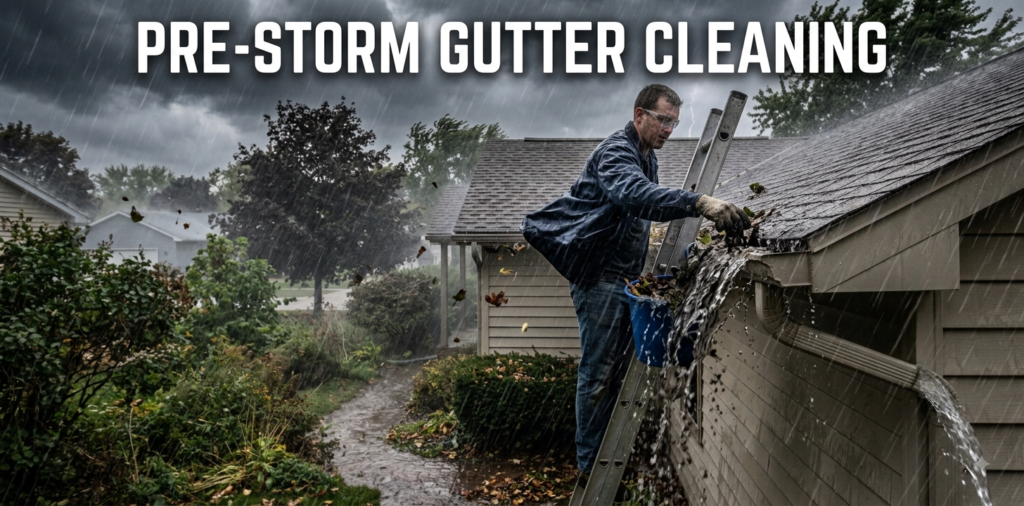
A gutter can look mostly clear from the ground and still fail in a downpour. The problem often sits at the outlet, where a mat of wet leaves can act like a plug. The level then rises fast as the roof keeps feeding runoff into the same channel.
This is why a pre-storm gutter cleaning is more than removing what you can see. The job should restore a clear path from the roof edge to the final discharge point. If water cannot move through the outlet and downpipe at a steady rate, the gutter may overflow even when most of the channel looks clean.
Timing matters too. Cleaning before the rain gives you a chance to find loose brackets, cracked joints, sagging sections, or other faults before bad weather arrives.
This guide is for people who want to lower the chance of preventable drainage problems before severe weather. It explains what to look for, what a proper clean should include, and when professional help makes more sense than climbing a ladder yourself.
A useful check is simple: look for where debris gathers, not just how much is present. A thin layer across the whole gutter may drain better than one tight clump pressed over an outlet. That small detail often decides whether rain moves away or starts backing up.
What a Storm-Ready Gutter System Should Actually Do
A storm-ready system does one basic job well: it moves roof runoff away from the building without backing up. The path starts on the roof, runs through valleys and gutter channels, passes through the outlets, travels down the downpipes, and then enters the stormwater system or another approved discharge point.
Each part matters. A clean gutter with a blocked downpipe is still a blocked drainage system. The same applies when the downpipe is clear but the gutter holds standing water because the fall is wrong. Water should move toward the outlet instead of sitting in low spots.
A hose test can reveal a lot. Water should travel along the gutter, enter the outlet without pooling, and discharge freely. If it rises around the outlet or drains slowly, a restriction or defect may need attention.
Treat the system as one connected route. That catches faults a quick scoop-and-go clean can miss.
After a flow test, water should not sit in a deep pocket several minutes later. A small film may remain on the metal, but a clear pool around a bracket or joint points to a low spot. That is useful evidence because it separates a cleaning issue from a fall or support problem.
How Sydney Conditions Increase Gutter and Downpipe Blockage Risk
Properties here can face heavy rain, seasonal leaf fall, wind-blown debris, and dense tree cover. Gum leaves, twigs, bark, and seed pods collect quickly under overhanging branches. Fine roof grit can settle between them and compact when wet.
Wind makes timing unpredictable. A recently cleaned gutter can collect fresh debris after rough weather. Roof valleys also trap leaves where two roof slopes meet.
Tree cover changes how often maintenance is needed. A home with open surroundings may stay clear longer than one under mature trees. Gutter guards can reduce larger debris, but they do not stop fine material from settling below the mesh or collecting on top of it.
Inspect based on property conditions, not just the calendar. If the roof sits under trees or has overflowed before, check it ahead of forecast heavy rain.
After windy weather, check the highest debris zones first: valley mouths, inside corners, and outlets beneath trees. These spots can clog while long straight gutter runs still look clear during a quick ground-level check.
What Happens If Gutters Are Blocked During Heavy Rain?

During heavy rain, a blockage cuts drainage capacity. The roof keeps shedding runoff, so water rises until it finds another route, such as over the edge, behind the gutter, through a failed joint, or into a roof cavity.
Overflow can wet fascia, stain walls, saturate garden beds, and pool near the building. Water reaching insulation or ceiling plasterboard may later show as staining, sagging, or a musty smell. Persistent moisture can also support mould and timber decay.
The failure point varies. A partially blocked downpipe may cope with light rain but fail as runoff rises. A gutter low spot can also hold water and sediment.
Cleaning reduces preventable restrictions, but it does not guarantee that every drainage system can handle every storm. Gutter size, roof area, stormwater capacity, and existing defects all affect performance.
That is why overflow should be treated as a symptom, not a diagnosis. If a recently cleared system still spills at the same point, the next step is to check fall, outlet size, downstream drainage, and roof-water concentration rather than simply cleaning it again.
Signs Your Gutters Need Cleaning Before a Storm
Some warning signs are obvious. Others appear only when water moves. A ground-level check, plus a safe closer look where access allows, can reveal drainage problems.
- Leaves, twigs, or plants are visible above the gutter edge.
- Water sits in the gutter after dry weather or remains after a hose test.
- Stains appear on the fascia or below gutter joints.
- Water spills over one section during ordinary rain.
- A downpipe gurgles, drains slowly, or backs up at the top.
- The gutter line sags between brackets.
- Debris has built up around a roof valley or outlet.
- Birds or pests keep returning to one section of the roofline.
One sign alone does not prove a blockage, but repeated overflow or standing water deserves attention. Water escaping behind the gutter may point to alignment, flashing, or connection problems rather than debris alone.
A gutter can also tell a story after rain. Fresh splash marks below one corner, washed mulch beside a downpipe, or a ceiling mark can help narrow the point where drainage failed.
What Should Be Included in a Proper Pre-Storm Gutter Clean?
A thorough service should cover more than the open gutter channel. It should restore flow, check the connected drainage path, and identify visible defects.
- Remove loose and compacted debris from accessible gutter channels.
- Clear leaves and sludge around gutter outlets.
- Remove debris from accessible roof valleys where runoff converges.
- Check downpipe openings and clear obvious blockages.
- Flush or flow-test downpipes where suitable.
- Check for standing water, poor fall, sagging, loose brackets, and leaking joints.
- Inspect gutter guards for trapped debris or damage.
- Remove collected waste from the property rather than leaving it below the roofline.
- Record visible faults that may need repair.
- Provide clear before-and-after evidence when that forms part of the service.
A professional gutter cleaning service should state what sits outside the cleaning scope. Underground blockages, roof repairs, failed flashing, and structural faults may need another trade or repair visit.
Why Downpipes, Roof Valleys and Stormwater Drainage Matter Just as Much
Gutters sit in the middle of the drainage route. Roof valleys feed runoff into them, and downpipes carry water away. If either side fails, cleaning the channel alone may not solve the problem.
Valleys trap branches and leaf litter. Because runoff from two roof slopes can meet there, a blockage can divert water sideways or overload one gutter section.
Downpipes can hide restrictions. Wet leaves may compact at a bend, around a connection, or near the base. A hose flush can help show whether water moves freely, but it should not force water into a known damaged or disconnected system.
The discharge point also matters. A blocked stormwater drain can cause backup or ground-level pooling. Rainwater tank systems may also have screens, inlets, or a first-flush diverter that needs inspection.
Gutter Defects That Cleaning Alone Cannot Fix

Cleaning restores space for water, but it cannot correct a damaged or poorly installed system.
A gutter with the wrong fall may hold water even when spotless. Loose brackets create low points. Cracked joints, failed end caps, corrosion, and rust holes can leak. Damaged fascia can also affect gutter position.
Gutter guards create another issue. If the mesh is bent, lifted, or clogged with fine debris, the system may need repair or partial removal before cleaning can be completed properly.
Underground stormwater blockages sit outside normal gutter cleaning. If water runs down the pipe but backs up at ground level, the restriction may be below the surface and need a drainage professional.
The key is simple: cleaning removes obstructions. Repairs restore damaged components. Some properties need both.
A good inspection records where the fault sits. For example, a leak at a mitred corner needs a different fix from water overtopping a straight section. Likewise, a loose bracket calls for support work, while rust perforation may require repair or replacement of the affected gutter section.
How Often Should Gutters Be Cleaned Before Storm Season?
No single schedule suits every property. Twice-yearly cleaning is a common baseline, but tree cover, roof shape, weather, and past drainage problems can justify more frequent checks.
A roof under mature trees can collect fresh debris within weeks. Pine needles, seed pods, bark, and small leaves can pass through or sit on some gutter guards. Properties with complex roof valleys or box gutters may also need closer attention because debris tends to settle in concentrated points.
Use triggers as well as dates. Check after strong winds, heavy leaf fall, visible plant growth, or overflow. A post-storm inspection can also catch shifted debris or loose components.
For more detail, see this guide on how often to clean gutters. The best schedule matches the property’s debris load and drainage risk.
DIY Gutter Cleaning vs Professional Cleaning: When Is It Safer to Call Someone?
DIY work may suit a low, simple roof where the gutter is safely reachable from stable ground. The main risk is access, not dirt.
Two-storey homes, steep roofs, wet surfaces, uneven ground, fragile roofing, and awkward rooflines raise fall risk quickly. Nearby electrical hazards add danger. Reaching sideways from a ladder also shifts your centre of gravity away from the rails.
If you choose to do basic maintenance yourself, read a practical guide on how to clean gutters and use tools suited to the task. A gutter cleaning tools guide can also help you avoid improvising with equipment that gives poor control.
Professional help makes more sense when access is uncertain, the roof is high, gutters are heavily packed, or water is entering the building.
What Does Pre-Storm Gutter Cleaning Cost and What Affects the Price?
Price depends on the work required, not just gutter length. A small single-storey home with easy access and light debris usually needs less labour than a two-storey property with heavy sludge, guards, or difficult access.
Storey count matters because height changes access needs. Roof pitch, box gutters, dense debris, fences, and garden structures can also add labour.
The condition of the system affects the quote too. Cleaning is one task. Repairs to rusted joints, failed brackets, damaged fascia, or underground drainage are separate jobs and should be priced clearly rather than hidden inside a vague cleaning fee.
Photos can make a quote easier to assess. A clear image of packed debris, a blocked outlet, or damaged mesh shows why extra work is needed. It also gives the owner a useful record of the condition before cleaning or repair.
Ask what the quote includes: downpipe checks, roof valleys, debris removal, photos, and condition notes. A clear scope makes price comparisons more useful.
When to Book Westlink Services Before the Next Heavy Rain Event
Book before the drainage system fails. Visible leaf build-up, slow downpipes, standing water, repeated overflow, or heavy tree cover are practical reasons to act early.
A useful service should tell you whether water flows properly, whether visible defects were found, and whether any part of the drainage path needs repair or further investigation.
If access is difficult or the system has gone unchecked, Westlink Services can inspect, clear, and test accessible gutters and downpipes before heavy rain. Early action also leaves time to deal with repairs before bad weather.
FAQs
How much should you expect to pay for gutter cleaning?
Cost depends on property size, height, access, debris volume, gutter type, and guards. A clear quote should state what is included rather than use one flat figure for every property.
What is the hourly rate for gutter cleaning?
Some contractors charge by time; others quote the full job. A fixed price can be easier to compare when the scope is clear. Ask whether downpipes, valleys, cleanup, and inspection are included.
How often should gutters be cleaned?
Twice a year is a common starting point, but heavy tree cover may require checks every few months. Inspect sooner after strong winds, major leaf fall, or overflow.
Can blocked gutters cause roof leaks?
Yes. Backed-up water can reach eaves, roof edges, joints, or flashing. Roof leaks can have other causes, so persistent water entry needs proper diagnosis.
Do downpipes need cleaning?
Yes. A clear gutter cannot drain properly through a blocked downpipe. Outlets and downpipes should form part of the same flow check.
How do you know if a downpipe is blocked?
Common signs include slow discharge, water rising around the gutter outlet, gurgling, or backup during a hose test. A blockage may sit lower in the pipe, so the top can still look clear.
Should gutter guards be cleaned?
Yes. Fine material can collect below the mesh, while larger debris sits on top. Guards still need inspection and maintenance.
Can gutters overflow in heavy rain?
Yes. Blockages, poor fall, undersized drainage, damaged outlets, or storm-water restrictions can all cause overflow. Cleaning removes one major cause, but system design and condition still matter.


