

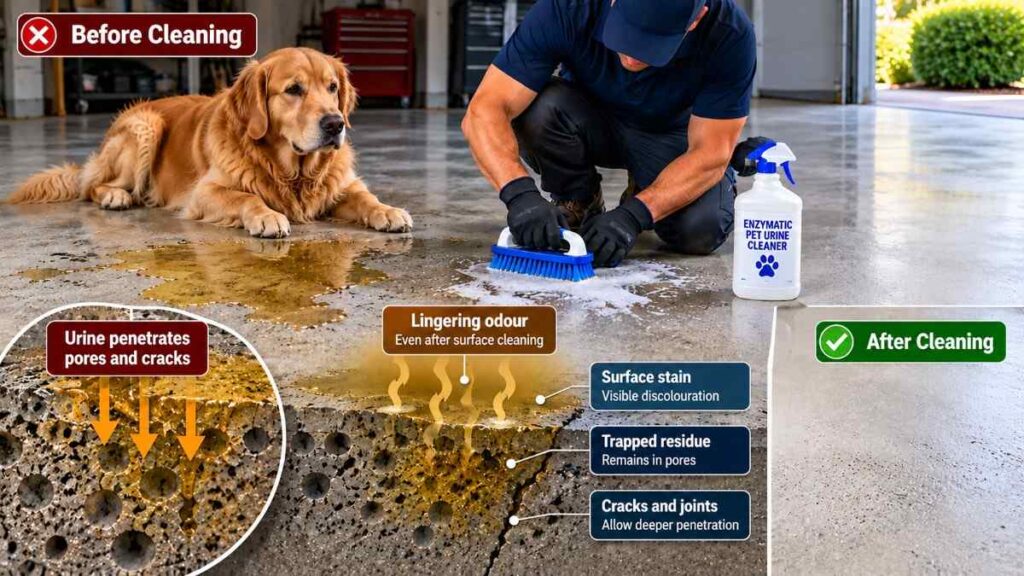
To clean dog pee from a concrete floor, absorb fresh urine, identify whether the concrete is sealed or unsealed, and apply a pet urine enzymatic cleaner suitable for that surface. Follow the product’s contact-time and removal instructions, then allow the floor to dry completely before checking for remaining odours. Old or repeated urine contamination may need further treatment because concrete can absorb liquid beneath the visible stain.
Dog urine can leave yellowish marks and unpleasant smells on garage floors, patios, basements and other concrete surfaces. The cleaning method matters because bare concrete absorbs liquids, while sealed, painted and polished concrete may react differently to moisture and cleaning products.
This guide explains how to remove fresh and old dog urine from concrete, choose a suitable cleaning solution, avoid surface damage and prevent recurring odours.
How to Remove Dog Urine From Concrete: Quick Answer
The best starting method for removing dog urine from concrete is to extract the fresh liquid and use a compatible enzymatic pet urine cleaner according to its label. This targets organic contamination rather than simply covering the smell with fragrance.
For a straightforward cleaning process:
- Keep pets away from the affected area and absorb fresh urine with disposable towels.
- Sweep or vacuum loose dirt and check whether the concrete is sealed, painted, polished or unsealed.
- Test a pet urine enzymatic cleaner on a small, inconspicuous area.
- Apply the product according to the manufacturer’s directions, treating the affected surface without mixing it with other cleaners.
- Allow the recommended contact time, then remove residue or rinse only as instructed.
- Let the concrete dry fully before checking whether the stain or odour remains.
Fresh urine is usually easier to address than contamination that has accumulated over several weeks or months. Repeated accidents can spread urine into cracks, joints and porous sections of a concrete slab.
Important: A visible stain may disappear before the odour does. Equally, a floor may continue to show discolouration after the odour has improved. Treat these as related but separate cleaning outcomes.
What You Need to Clean Dog Urine From Concrete

Before cleaning, gather suitable equipment and check the instructions for the product you intend to use.
| Cleaning item | Purpose |
|---|---|
| Pet urine enzymatic cleaner | Treats organic urine contamination when compatible with the surface |
| Disposable towels or absorbent cloths | Removes fresh liquid before it spreads |
| Soft or medium nylon brush | Helps loosen surface dirt without aggressive abrasion |
| Wet-dry vacuum, if suitable | Extracts liquid from compatible surfaces |
| Clean water | Used for rinsing only when the cleaner requires it |
| Microfibre mop or clean towels | Removes residue and surface moisture |
| Protective gloves | Reduces contact with urine and cleaning products |
| Ventilation or fans | Supports safe air circulation and drying |
Choose an enzymatic cleaner specifically intended for pet urine and approved for the material being treated. A general-purpose fragranced cleaner may reduce the smell temporarily without addressing contamination trapped within porous concrete.
For sealed or polished floors, check compatibility with the existing finish. A cleaner suitable for bare concrete is not automatically appropriate for epoxy, polyurethane, painted or decorative coatings.
Avoid combining enzymatic products with vinegar, bleach, strong oxidisers or other cleaning chemicals. Mixing products may create hazards, damage the surface or interfere with the intended treatment.
How to Clean Dog Pee From Concrete Step by Step

The following method applies to accessible concrete surfaces such as garage floors, patios and indoor utility areas. Always follow the chosen cleaner’s instructions where they differ from general guidance.
Step 1: Absorb Fresh Urine and Clear the Area
Remove as much fresh dog urine as possible before adding any cleaning solution.
Keep your dog and other pets away from the affected area. Put on gloves, then blot the spill using disposable towels or absorbent cloths.
Press the towels onto the wet area instead of spreading the liquid across the floor. Replace the towels until little additional moisture transfers.
Once the fresh urine has been absorbed:
- Remove nearby rugs, mats or movable objects that may also be contaminated.
- Sweep or vacuum loose dirt, dust and pet hair.
- Check nearby cracks, joints and wall edges for signs of moisture.
- Keep the area ventilated if cleaning indoors.
Avoid flooding the floor immediately. Adding unnecessary water can spread contamination, especially where cracks or porous surfaces are present.
Why this step matters: Removing loose urine first reduces the amount of contamination the cleaner must address and makes it easier to identify the affected area.
Step 2: Check Whether the Concrete Is Sealed
Determine whether your concrete floor has a protective coating before choosing the cleaning method.
Bare concrete is usually more absorbent than a properly sealed surface. Painted, epoxy-coated and polished concrete may have different cleaning restrictions.
Start with a visual inspection. Look for a glossy or uniform protective finish, worn patches, flaking coatings or visible cracks.
If the finish is uncertain, a small water-drop test on a clean, unaffected area may provide a clue. Water that beads on the surface suggests reduced absorption, while water that quickly darkens the concrete suggests a more absorbent finish.
This test is not conclusive. Some densified or treated floors absorb slowly without having a conventional surface coating.
| Surface condition | Cleaning consideration |
|---|---|
| Unsealed concrete | Urine and cleaning solutions may penetrate the pores |
| Sealed concrete | Check whether the cleaner is compatible with the sealer |
| Painted or epoxy-coated concrete | Avoid products that could discolour or damage the coating |
| Polished concrete | Use finish-compatible cleaning products and avoid harsh acids |
| Damaged or cracked coating | Contamination may have reached the concrete underneath |
The same principle applies to routine concrete floor maintenance: the correct method depends on the surface finish, not simply the underlying concrete.
For more detailed guidance on surface preparation and cleaning techniques, see Westlink’s guide to cleaning cement floors, which explains considerations for different concrete conditions.
Step 3: Apply a Concrete-Compatible Enzymatic Cleaner
Apply a pet urine enzymatic cleaner that is approved for the affected concrete surface and intended for urine odour treatment.
Read the product label before opening the container. Check the recommended application method, surface compatibility, required contact time, ventilation precautions and whether the product must be rinsed.
Test a small hidden area first, particularly on sealed, coloured or decorative concrete.
For unsealed concrete, the visible stain may not represent the complete affected area. Apply the product according to its instructions so that the required area receives adequate treatment.
For sealed or coated floors, avoid excessive saturation if the product or finish manufacturer advises against it.
If gentle agitation is permitted, use a suitable nylon brush. Do not use metal brushes or aggressive scraping tools that can scratch coatings or damage the concrete surface.
Why this step matters: Enzymatic cleaning products are formulated to target certain organic residues. Their effectiveness depends on the product formulation, surface compatibility and the ability to reach the contaminated material.
Do not assume that every enzymatic cleaner is suitable for every type of concrete or that a single application will remove deeply absorbed urine.
Step 4: Allow the Recommended Contact Time
Leave the cleaner in contact with the surface for the exact period specified by its manufacturer.
Contact time matters because cleaning products need an opportunity to act on the contamination. However, instructions differ between formulations.
Some products require the treated area to remain moist for a specified period. Others have different application, drying or residue-removal requirements.
Do not automatically cover the area with plastic or leave chemicals on the floor overnight. Only use these techniques when specifically recommended by the product manufacturer.
Keep children and pets away during treatment. If the area is indoors, maintain appropriate ventilation.
For old stains, assess the result after the complete treatment and drying process. A second application may be appropriate if the product instructions allow it.
Step 5: Remove Residue and Dry the Floor
After the required contact time, follow the cleaner’s directions for removing residue, rinsing and drying.
Depending on the product, this may involve blotting excess liquid, rinsing with clean water, extracting moisture or allowing the solution to dry naturally.
Where extraction is appropriate, use a wet-dry vacuum designed for the task or absorbent towels. Do not use an ordinary domestic vacuum to collect liquid.
Remove excess moisture without flooding the slab. In garages and interior rooms, ventilation and fans can help the floor dry.
Drying time varies with the amount of moisture, floor porosity, temperature, humidity and ventilation.
Do not apply a concrete sealer or replace moisture-sensitive coverings until the floor meets the relevant product’s drying requirements.
Why this step matters: Residual moisture can make it difficult to assess whether an odour remains and may affect some flooring finishes or subsequent coating work.
Step 6: Check for Remaining Stains or Odour
Inspect the concrete only after the treated area has dried sufficiently to assess the result.
Look for remaining yellowish or brown discolouration and check whether the urine smell is still noticeable.
If the odour remains, identify whether the problem could involve:
- Older contamination that penetrated below the surface.
- Urine accumulated in joints or cracks.
- Residue beneath a damaged coating.
- Nearby contaminated rugs, skirting boards or other materials.
- Incomplete treatment or an unsuitable cleaning product.
Repeat an approved cleaning treatment only in accordance with the manufacturer’s instructions.
Persistent odour does not always mean the product was applied incorrectly. Some contamination extends beyond what a surface treatment can reach.
If the smell continues after appropriate treatment, arrange a professional assessment rather than repeatedly adding stronger chemicals.
How to Remove Old Dog Urine Smell From Concrete

Old dog urine odours in concrete can be harder to remove because repeated contamination may have penetrated the slab, entered cracks or spread beneath an existing floor coating. A surface wipe may improve the appearance without addressing the source of the smell.
Begin by identifying the affected area and checking the concrete’s finish. Look for visible stains, worn coatings, cracks, joints and locations where the dog repeatedly urinates.
For unsealed concrete, select an enzymatic pet urine product that specifically permits use on porous mineral surfaces. Some products have special instructions for heavily contaminated areas. Follow those directions rather than applying an arbitrary soaking time.
If the first treatment does not resolve the problem, allow the area to dry and reassess before applying another treatment. Repeated application may be necessary for some old stains, but it should follow the product’s instructions.
For sealed or epoxy-coated concrete, persistent odour may indicate contamination trapped beneath a damaged section of coating. A topical cleaner cannot necessarily reach material below an intact coating.
In this situation, professional assessment may be required to determine whether cleaning alone is sufficient or whether the damaged finish needs repair or replacement.
What about old yellow stains?
A yellow or brown mark may remain even when the noticeable odour has improved. Staining can involve residues, surface changes or other contaminants, so the treatment that reduces smell may not restore the original colour.
Do not use concentrated oxidisers, harsh acids or abrasive grinding to remove discolouration without assessing the floor. These methods can damage the concrete or its protective finish.
What if the smell returns when the concrete gets wet?
Recurring odour after rain, mopping or changes in humidity may indicate that contamination remains within the surface, although other moisture-related causes should also be investigated.
Check nearby cracks, wall junctions and areas previously covered by flooring. If the source cannot be identified or normal treatment has failed, seek professional help.
Why Dog Urine Smells Linger in Concrete
Dog urine odours can linger in concrete because the material contains pores and small gaps that allow liquids to penetrate below the visible surface. Unsealed concrete is especially vulnerable to absorption.
Urine contains water, dissolved salts, urea and other organic compounds. As urine ages, chemical and microbial processes can produce unpleasant odours, including ammonia-like smells.
Several conditions can make the problem more persistent.
Concrete porosity
Unsealed concrete may absorb urine faster than a properly maintained sealed surface. The liquid can move into pores and cracks, making it more difficult to remove through ordinary mopping.
Repeated contamination
If a dog repeatedly urinates in the same place, additional residue may accumulate before earlier contamination has been fully removed.
Surface coatings
A sound coating can help reduce absorption. However, cracks, damaged joints or worn sections may allow urine to reach the concrete underneath, where cleaning becomes more complicated.
Humidity and moisture
Dampness can make existing odours more noticeable. A smell that returns after wet weather does not necessarily mean fresh urine is present.
Inadequate cleaning
Fragranced products may temporarily mask unpleasant smells without removing the contamination responsible for them.
This is why a cleaning method should address both the visible surface and the likely depth of contamination, while respecting the material’s limitations.
Can You Use Vinegar, Baking Soda or Bleach on Concrete?
Vinegar and baking soda are not reliable substitutes for a compatible pet urine treatment, while bleach should be avoided when cleaning urine-contaminated areas because of chemical mixing hazards.
The suitability of any cleaning product also depends on whether the concrete is bare, sealed, coloured, painted or polished.
| Cleaner | Suitability | Main limitation |
|---|---|---|
| Pet urine enzymatic cleaner | Preferred starting option when approved for the surface | May require repeat treatment or may not reach trapped contamination |
| White vinegar | Not recommended as a universal concrete treatment | Acidity can affect cementitious surfaces and finishes |
| Baking soda | May help with some superficial odours | Does not reliably remove absorbed urine contamination |
| Bleach | Avoid for urine-cleaning applications | Hazardous reactions with ammonia-containing residues or other cleaners |
| Mild pH-neutral floor cleaner | Useful for routine cleaning on compatible floors | Not necessarily designed for absorbed urine odours |
Can vinegar remove dog pee smell?
Vinegar may temporarily change or reduce certain odours, but it does not guarantee removal of urine contamination absorbed into concrete.
Because vinegar is acidic, repeated use can adversely affect some cementitious surfaces and protective finishes. It should not be the default treatment for polished or decorative concrete.
Does baking soda remove dog urine odour?
Baking soda may absorb moisture or reduce some surface odours, but it is not a reliable standalone treatment for deeply contaminated concrete.
Applying it over a wet cleaning product may also create residue that requires additional removal.
Why avoid bleach?
Bleach can react dangerously with ammonia-containing substances and other cleaning chemicals. Do not combine it with urine residues, vinegar, ammonia-based products or other cleaners.
If bleach or another incompatible chemical has already been applied, do not immediately add an enzymatic cleaner. Stop, follow the relevant safety instructions and obtain advice if the chemicals may have reacted.
For routine care of indoor concrete surfaces, Westlink’s interior concrete floor cleaning guide explains why finish-compatible cleaning products and controlled moisture are important for sealed and polished floors.
How to Clean Sealed vs Unsealed Concrete

Unsealed concrete usually requires greater attention to absorbed contamination, while sealed concrete requires careful selection of products that will not damage its protective finish.
The cleaning approach should be based on the actual floor condition.
| Surface type | Main issue | Recommended approach |
|---|---|---|
| Unsealed concrete | Urine can penetrate pores | Use a compatible cleaner intended for porous concrete |
| Sealed concrete | Coating compatibility | Clean with products approved for the sealant |
| Epoxy-coated concrete | Potential coating damage | Avoid aggressive chemicals and excessive abrasion |
| Polished concrete | Sensitivity of protective finish | Use approved, finish-compatible cleaning methods |
| Cracked or damaged coating | Possible contamination underneath | Assess whether surface treatment can reach the affected area |
Cleaning unsealed concrete
Remove fresh urine promptly and use a cleaner that is suitable for porous concrete. Follow instructions for coverage, contact time and removal.
Do not assume that saturating the floor will always improve the result. Excess liquid can spread contamination or create moisture problems in indoor areas.
Cleaning sealed concrete
A well-maintained sealer generally makes fresh spills easier to remove. Blot the urine, check product compatibility and clean without unnecessary abrasion.
If the coating is damaged and odour persists, contamination may be present underneath. Do not automatically strip or grind the finish yourself.
Cleaning polished or decorative concrete
These surfaces require additional care because inappropriate cleaners or abrasive tools can affect colour, appearance and surface protection.
Use products permitted by the floor’s installer or finish manufacturer.
Should you reseal after removing dog urine?
Sealing may help reduce future liquid absorption, but it should only be considered after contamination has been addressed and the concrete meets the sealer manufacturer’s preparation and moisture requirements.
Applying a new sealer over unresolved contamination can make future treatment more difficult.
For broader maintenance information, Westlink’s concrete and cement floor cleaning guide provides additional context on cleaning different types of concrete surfaces.
Common Cleaning Mistakes to Avoid
Improper cleaning can spread contamination, damage the floor or make it harder to identify the source of a persistent smell.
| Common mistake | Why it is a problem | Better approach |
|---|---|---|
| Using bleach on urine contamination | Can create dangerous chemical reactions | Choose a compatible pet urine product |
| Mixing vinegar, peroxide and other cleaners | Can produce unsafe reactions or interfere with cleaning | Use one product as directed |
| Applying the same method to every floor | Coatings and concrete finishes respond differently | Identify the finish first |
| Rinsing too early | May interrupt the prescribed treatment | Follow the label’s contact time |
| Over-saturating indoor concrete | Can spread moisture and contamination | Apply the instructed amount |
| Scrubbing with a metal brush | May scratch or damage surfaces | Use suitable non-metal tools |
| Assuming one treatment guarantees success | Older contamination may be deeply absorbed | Reassess after drying |
| Sealing before proper preparation | May leave unresolved contamination beneath the finish | Complete treatment and assess moisture first |
| Relying on strong fragrance | Can hide odours temporarily | Address the contamination source |
Can pressure washing remove dog urine from concrete?
Pressure washing can remove some surface dirt and residue from suitable outdoor concrete, but it is not a guaranteed treatment for urine that has penetrated the slab.
It may also damage weak concrete, coatings or paving joints if used incorrectly.
For an indoor garage, basement or coated floor, pressure washing can create additional moisture and drainage problems. Select a cleaning method suitable for the location rather than relying on water pressure alone.
How to Prevent Dog Urine Stains on Concrete
The most effective prevention is to remove accidents promptly, maintain the floor’s protective finish and address repeated urination in the same area.
Practical measures include:
- Clean fresh accidents immediately. Absorb urine before it spreads or penetrates the concrete.
- Maintain suitable surface protection. Inspect existing sealers and coatings for damage, following manufacturer maintenance guidance.
- Keep a compatible pet urine cleaner available. Faster treatment can reduce the time contamination remains on the surface.
- Inspect joints and cracks. These can allow liquid to collect beneath the visible surface.
- Use a designated toileting area. A consistent outdoor location can reduce repeated accidents on patios or garage floors.
- Use reward-based training. Reinforce appropriate toileting habits rather than relying on irritating deterrent chemicals.
- Review repeated accidents. Sudden changes in a dog’s urination habits may warrant veterinary advice.
Avoid applying household essential oils, harsh deterrents or strong chemical products to areas accessible to pets unless their safety is established for that use.
How often should concrete floors be cleaned?
Remove pet urine promptly whenever an accident occurs. Routine sweeping and floor cleaning can be scheduled according to traffic, contamination and surface type.
There is no universal requirement to deep-clean or reseal every concrete floor at a fixed six-month or yearly interval.
Instead, monitor the condition of the surface and follow the floor finish and sealer manufacturers’ maintenance recommendations.
When to Hire a Professional Concrete Cleaner
Consider professional concrete cleaning when dog urine odours remain after suitable treatment, the contamination covers a large area, or you suspect urine has penetrated beneath a damaged floor coating.
Routine cleaning may be adequate for fresh accidents on accessible concrete. However, heavily contaminated garages, kennels, enclosed utility areas and floors affected by repeated accidents may require more detailed assessment.
Professional assistance is particularly useful when:
- Urine odours repeatedly return after the concrete dries.
- Yellow or brown discolouration remains after cleaning.
- The floor has cracks, damaged sealant or deteriorating coatings.
- Contamination extends across a large garage or commercial floor.
- The surface is polished, decorative, epoxy-coated or otherwise sensitive.
- The affected area requires mechanical extraction or specialist treatment.
- You cannot identify the source of a persistent smell.
A professional should assess the floor finish, contamination and access conditions before recommending cleaning, coating treatment or restoration.
How much does professional concrete floor cleaning cost in Australia?
General hard-floor cleaning in Australia is commonly advertised at approximately $3–$8 per square metre, while heavily soiled or commercial floor work may be priced higher. Polished concrete cleaning and buffing may fall around $5–$10 per square metre.
However, these are broad floor-cleaning benchmarks, not verified rates for specialist dog urine removal. Deep odour treatment, damaged-coating repairs and other restoration work require separate assessment.
When obtaining a quote, ask whether it includes:
- Assessment of the affected concrete and floor finish.
- Pet urine stain and odour treatment.
- Compatible cleaning products.
- Extraction or residue removal.
- Additional treatment if contamination remains.
- Drying requirements.
- Any necessary coating or sealing work.
- GST and other applicable charges.
If ordinary cleaning has not resolved the issue, Westlink’s professional hard floor cleaning services in Sydney provide information about cleaning methods for concrete and other hard surfaces.
For broader property maintenance, Westlink’s floor cleaning services also cover different surface finishes and professional cleaning requirements.
Ask the provider to confirm whether specialist pet urine odour removal is within its service scope. General floor cleaning does not automatically include deep urine decontamination or guarantees of complete odour elimination.
Frequently Asked Questions
1. What is the best cleaner for dog urine on concrete?
A pet urine enzymatic cleaner specifically approved for concrete is a suitable starting choice. These products are designed to treat organic residues, but their effectiveness depends on the formulation, concrete finish, contamination depth and application instructions.
2. How do you remove dog urine smell from unsealed concrete?
Absorb fresh urine, remove surface dirt and apply a compatible enzymatic cleaner according to its label. Allow the prescribed treatment and drying time before assessing the result. Older contamination may require repeat treatment or professional assessment.
3. Why does my concrete floor still smell like dog urine after cleaning?
The odour may persist because urine has penetrated porous concrete, entered cracks or reached material beneath a damaged coating. Incomplete treatment, nearby contaminated materials and continuing moisture can also contribute.
4. Can dog urine penetrate sealed concrete?
A sound, compatible sealer can reduce urine absorption. However, cracks, joints and worn or damaged coating areas may allow liquid to penetrate. Persistent odours near damaged coatings may require professional inspection.
5. Does vinegar permanently remove dog urine smell from concrete?
No permanent result can be assumed. Vinegar may alter some surface odours, but it is not a reliable solution for urine deeply absorbed into concrete. Its acidity can also affect certain concrete finishes.
6. Can baking soda remove dog pee stains from concrete?
Baking soda may help with some superficial odours or moisture, but it is not a reliable standalone method for removing deeply absorbed urine stains or contamination. A suitable pet urine cleaner is generally a more targeted option.
7. Is bleach safe for cleaning dog urine from concrete?
Bleach is not recommended for urine-contaminated areas because of possible hazardous reactions with ammonia-containing residues and other cleaners. Do not mix bleach with vinegar, ammonia or other cleaning products.
8. How long does it take to remove dog urine smell from concrete?
The time depends on the product, severity of contamination and how long the floor takes to dry. Fresh accidents may need less treatment than old, repeatedly contaminated areas. Always use the manufacturer’s contact time rather than assuming a fixed number of minutes or hours.
9. Can a pressure washer remove dog urine from concrete?
Pressure washing may remove surface residue from suitable outdoor concrete, but it does not guarantee removal of deeply absorbed urine. Incorrect pressure can damage weak concrete or coatings, while excessive water can spread contamination.
10. How do you remove old dog urine stains from a garage floor?
Identify whether the floor is sealed, epoxy-coated or bare concrete. Use a compatible urine treatment, follow its instructions and reassess after drying. If staining or odour remains beneath damaged coatings, consult a qualified floor-cleaning or restoration professional.
11. Are enzymatic cleaners safe for dogs?
Some enzymatic products are labelled for use in homes with pets, but safety depends on their ingredients and directions. Keep pets away during treatment and only allow access again when the label indicates it is safe, including any required drying period.
12. Should you seal concrete after removing dog urine?
Sealing can reduce future liquid absorption when an appropriate product is installed correctly. However, the concrete must first be properly cleaned, assessed and prepared. Do not seal over unresolved contamination or excessive moisture.
13. How can I stop dog urine odours from returning?
Clean accidents promptly, use a suitable cleaner, maintain the concrete’s protective finish and inspect cracks or joints that may collect urine. Repeated odours may require deeper treatment, particularly if contamination has entered unsealed concrete.
14. When is professional dog urine removal worth it?
Professional assessment is worth considering when contamination covers a large area, treatment has repeatedly failed, a coating is damaged or the floor requires specialist cleaning or restoration. Request an itemised quote and confirm whether pet urine treatment is included.
Conclusion
Removing dog urine from concrete requires more than eliminating the visible stain. Because concrete can absorb liquids, a lingering odour may indicate contamination within pores, cracks or damaged floor coatings.
For most accessible surfaces, the best starting approach is to remove fresh urine, identify the floor finish and use a compatible pet urine enzymatic cleaner according to its instructions. Allow the floor to dry fully before assessing whether further treatment is necessary.
Avoid mixing cleaning chemicals, using aggressive treatments on decorative finishes or sealing concrete before contamination and moisture have been addressed.
If dog urine odours continue despite appropriate cleaning, a professional floor assessment can help identify whether additional cleaning or surface restoration is needed.
For Sydney properties requiring professional maintenance, Westlink Cleaning Services provides information about floor cleaning for different surface materials and conditions. Confirm the availability of specialist pet urine treatment when requesting a quote.


