

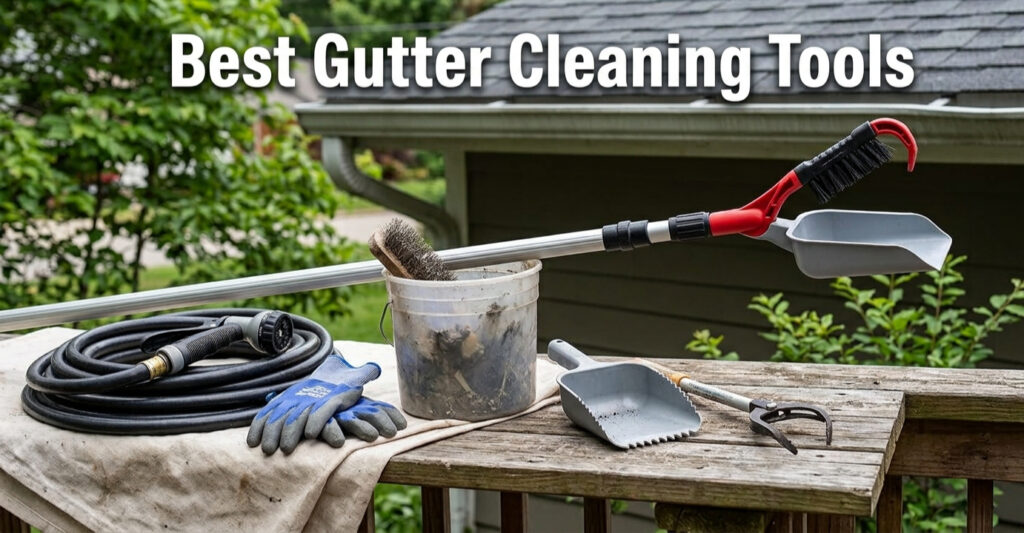
The best gutter cleaning tools are the ones that match the height of the gutter, the type of debris inside it, and the way you can safely reach the area. A scoop works well for heavy, wet waste, while vacuums, blower attachments, water wands, and pressure systems suit different jobs. No single tool does everything well. The safest choice is the one that gives you control, clear access, and enough reach without forcing you into an awkward position.
Blocked gutters rarely contain one kind of mess. Dry leaves may sit on top while wet sludge packs around the outlet. A tool that clears loose leaves quickly may barely move dense mud.
This guide helps homeowners choose equipment by reach, weight, debris type, visibility, cleanup, and the ability to clear the gutter outlet.
What to Look for in a Gutter Cleaning Tool
Start with the job, not the product label. Extra reach can reduce control. Strong spray can spread dirty water, while large clumps can block a vacuum hose.
Check these factors before choosing:
- Debris type: Dry leaves, wet leaves, twigs, fine grit, mud, moss, and compacted sludge respond differently. Match the cleaning action to the material.
- Working reach: Check the extended pole length, your standing position, eave depth, and the angle needed to reach the gutter channel.
- Pole rigidity: Long poles flex. More flex means less scraping force and less accurate control at the cleaning head.
- Tool weight: Weight matters more when the pole is fully extended or filled with water. Heavy heads also increase wrist and shoulder fatigue.
- Head shape and angle: Curved, pivoting, or adjustable heads help reach behind the front lip and into corners.
- Compatibility: Make sure attachments fit your hose, vacuum, blower, pressure unit, or extension pole before buying.
- Visibility: Ground-level cleaning is harder when you cannot see the gutter base. A camera, mirror, or final flow check can help confirm the result.
- Cleanup: Blowers can scatter waste. Vacuums collect it. Water tools may move dirt onto walls, windows, paving, or garden beds.
10 Best Gutter Cleaning Tools
The best option changes with the job. In many homes, two tools work better than one. For example, a scoop or vacuum can remove bulk debris first, then a hose can rinse fine dirt and confirm that water reaches the outlet.
1. Gutter Scoop

A gutter scoop is a simple tool for dense, wet material. Its shallow shape follows the gutter base and lifts leaves, mud, seed pods, and sludge without adding water.
Plastic scoops suit painted metal because they are less likely to scratch than a sharp steel edge. The weak point is reach, so use one only where you have safe access.
Choose a scoop narrow enough to fit between the front lip and roof edge. Wide heads can jam around brackets. Keep a bucket or garden bag close for the waste.
2. Gutter Cleaning Brush

A gutter brush works best after bulky waste has gone. Stiff bristles loosen fine dirt, dried residue, moss, and material along seams or corners.
An extension pole adds reach, but control drops as it gets longer. If the head skips over the base, shorten the pole where possible for better pressure and contact.
Brushes can also clean some gutter guards. They are less useful on thick sludge because the bristles tend to spread it instead of removing it.
3. Telescopic Gutter Cleaning Wand

A telescopic wand connects to a garden hose and extends the cleaning head above normal reach. Angled or pivoting heads help direct water into the channel from the ground.
It suits fine dirt, light leaf waste, and final rinsing. It also tests drainage after bulk debris comes out. If the gutter fills faster than it drains, the outlet or downpipe may still be restricted.
Visibility is the trade-off. From below, you may only move debris along the channel instead of removing it. For the full process, see how to clean gutters.
4. Gutter Vacuum

A gutter vacuum uses suction to pull leaves, dirt, and loose material into a collection drum. Long rigid poles and curved nozzles can allow ground-level work.
Its main advantage is debris control. The system collects waste instead of throwing it over the roof edge, which reduces cleanup around paths, gardens, entrances, and vehicles.
Cost, hose blockages, and oversized debris are the main limits. Long twigs or dense clumps can lodge in bends. A camera also helps confirm whether the gutter base is clear.
5. Wet/Dry Shop Vacuum With Gutter Attachment

A wet/dry shop vacuum can suit DIY work when it has enough airflow and a proper gutter attachment. Curved extension tubes let the nozzle reach over the edge while the machine stays below.
This setup handles loose leaves and some damp waste. Heavy compacted sludge is harder to move through small tubes or several bends.
Check the manual before wet pickup because filter setups differ. Keep the hose path straight where possible, since tight bends give leaves and twigs places to catch.
6. Leaf Blower With Gutter Attachment

A blower with a curved gutter tube clears dry leaves quickly. It works best when material is light and loose rather than stuck to the base.
The downside is cleanup. Leaves may land on paths, lawns, garden beds, roofs, or driveways. Wear eye protection because grit can move with them.
Blowers struggle with wet leaves, mud, and packed debris. They also do little for a blocked outlet unless airflow can move the blockage.
7. Pressure Washer With Gutter Attachment

A pressure washer provides more cleaning force than a garden hose. With a curved nozzle or telescopic lance, it can shift stubborn grime and rinse residue.
That force needs control. A poorly aimed jet can throw dirty water over walls, windows, fascia, paths, and the operator. It may also send water into weak roof details or gutter joints.
Remove large debris first. Otherwise, the jet can push leaves into the outlet and tighten a blockage. A lower-force rinse is often enough for the final flow check.
8. Gutter Claw or Gutter Grabber

A gutter claw, grabber, or tong-style tool removes clumps by gripping or dragging them along the channel. Extension-pole versions can reach sections that are hard to access by hand.
They work on leaves and small twigs in visible piles but struggle with thin layers of grit or sludge.
A long pole can twist when the claw catches a bracket, guard, or roof edge. Slow movements work better than hard pulls, especially when the head is difficult to see.
9. Gutter Hoe or Gutter Rake

A gutter hoe or rake pulls debris toward you instead of lifting it straight out. It suits long runs where dry or damp leaves form a continuous layer.
The head must fit the gutter profile without catching on brackets. A rigid pole helps transfer enough force to move material; flexible poles may bend first.
A rake handles bulk waste. Afterward, inspect or rinse the base so fine dirt does not remain around seams and outlets.
10. Garden Hose With High-Pressure Spray Nozzle

A garden hose with a focused spray nozzle is simple and useful for the last stage. It moves fine dirt, rinses corners, and shows whether water flows toward the downpipe.
Do not start with a hose when the gutter is packed with leaves. Water can create a heavier mess and push debris into the outlet.
Use it after physical removal. Work toward the outlet. If water pools, stop and check the blockage instead of forcing in more water.
Gutter Cleaning Tools Comparison Table
The table below shows where each option fits best. It is a practical guide, not a guarantee. Gutter shape, access, roof overhang, and the condition of the debris can change the result.
| Tool | Best for | Main strength | Main limitation |
| Gutter scoop | Wet leaves, mud, sludge | Direct removal | Needs close access |
| Cleaning brush | Fine dirt, residue | Good surface contact | Poor for bulky waste |
| Telescopic wand | Rinsing, light debris | Ground-level reach | Limited visibility |
| Gutter vacuum | Loose wet or dry debris | Contains the mess | Higher cost |
| Wet/dry vacuum attachment | DIY suction cleaning | Uses existing equipment | Tubes can block |
| Leaf blower attachment | Dry leaves | Fast bulk removal | Scatters debris |
| Pressure washer attachment | Stubborn residue | Strong cleaning force | Splash and water risk |
| Gutter claw | Leaf clumps, twigs | Grabs visible debris | Poor on fine dirt |
| Gutter rake | Long runs of leaves | Pulls bulk waste | Needs pole control |
| Hose spray nozzle | Final rinse, flow check | Simple and cheap | Weak on packed waste |
Choosing Gutter Cleaning Tools for Sydney Homes
Roof shape matters as much as tool type. Deep eaves can push the gutter farther from your standing position, so a pole that looks long enough on paper may still fall short once it has to reach out and up. Narrow gaps between the roof edge and gutter lip can also limit the size of scoops, vacuum heads, and curved attachments.
Eucalyptus leaves and seed pods create another practical issue. Dry material can blow out easily, but once it becomes wet and compressed, suction or physical removal usually gives better control. Fine roof grit often remains after the larger debris is gone, so a final rinse helps expose slow drainage.
A practical check before buying is to measure the gutter height and note how far the eave projects from the wall. Then look at the gutter opening itself. A wide vacuum nozzle or scoop may not fit beneath a low roof edge, even when the pole reaches easily. Also find the outlet position. Tools that move debris toward a hidden outlet can create a plug if you cannot see or clear that point first.
For two-storey work, do not judge reach by pole length alone. The longer the pole, the more important balance, rigidity, head weight, and visibility become. If safe access or clear visibility becomes a problem, using professional gutter cleaning services can be more practical than trying to extend a DIY tool beyond its useful working range.
Professional Gutter Cleaning With Westlink Services
Professional gutter cleaning makes sense when access, height, blocked outlets, or heavy buildup turns a simple maintenance job into a difficult one. A trained service can match the cleaning method to the gutter condition, remove the waste, check drainage, and identify visible issues that may need repair.
It also avoids buying several attachments for a job that may only happen occasionally. The value is not just speed. It is having the right reach, suction, water control, and inspection method for the conditions on the day.
Final Thoughts
A useful gutter-cleaning setup does not need to be complicated. Match the tool to the debris first, then check whether you can reach and control it safely. Scoops handle dense waste. Blowers handle dry leaves. Vacuums contain loose debris. Water tools rinse and test flow.
The important part is finishing the whole job, not just making the gutter look clearer from below. Remove bulk waste, clear the outlet, rinse the channel, and confirm that water drains as expected. If a blockage, access problem, or damaged section prevents that, forcing the job usually creates more risk than value.
If the work is beyond safe DIY reach, Westlink Services can handle the cleaning with professional equipment and a method suited to the gutter condition.
FAQs About Gutter Cleaning Tools
What Is the Best Tool for Cleaning Gutters?
For heavy wet debris, a gutter scoop or vacuum usually gives better control. For dry leaves, a blower can be faster. For fine dirt and final rinsing, a hose wand works well. The best choice depends on debris, reach, and access.
What Is the Easiest Way to Clean Gutters From the Ground?
Use a telescopic system that matches the debris. A vacuum suits loose waste, a blower suits dry leaves, and a water wand suits rinsing. Ground cleaning works better when you can also inspect the result.
Can You Clean Gutters Without a Ladder?
Yes, if the gutter is reachable with a telescopic vacuum, wand, blower tube, claw, or similar extension system. The main challenge is seeing whether the channel and outlet are fully clear. See how to clean gutters without a ladder for more detail.
Are Gutter Vacuums Worth It?
They can be worth it for frequent cleaning, high gutters, or areas where scattered debris would create extra work. For a small, easy-to-reach gutter cleaned only occasionally, the cost may be hard to justify.
Can You Use a Leaf Blower to Clean Gutters?
Yes, but it works best on dry, loose leaves. Wet sludge, moss, and compacted material usually need suction or physical removal. Expect to clean up the debris after blowing it out.
Can You Use a Pressure Washer on Gutters?
Yes, with care. Pressure can remove stubborn residue, but it can also spread dirty water and force water into weak joints or nearby roof details. Remove large debris first and use only the force you need.
What Tool Removes Wet Leaves From Gutters?
A scoop works well when you can reach the gutter safely. A wet-capable gutter vacuum can also remove damp leaves while keeping the waste contained. Blowers are usually a poor match for heavy wet material.
How Do You Clean Gutters on a Two-Storey House?
Use equipment designed for the working height, not just a long pole. High-level cleaning also needs good visibility and control. If the gutter cannot be reached safely from the ground, professional cleaning may be the better option.
How Do You Clear a Blocked Downpipe?
First remove debris from the outlet. Then test the flow with water. If the pipe remains blocked, a suitable hose, vacuum, flexible drain tool, or other clearing method may help. Stop if the blockage is beyond safe access or the drainage path is uncertain.
How Often Should Gutters Be Cleaned?
There is no single schedule for every property. Trees, roof shape, gutter guards, storms, and debris load all affect how quickly gutters fill. Inspect them regularly and clean when buildup starts to restrict flow. This guide explains how often to clean gutters.


