
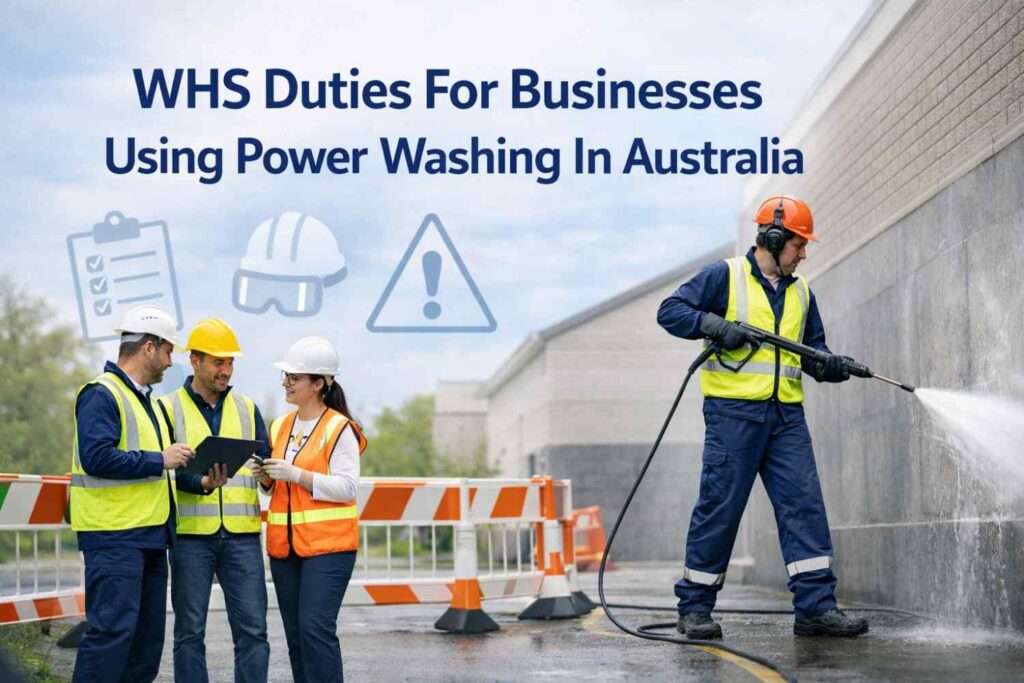
Businesses using power washing must keep workers and other people safe by running a safe system of work, not just by handing out PPE. That duty includes safe equipment, safe work methods, safe chemical handling, training and supervision, and reviewing controls when conditions change.
This guide explains the duties in plain English so you can turn them into day-to-day job steps.
This is general information, not legal advice, so always check your local WHS regulator if you are unsure.
What these duties mean in plain English

WHS duties require businesses to ensure safe work for everyone involved in power washing. As a PCBU, you must provide a safe workplace, equipment, and systems to prevent harm. This includes workers, contractors, visitors, and bystanders near the site. For example, you identify hazards like high-pressure jets that can cause serious cuts, then put controls in place. You also need to consult workers on safety matters and coordinate with others, like suppliers of pressure cleaning equipment. Duties extend to maintaining plant-like pumps and hoses to avoid failures. Workers share responsibility by following safe systems and reporting issues. In practice, this means planning each job to minimize risks, such as using barriers to protect the public. Overall, these rules help avoid accidents in high-risk tasks like surface cleaning.
If you want a simple baseline, start by explaining what pressure cleaning is in one short paragraph during induction, so everyone understands the task and the risks.
Why is power washing higher risk than people think
Power washing can cause serious injury because the water jet has cutting force and can knock people off balance. The biggest “high consequence” risks include injection injuries, eye injuries, slips and falls, electric shock, and burns if hot water is used.

Injection injuries matter because they can look small but be severe under the skin. If a jet breaks the skin, it can push contaminants deep into tissue and require urgent medical care even when the wound looks minor. Noise and flying debris can also cause harm in everyday jobs. This is why eye protection and hearing protection are common controls for this work.
If you want a simple hazard list, see basic risks when pressure cleaning surfaces. For deeper risk controls, use the Safe Work Australia guide for managing risks from high-pressure water jetting.
If your team is not clear on the difference, link them to power washing vs pressure cleaning so they know when heat changes the hazard level.
A small wound can still be a big emergency
High-pressure injection injuries can look small at first, but they can cause serious damage under the skin. Research describes injection injuries happening from simple errors like tripping or falling while operating equipment. Your procedure should treat any “jet hit” to the skin as urgent and escalate for medical review, even if the cut looks minor.
If you want a plain-language explainer for operators, include a short link to how pressure cleaning works so the “why it injures” makes sense.
A risk assessment workflow you can reuse on every job
A job risk assessment works best when it is short, repeatable, and done before the trigger is pulled. Your goal is to spot what can go wrong on this site, then pick controls that reduce the chance and the harm.
Use a quick walk-through first. Check the surface, slopes, drains, nearby power, public access, and any fragile items that can break or turn into projectiles.

Then record the key hazards and controls. Keep it short so your team actually uses it.
5-minute pre-start scan
- Surface type and condition (cracks, loose stones, flaking paint)
- Slopes, stairs, edges, and trip points
- Where water will run and pool
- Nearby electrical items (outlets, lights, extension leads)
- People nearby (clients, pedestrians, vehicles, pets)
- Chemicals and hot water are planned for the job
- Equipment condition (hoses, couplings, gun, nozzle)
Simple risk table
| Hazard | Who can be harmed | What can happen | Controls you will use |
| Slips from runoff | Workers, public | Falls, sprains, and head injuries | Cones and signs, plan runoff, stop pooling, hose management |
| Jet contact | Operator, helpers | Cuts, injection injury | Exclusion zone, stable stance, correct nozzle, never point at people |
| Electric shock | Workers, public | Shock, burns | Keep cords dry, isolate power, use RCD protection, and avoid wet outlets |
| Flying debris | Workers, public | Eye injuries | Eye and face PPE, clear loose items, control spray angle |
| Chemical splash | Operator | Burns, irritation | Follow label, correct dilution, gloves, eye protection, rinse plan |
For the risk process steps, follow Safe Work Australia’s managing risks guidance. To keep job steps consistent, use a standard process like this standard pressure cleaning workflow.
Training and competency
Training matters because power washing looks easy, but mistakes happen fast. Safe Work Australia lists training, information, and supervision as part of a PCBU’s primary duty.
That means “watching someone once” is not enough for high-pressure work, especially with hot water units or public-facing jobs.

What to train
Train staff on what causes harm, not just which button to press.
Cover these topics:
- Pre-start checks and setup steps
- Safe trigger control and never pointing at people
- Nozzle choice, distance, and safe angles
- How to avoid slips, trips, and hose hazards
- Exclusion zones, signage, and stopping work if people enter
- Electrical basics near water
- Chemical handling and safe mixing
- Hot water and steam controls
- What to do in an injury or near miss
For practical setup training, link staff to a simple internal checklist like this power washer setup checklist and make them walk through it with a supervisor.
How to verify competency
Competency is real when the worker can do the job safely without prompts.
Use three checks:
- A short quiz on hazards and emergency actions
- A supervised practical run on a low-risk area
- A sign-off that records who assessed the worker and when
Refresher training is also important when equipment changes or after an incident.
To support training on equipment and controls, use practical setup guidance like PSI and flow rates for power washing.
SWMS explained without the legal fog
A SWMS is a written plan that lists the job steps, hazards, and controls before high-risk construction work starts.WorkSafe Victoria explains that a SWMS sets out the high-risk construction work, the hazards and risks, and the control measures, and it must be prepared before that work begins.
In plain terms, a SWMS is the “how we will do it safely today” document for higher-risk construction site tasks.

When a SWMS is likely to be needed
A SWMS is most common when power washing happens inside a construction site setting with extra risks.
Examples include:
- Work at height or near edges
- Work near traffic or a moving plant
- Work in tight areas where hoses create trip hazards
- Work where the public can get close
- Work where the jet can dislodge sharp debris
What a good SWMS includes
A good SWMS is useful because it tells workers what to do step by step.
Include:
- Job steps in order (setup, test, washdown, shutdown)
- Hazards for each step
- Controls for each hazard (engineering, admin, PPE)
- Exclusion zone and signage plan
- PPE list and when to upgrade it
- Emergency plan and stop-work rules
- Supervisor and worker sign-off, plus review notes
Equipment and maintenance duties (plant mindset)
Equipment safety is a duty because worn hoses, couplings, and faulty triggers can turn into serious incidents. Safe Work Australia lists providing and maintaining safe plant as part of the primary duty of care.
The high-pressure water jetting guide also stresses inspection, servicing, and not using systems with faults that could affect safe operation.

If operators need a clear equipment overview, link to basic pressure cleaning equipment types so they understand what they are handling.
Pre-start checks
A pre-start check prevents the most common “bad surprises” like leaks, damaged hoses, and loose fittings.
Check:
- Hose condition: no cuts, blisters, or exposed braid
- Couplings and clips are secure
- Trigger and safety lock work properly
- Nozzle is correct and seated
- Pressure settings are appropriate for the surface
- Hot water temperature is set only as high as needed
- Area is clear, and the exclusion zone is ready
To support safe setup choices, link to choosing nozzles and lances for safer work, and keep it as the “why this nozzle” reference.
Maintenance and defect tagging
Maintenance works when it is planned and recorded, not when it is remembered.
Create a simple rule: “If it is faulty, tag it and remove it from service.”
Also, make sure only authorised people fix or replace high-pressure parts, because wrong parts can fail under load.
PPE selection that matches the hazards
PPE helps, but it should sit on top of a good setup, good equipment, and good training. Your PPE choice should match the risks of jet impact, debris, chemicals, noise, and heat.
Make PPE rules simple, visible, and enforced every time.

Minimum PPE set for most jobs
Most power washing jobs need a basic set of protection.
Common minimum PPE:
- Eye protection, and a face shield when splash or debris risk is high
- Hearing protection when noise is high or when there is long exposure is likely
- Gloves with a good grip
- Closed-toe, slip-resistant boots
- Long pants and long sleeves to reduce spray injuries
When you need more PPE
Extra PPE is needed when chemicals, hot water, or heavy debris risk is present.
Examples:
- Chemical-resistant gloves are required when handling strong detergents
- Waterproof apron or suit for heavy splash zones
- Respiratory protection is required if mist and chemicals build up in poor airflow
For a simple safety baseline that many teams understand, use safety basics for DIY pressure cleaning. It is written for DIY readers, but the PPE logic still helps teams start with common sense and then step up controls.
Site setup and public safety controls
Site setup is a WHS duty because other people can be hurt even if your operator is skilled. WorkSafe Victoria notes that flying debris, flailing hoses, and coupling failures can hit people nearby. That is why you should set an exclusion zone and stop work if anyone enters it.

Exclusion zone checklist
An exclusion zone works when it is clear, enforced, and sized to the risk.
Use this checklist:
- Put up warning signs before you start
- Use cones, tape, or barriers to mark the boundary
- Keep hoses routed so they do not trip people
- Place the operator so the jet never points at walkways
- Assign a spotter if the public is close
- Stop work if a person enters the zone
Traffic and shared workplaces
Traffic and shared work areas raise risk because people move through your job space. If you work near vehicles or pedestrians, plan the zone like a mini worksite with clear entry points and a stop-work rule.
For the “before we start” stage, it can help to link staff to how to prepare your property for pressure cleaning because it covers clearing obstacles and protecting items that can become projectiles.
Chemicals and hot water
Chemicals and hot water increase risk because they add burns, fumes, and splash exposure on top of the water jet. Safe Work Australia includes safe use, handling, and storage of substances as part of a PCBU’s duty.
Treat chemical handling as a planned step, not something the operator “figures out” mid-job.

Safe mixing and storage basics
Safe chemical use starts with following label directions and keeping products in their original containers.
Use simple rules:
- Mix only what you need for the job
- Never mix unknown products
- Keep chemicals away from ignition sources
- Wash your hands after handling chemicals and before eating
Hot water and steam controls
Hot water and steam need extra controls because burns can happen in seconds.
Control heat by:
- Using the lowest temperature that still works
- Warning others that hot water is in use
- Keeping hoses and hot parts away from walkways
- Avoiding tight indoor spaces unless ventilation is strong
For chemical basics, use pressure washing chemicals. For how heat changes hazards, use hot water vs cold water power washing.
Records and review
Records matter because they show you run a system, and they help you improve after near misses. Safe Work Australia’s risk process includes reviewing control measures, and the water jetting guide also stresses reviewing controls and consulting workers.
Keep records short, consistent, and easy to find.

What to keep
Keep the records that prove planning, training, and maintenance.
A good minimum set is:
- Risk assessment for each job
- SWMS when used
- Training and competency sign-offs
- Pre-start check sheets
- Maintenance and repair logs
- Incident and near-miss reports
When to review
Review your controls when something changes or when something goes wrong.
Good review triggers include:
- New equipment, new chemicals, or new staff
- A near miss, complaint, or damage event
- A new job type or a new site risks
To support consistent close-out, use what to do after pressure cleaning.
DIY vs professional
Some power washing is low risk, but high-pressure water jetting in complex sites can quickly become specialist work. If the job involves tight access, public exposure, hot water units, heavy contamination, or construction-site conditions, stronger planning, training, and documentation are often needed.
For smaller jobs, operators can still follow the same safety basics and step-by-step setup to reduce harm.

If you want a results page for client trust and quality expectations, use pressure cleaning before and after to show what “done properly” looks like.
FAQ (Frequently Asked Questions)
What do you need for a pressure washing business?
You need safe equipment, trained operators, a repeatable risk process, and clear site controls like signage and exclusion zones.
What PPE is required when using a pressure washer?
You usually need eye protection, sturdy footwear, gloves, and hearing protection when noise is high, and you may need more for chemicals or hot water.
What safety measures should be taken when working with high-pressure equipment?
You should control the area, check the equipment before use, use the right nozzle and settings, and stop work if people enter the exclusion zone.
What are safe work procedures for pressure washer work?
Safe procedures include pre-start checks, a test patch, controlled trigger use, safe hose routing, and a clear shutdown and depressurization step.
What are four WHS policies and procedures a business should have?
A simple set is risk management, training and competency, equipment maintenance, and incident reporting and review.
What is needed for a power washing business (hot water units)?
Hot water work needs all the usual controls plus extra burn and steam controls, like temperature limits and stronger PPE where splash is likely.
What do pressure washing businesses do?
They remove dirt, grime, mould, grease, and stains from surfaces, often using water pressure, heat, and detergents depending on the job.
What are the rules for pressure washing in a workplace?
The practical rule is to manage risks: identify hazards, control them, and keep reviewing, while providing safe systems, equipment, and training.
What are the duties of a pressure washer operator?
Operators must follow instructions and procedures, use PPE correctly, and work in a way that does not put themselves or others at risk.
What time is acceptable to power wash?
It depends on your local area and site rules, so it is best to follow council guidance, strata rules, or client site requirements and avoid early or late noise.


