

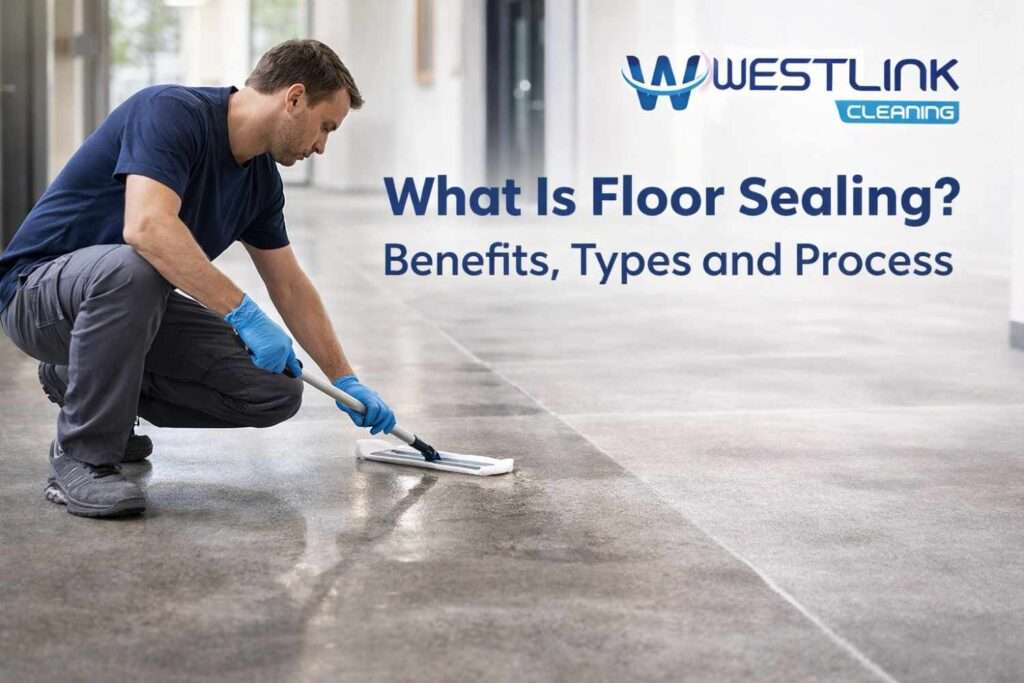
Floor sealing is a protective treatment that reduces moisture absorption, staining, and surface wear on hard floors such as concrete, grout, stone, and some timber floors. It improves cleanability, supports durability, and may reduce restoration frequency.
Floor sealing is the application of a protective treatment that reduces liquid absorption, staining, abrasion, and cleaning difficulty on hard floors such as concrete floors, tile floors, grout joints, stone floors, terrazzo floors, and some timber floors. Penetrating sealers protect within pores. Film-forming systems protect at the surface. The correct system depends on substrate porosity, traffic level, moisture exposure, cleaning method, and finish requirement.
Why does floor sealing matter?
Floor sealing matters because unprotected hard floors absorb water, oil, dirt, and chemical residue more easily. That absorption increases stain risk, supports uneven wear, and makes routine cleaning less effective.
Research on penetrating sealers for concrete shows they are used to reduce water and aggressive substance ingress. Guidance for natural stone also states that sealing improves stain resistance, not stain proofing.
What are the main benefits of floor sealing?

The main benefits of floor sealing are lower absorption, better stain resistance, easier cleaning, slower surface wear, and a more consistent appearance over time. Hard floors such as concrete, stone, tile, grout, and terrazzo often have pores or surface texture that allow water, oil, dust, and residue to settle in.
Once that happens, the floor can become harder to clean, more likely to stain, and more expensive to maintain. Floor sealing helps reduce those problems by creating a protective barrier either within the surface or on top of it, depending on the sealer type.
Lower absorption
One of the biggest benefits of floor sealing is that it reduces how much liquid the floor absorbs. On unsealed or worn floors, water, oils, food spills, and cleaning chemicals can soak into the material. This is especially common on porous surfaces such as concrete, grout, and natural stone. Once moisture or residue gets into the floor, it can leave dark patches, stains, odours, or long-term damage. A sealed floor is better protected because more of that liquid stays near the surface, where it can be cleaned before it causes deeper problems.
Better stain resistance
Floor sealing helps reduce the risk of permanent staining. Spills such as coffee, grease, soft drinks, food residue, or dirty water are less likely to soak in quickly when the floor has proper protection. This is important in kitchens, bathrooms, commercial spaces, retail areas, entry points, and other places where spills happen often. Stain resistance does not mean the floor becomes impossible to mark, but it usually gives more time to clean the spill before it leaves lasting damage.
Easier cleaning
A sealed floor is usually easier to mop, scrub, and maintain because dirt and residue stay closer to the surface instead of becoming trapped in pores, grout lines, or worn areas. This means regular cleaning becomes more effective. In many cases, cleaners can remove spills, dust, and marks with less effort. That can improve cleaning efficiency in homes, offices, shops, schools, warehouses, and other busy environments where routine floor care matters.
Slower wear
Daily foot traffic slowly wears down floor surfaces, especially in hallways, entry areas, kitchens, retail spaces, and work zones. Dirt and grit can also act like fine abrasive particles that scratch the surface over time. Floor sealing helps reduce that wear by adding a layer of protection between the floor and everyday use.
Which floors commonly benefit from sealing?

Floors that commonly benefit from sealing include concrete floors, tile and grout floors, natural stone floors, terrazzo floors, and some timber floors. These floor types often face regular exposure to water, spills, dirt, foot traffic, cleaning chemicals, and surface wear. When the surface is porous or the finish has started to wear down, the floor can absorb moisture and stains more easily. Sealing helps reduce that risk by adding a protective layer or by protecting the material within its pores, depending on the sealer type.
Concrete floors
Concrete floors commonly benefit from sealing because concrete is naturally porous. If left unsealed, it can absorb water, oil, grease, dirt, salts, and other contaminants. This can lead to dark patches, staining, surface dusting, and faster wear in busy areas. Sealing helps reduce absorption, supports easier cleaning, and improves the floor’s ability to handle regular use in places such as garages, warehouses, showrooms, retail shops, driveways, and commercial premises.
Tile and grout floors
Tile and grout floors also commonly benefit from sealing, especially because grout lines are usually more porous than the tiles themselves. Grout can absorb dirty water, soap residue, grease, food spills, and general grime, which can make the floor look patchy and harder to clean. Sealing helps protect the grout, supports better hygiene, and makes routine maintenance easier in spaces such as kitchens, bathrooms, laundries, cafes, restaurants, and office amenities.
Natural stone floors
Natural stone floors often benefit from sealing because many stone surfaces can absorb moisture and staining agents if they are not protected properly. Materials such as marble, limestone, travertine, slate, and sandstone may react differently depending on their density and finish, but many still need sealing as part of a proper care plan. Sealing helps reduce stain risk, supports easier maintenance, and helps preserve the look of the stone in areas such as entryways, hallways, living areas, hotel lobbies, and commercial interiors.
Terrazzo floors
Terrazzo floors can also benefit from sealing because they are often used in areas that receive regular traffic and routine cleaning. Over time, exposure to foot traffic, spills, cleaning chemicals, and abrasion from dirt can affect the appearance of the surface. Sealing helps protect the finish, improve cleanability, and support a more even appearance in places such as schools, hospitals, shopping centers, offices, and public buildings.
Timber floors and other hard floors
Some timber floors and other hard floors may benefit from sealing or resealing, depending on the material, the current condition, and the type of finish already on the surface. Timber is more sensitive to moisture, scuffing, scratches, and finish wear, so the right protective treatment is important. Sealing or resealing can help support surface protection and improve maintenance in areas such as homes, offices, meeting rooms, retail spaces, and reception areas.
Floor types and common sealing goals
| Floor type | Common problem | Common sealing goal | Typical result |
| Concrete floors | Water, oil, dirt, abrasion | Reduce absorption and surface wear | Easier cleaning, lower stain risk |
| Tile and grout floors | Grout staining, moisture entry | Protect porous grout and joints | Better cleanability |
| Natural stone floors | Staining, moisture uptake | Improve stain resistance | More stable appearance |
| Terrazzo and similar hard floors | Wear in traffic lanes | Support durability and finish retention | More consistent finish |
| Some timber floors | Surface wear, moisture exposure | Protect the finish layer | Easier maintenance |
The floor type determines the sealer type, gloss level, and maintenance cycle. Dense surfaces usually need a different system than porous surfaces. Wet areas, food-service areas, retail spaces, and entry zones also need different levels of moisture resistance, wear resistance, and cleanability.
What types of floor sealers are used?

The main sealer categories are penetrating sealers, acrylic sealers, polyurethane sealers, and epoxy systems. Each category has a different role in protection, appearance, and durability.
1. What are penetrating sealers?
Penetrating sealers enter the pore structure and protect the floor from within. They are commonly used on porous materials such as concrete, grout, masonry, and some natural stone when a lower-change, more natural finish is required.
2. What are acrylic sealers?
Acrylic sealers are surface-oriented sealers that can add light sheen and visual enhancement. They are often selected when presentation matters and where a more visible finish is acceptable.
3. What are polyurethane sealers?
Polyurethane sealers are higher-build surface systems used when stronger wear resistance is needed. They are commonly chosen for areas exposed to heavier traffic, marking, or moisture.
4. What are epoxy systems?
Epoxy systems are high-durability floor systems used in commercial and industrial settings that need stronger resistance to traffic, impact, and some chemicals. They are often used where service conditions are harder and maintenance demands are higher.
How does the floor sealing process work?

A correct floor sealing process follows six steps: inspect, clean, repair, apply, cure, and check. Surface preparation is a critical control point because dirt, residue, moisture, and dense surfaces can reduce penetration or adhesion. Guidance for concrete sealing also notes that old and dirty concrete may need preparation before sealing, and many sealing compounds are applied after full cure at about 28 days.
Floor sealing process
- Inspect the floor. Identify the substrate, existing coating, porosity, wear pattern, and traffic level.
- Deep clean or strip the floor. Remove soil, grease, detergent residue, wax, and failed coating.
- Repair defects. Correct cracks, damaged grout, edge wear, and uneven areas before sealing.
- Apply the selected sealer evenly. Use the application method recommended for that product and surface.
- Allow drying and curing. Restrict traffic until the product reaches the required cure stage.
- Complete a final inspection. Check coverage, finish consistency, and surface protection.
If the floor is dirty or uneven, preparation comes before sealing. That sequence improves bond quality, finish consistency, and service life.
What are the signs that a floor needs sealing or resealing?

A floor often needs sealing or resealing when water stops beading, stains appear faster, traffic lanes look patchy, or routine cleaning becomes less effective. Those signs usually indicate higher absorption, weaker surface protection, or uneven wear. On stone, faster staining does not always mean structural damage, but it often indicates reduced stain resistance.
Common signs
- Water spreads quickly instead of beading
- Spills leave marks more easily
- Traffic lanes look dull or patchy
- The surface feels harder to clean
- Old coating shows uneven wear
What is the difference between floor sealing, floor polishing, and floor coating?

Floor sealing reduces absorption and surface damage. Floor polishing improves surface clarity, smoothness, or gloss. Floor coating adds a thicker protective layer for durability, finish, or chemical resistance. Green Seal defines floor coatings as durable, clear, transparent, or opaque systems used on general-purpose flooring such as concrete, masonry, tile, and terrazzo.
Comparison table
| Treatment | Main purpose | Typical layer | Main outcome |
| Floor sealing | Reduce absorption and staining | Thin penetrating or surface layer | Protection and easier maintenance |
| Floor polishing | Improve smoothness and gloss | Mechanical refinement or polish step | Better visual finish |
| Floor coating | Add durable protective film | Higher-build surface layer | Stronger wear or chemical resistance |
When is professional floor sealing the better choice?

Professional floor sealing is the better choice when the floor is porous, large, heavily used, already coated, visibly stained, or located in an occupied interior. Professional application reduces the risk of incorrect product selection, weak adhesion, patchy appearance, early wear, and indoor-air problems caused by poor ventilation or high-VOC products. EPA guidance notes that indoor levels of several organic compounds are often 2 to 5 times higher than outdoor levels, and water-based coatings can help reduce VOC emissions.
Why do property owners use Westlink Services for floor sealing?
Westlink Cleaning Services approaches floor sealing as a floor-care process, not as a single product application. That process includes substrate assessment, surface preparation, sealer selection, controlled application, and post-application review. For homes, offices, retail spaces, and commercial premises, the goal is clear: improve cleanability, reduce stain risk, and support longer service life.
Conclusion
Floor sealing is a protective floor-care treatment used to reduce absorption, staining, moisture exposure, and surface wear on hard floors. The correct result depends on three factors: the right sealer, the right preparation, and the right application method. If a floor shows higher absorption, patchy wear, or reduced cleanability, sealing or resealing is a practical next step.
FAQs
1. What is floor sealing used for?
Floor sealing is used to help protect hard floors from stains, moisture, dirt, and everyday wear. It also makes the surface easier to clean and maintain.
2. Which types of floors usually need sealing?
Concrete floors, natural stone floors, tile and grout, terrazzo floors, and some timber floors often benefit from sealing, especially in areas with regular traffic or spills.
3. How does floor sealing work?
Floor sealing works by applying a protective product either into the pores of the floor or over the surface. This helps reduce liquid absorption, staining, and surface damage.
4. What are the main benefits of floor sealing?
The main benefits include stain resistance, moisture protection, easier cleaning, improved appearance, and better long-term durability.
5. How long does floor sealing last?
Floor sealing can last from several months to a few years, depending on the floor material, the type of sealer used, and how much traffic the area receives.
6. Does every floor need the same type of sealer?
No. Different floor materials need different sealing systems. The right sealer depends on the floor type, surface condition, and how the space is used.
7. What is the difference between floor sealing and floor coating?
Floor sealing mainly helps protect the floor from moisture, stains, and wear. Floor coating usually adds a thicker protective layer on top for stronger surface protection or a different finish.
8. How do I know if a floor needs resealing?
A floor may need resealing if water no longer beads on the surface, stains appear more easily, the finish looks dull or patchy, or cleaning becomes harder than before.
9. Can I seal a floor myself?
Some small floor sealing jobs can be done by property owners, but larger areas or worn floors usually need professional preparation and application for a better result.
10. Is floor sealing only for commercial properties?
No. Floor sealing is useful for both residential and commercial properties, especially where floors are porous, heavily used, or exposed to spills and moisture.


