

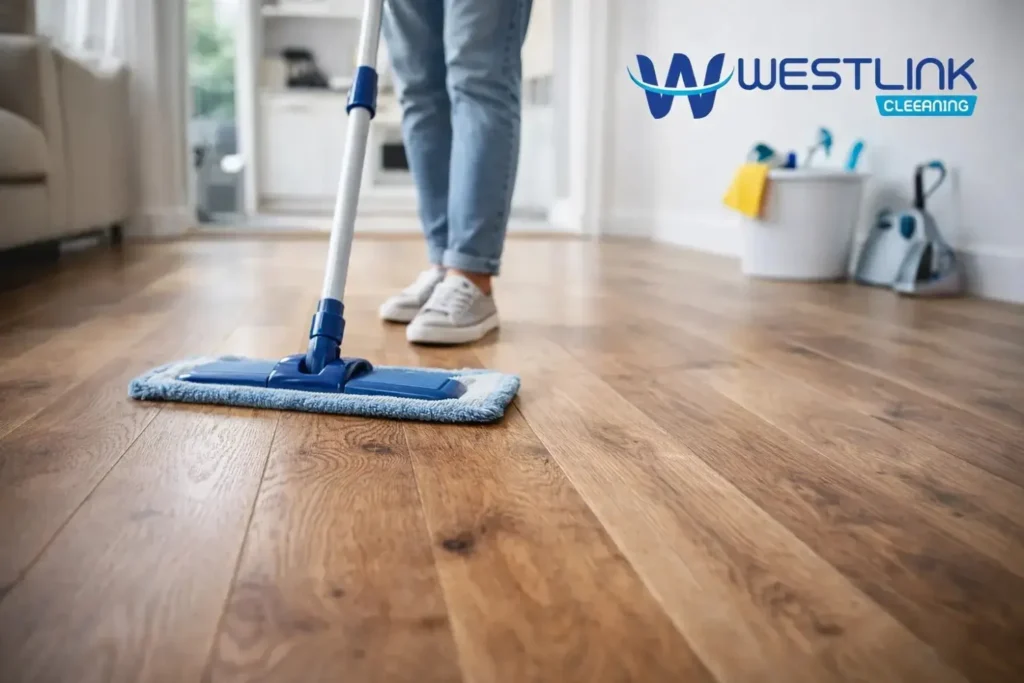
Clean timber floors by vacuuming or dry mopping first, then using a barely damp microfiber mop with a pH-neutral cleaner made for the floor finish. Avoid excess water, steam, vinegar, bleach, and harsh detergents because they can damage the surface, leave residue, or let moisture reach the wood. This is the safest basic method.
Timber flooring is affected by grit, excess moisture, steam, unsuitable cleaning products, and poor maintenance habits, not just visible dirt. Many problems that seem like simple cleaning issues are actually caused by residue buildup, finish damage, or moisture exposure.
This article covers the safest way to clean timber floors, why floor type and finish change the process, which tools and products are safe, how often to clean, how to handle common problems, when professional floor cleaning services are the better option, and what to avoid. The key principle is simple: protect the surface from scratches, use the right product, keep moisture low, and deal with spills quickly.
What Is the Safest Way to Clean Timber Floors?

The safest way to clean timber floors is to use a dry-first, low-moisture method. Start by removing dust, grit, crumbs, and pet hair with a vacuum or dry microfiber mop. After that, clean the surface with a barely damp microfiber mop and a cleaner that suits the floor finish.
This method works because timber floors face two major risks during cleaning. The first is abrasion. Dust, sand, and small grit particles act like sandpaper under shoes, chair legs, and foot traffic. The second is moisture. Too much water can enter open joints, worn edges, scratches, and damaged finish areas. Once that happens, the floor can swell, cup, warp, stain, or show finish failure.
A safe routine is simple. Remove loose dirt first. Check the floor condition. Use the right cleaner for the finish. Keep moisture tightly controlled. Dry any remaining dampness quickly. Clean spills as soon as they happen.
Everything else in this article builds on that method for different timber floors, finish types, and cleaning problems.
What Type of Timber Floor Are You Cleaning?
Before choosing a cleaner, mop, or method, identify the floor properly. This is where many mistakes start. Some people confuse construction type with finish type, but they are not the same. Solid timber and engineered timber describe how the floor is built. Sealed, unsealed, oiled, lacquered, polished, and polyurethane-coated describe the surface you are actually cleaning.
1. Solid Timber Floors
Solid timber floors are made from full pieces of wood. They are durable and often repairable, but they are still sensitive to moisture. If water sits in joints, reaches worn patches, or stays around edges, the timber can absorb it. That may lead to swelling, cupping, staining, or movement.
If the finish is intact, clean with minimal moisture. If the finish is worn or scratched through, be even more careful because the wood is more exposed.
2. Engineered Timber Floors
Engineered timber floors have a real wood top layer over a more stable core. That construction improves stability, but it does not make the floor waterproof. It also does not make steam or wet mopping safe.
The cleaning method is still dry-first and low-moisture. Remove grit first, then use a lightly damp microfiber mop and a cleaner that matches the finish. If the surface is worn, patchy, or damaged, professional engineered timber floor restoration.
3. Sealed Timber Floors
A sealed timber floor has a protective surface coating such as polyurethane, lacquer, or a factory-applied finish. These floors are usually easier to clean because dirt stays on the surface instead of entering the wood.
For sealed timber floors, the safest routine is vacuuming or dry mopping first, followed by a barely damp microfiber mop with a pH-neutral timber floor cleaner. Minimal moisture still matters because the seal does not remove risk at board edges, joints, or worn areas.
4. Unsealed Timber Floors
Unsealed timber is much more moisture-sensitive. Because there is little or no protective barrier, water and cleaning chemicals can enter the wood more easily. That increases the risk of staining, swelling, and patchy colour change.
For unsealed timber, dry cleaning should be the default method. Vacuuming, sweeping, or dry microfiber mopping is safer than liquid cleaning. If a mark needs more than dry cleaning, use very little moisture and test first.
5. Oiled Timber Floors
Oiled or wax-oiled timber floors need different care because the surface behaves differently from a coated floor. A generic hardwood floor cleaner made for lacquered or polyurethane-coated floors may not be the right choice for an oil-finished surface.
Use a finish-specific cleaner designed for oiled timber and keep moisture tightly controlled. If the surface looks dull, uneven, or worn, professional timber floor polishing.
What Tools and Products Are Safe for Timber Floors?

The safest tools and products are the ones that remove dirt without scratching the finish or pushing too much moisture into the floor.
A vacuum with a soft floor head or bare-floor setting is one of the best tools for timber floor cleaning. It removes dust, grit, crumbs, and pet hair without the scratching risk of a rotating beater bar. If the vacuum has a brush roller, switch it off before use.
A dry microfiber mop is also safe because it lifts fine dust and grit without adding water. That makes it ideal for regular maintenance. A slightly damp microfiber mop is safe for most sealed timber floors when used correctly. It should be lightly damp, not wet, and it should never leave visible water behind.
Cleaner choice should always match the finish. For sealed polyurethane or lacquered floors, use a pH-neutral cleaner made for timber or hardwood floors. For oiled floors, use a finish-specific cleaner made for oil-finished surfaces. For unsealed timber, avoid routine liquid cleaning and use very limited moisture only when needed. Before using any stronger cleaner, check the product label guidance and, where one is supplied, the Safety Data Sheet (SDS).
Safe cleaning tools usually include a vacuum with a soft floor head, a dry microfiber mop, a barely damp microfiber mop, a pH-neutral timber floor cleaner, a finish-specific cleaner for oiled timber, and a soft cloth for spot cleaning or spills.
Unsafe or risky options include soaked mops, buckets of water, steam mops, vinegar, bleach, ammonia, abrasive pads, steel wool, dish soap as a routine cleaner, and harsh all-purpose sprays. These products either add too much moisture, strip the finish, leave cloudy film, create stickiness, or damage the surface.
How Do You Clean Timber Floors Step by Step?
Once you know the floor type and the correct cleaner, the process becomes simple. This method suits most sealed timber floors and most engineered timber floors with an intact finish.

Step 1: Remove Loose Dirt and Grit
Vacuum with a soft floor head or use a dry microfiber mop. Focus on entry points, hallways, kitchens, dining areas, and furniture edges where grit builds up fastest. This step matters because grit causes scratches if it is dragged around during damp cleaning.
Step 2: Inspect the Floor
Check for worn finish, cloudy patches, sticky buildup, open joints, dark stains, or visible damage. This helps you decide how careful you need to be with moisture and whether spot testing matters.
Step 3: Choose the Right Cleaner
Use a pH-neutral cleaner for sealed timber floors. Use a finish-specific cleaner for oiled floors. If the finish is unknown, test first instead of guessing. The wrong cleaner can dull the finish, leave haze, or create residue.
Step 4: Spot Test First
Apply a small amount of cleaner in a low-visibility area and let it dry. Check for cloudiness, dullness, stickiness, or uneven appearance. This is especially important on older floors or floors with unknown finish history.
Step 5: Damp Mop With Minimal Moisture
Use a microfiber mop that is only slightly damp. Work in small sections. Do not flood the floor and do not let liquid pool around joins, corners, or skirtings. The mop should clean the surface, not soak it.
Step 6: Dry the Floor if Needed
A correctly cleaned timber floor should dry quickly. If moisture remains, go over the area with a dry microfiber pad or soft cloth. Faster drying reduces the chance of moisture entering weak points.
Step 7: Clean Spills Immediately
Wipe up water, coffee, juice, pet accidents, food splashes, and wet footprints as soon as possible. Fast spill response helps prevent staining, stickiness, and moisture entry.
How Often Should Timber Floors Be Cleaned?
The right cleaning frequency depends on foot traffic, pets, children, outdoor grit, food residue, and how quickly the floor shows dust. A quiet bedroom does not need the same routine as a busy hallway or kitchen.
A practical maintenance pattern is simple. Wipe spills immediately. Dry mop or vacuum high-traffic areas several times each week in active homes. Vacuum or dry mop the full floor weekly. Damp clean with the correct product only when needed, often every one to four weeks depending on traffic and soil level.
The goal is not frequent wet cleaning. The goal is regular dry maintenance and controlled damp cleaning when the floor actually needs it. That approach protects the finish better and lowers the risk of residue and moisture-related damage.
How Do You Remove Common Problems From Timber Floors?
Routine cleaning handles everyday dirt, but timber floors also develop buildup, haze, scuffs, and surface issues. The right solution depends on the cause.

1. Dust and Grit
Dust and grit should always be removed with a vacuum or dry microfiber mop before any damp cleaning. Fine grit is one of the biggest causes of surface scratching, especially near entrances and under chairs.
2. Sticky Residue
Sticky residue usually means too much cleaner, the wrong cleaner, or repeated product buildup. Do not solve this by adding more products. Re-clean the area with the correct timber floor cleaner using a clean microfiber pad and very little moisture.
3. Scuff Marks
Scuff marks from shoes or furniture movement often sit on the finish rather than in the timber itself. Start with a dry microfiber cloth. If needed, use a small amount of approved cleaner on a soft cloth and rub gently.
4. Food Spills
Food spills should be blotted first, then cleaned with a soft cloth and the correct floor-safe cleaner if needed. Sugary drinks, oily splashes, and sauces can leave residue if allowed to dry.
5. Pet Mess
Pet urine, vomit, and repeated bowl spills should be handled quickly because they can affect both the finish and the timber below. Blot first, clean with a suitable product, and dry the area fully.
6. Cloudy Appearance
A cloudy floor is usually caused by product buildup, wrong cleaner use, detergent film, vinegar use, hard-water residue, or moisture left on the surface. The answer is careful re-cleaning with the correct cleaner and a clean microfiber pad. If the haze does not improve, the finish may already be affected.
7. Mild Stains
Mild stains on sealed timber often sit in or on the finish layer. Start with a soft cloth and the correct cleaner. On unsealed timber, stains are more serious because the wood absorbs contamination more easily.
When Should You Call a Professional for Timber Floor Cleaning?

You should call a professional when the issue goes beyond normal dirt or routine maintenance. This usually includes heavy buildup, repeated stickiness, deep staining, finish haze that does not improve, pet urine damage, water marks, black edge staining, or areas where the coating is worn through. Professional help is also the safer choice when the floor type or finish is unknown and you do not want to risk making the problem worse.
A professional assessment matters because some timber floor problems are not cleaning problems. They are finish problems, moisture problems, or restoration problems. A floor that looks dirty may actually need residue removal, polishing, recoating, stain treatment, sanding, or finish repair. Using more water or stronger chemicals at home can make these problems worse.
If the floor still looks cloudy after correct re-cleaning, feels sticky after residue removal, shows dark staining around board edges, or has worn traffic lanes where the finish has failed, it is usually time to stop DIY testing and get the floor assessed properly.
What Does Professional Timber Floor Cleaning or Restoration Include?
Professional timber floor cleaning usually starts with identifying the floor construction, finish type, wear level, and the true cause of the problem. That matters because sealed timber, oiled timber, engineered timber, and worn solid timber do not all need the same treatment.
A proper service may include low-moisture deep cleaning, residue removal, stain treatment, finish-safe spot correction, and advice on the right maintenance products for the surface. In more advanced cases, the floor may need more than cleaning. It may need polishing, buffing, recoating, oil maintenance, or sanding and refinishing if the surface coating has failed.
The real value of a professional service is not just stronger cleaning. It is a correct diagnosis. That helps avoid the common mistake of treating a restoration problem like a normal cleaning problem.
What Should You Never Use on Timber Floors?

Some products create immediate issues. Others cause slower damage that becomes obvious later. Wet mops and buckets of water should not be standard practice on timber floors. Steam mops and steam cleaners are also unsafe as a default method. Vinegar should not be treated as a normal timber floor cleaner. Bleach, ammonia, harsh all-purpose sprays, abrasive scrub pads, steel wool, and dish soap as a routine cleaner all create unnecessary risk. Beater-bar vacuum heads can also scratch the surface.
The reasons are practical. Excess water can cause swelling, cupping, warping, finish breakdown, and residue problems. Steam forces heat and moisture into the floor system. Harsh chemicals can dull, strip, or weaken the finish. Soap-heavy products can leave a cloudy or sticky film. Abrasive tools can scratch the surface.
If a method sounds saturated, aggressive, or harsh, it is usually the wrong starting point for timber flooring.
How Do You Protect Timber Floors After Cleaning?
Cleaning removes dirt, but protection habits reduce how much dirt and damage reach the floor in the first place. That is why good timber floor care includes prevention as well as cleaning.
Use entry mats at outside doors to catch dust, sand, and grit before they spread across the floor. Use felt pads under chairs, stools, couches, and other movable furniture. Replace worn pads before they start scratching the finish.
Avoid dragging furniture across the floor. Lift it instead. Clean up water around plant pots, pet bowls, and doorways quickly. Keep pet nails trimmed where practical. If strong sunlight is causing uneven fading, use blinds or curtains during peak sun periods.
Humidity also matters. Timber responds naturally to seasonal moisture changes in the air. Very dry indoor conditions can increase shrinkage and gaps. Very humid conditions can increase swelling and movement. Stable indoor conditions help reduce stress on the boards and finish.
Does the Cleaning Method Change for Polished, Oiled, or Engineered Timber Floors?
Yes, the method changes when the surface system changes, but the main rule stays the same. Match the cleaner to the finish and keep moisture tightly controlled.
A polished timber floor often means a timber floor with a coated surface that has been finished to a smooth sheen. In many homes, that means polyurethane or lacquer. These floors usually need a pH-neutral timber floor cleaner, a microfiber mop, and very low moisture.
An oiled or wax-oiled timber floor needs different care because the surface behaves differently. Use a cleaner made for oil-finished floors. Do not assume that one generic hardwood cleaner suits every timber floor.
Engineered timber floors are usually cleaned much like sealed solid timber floors when the finish is intact, but they still should not be steam cleaned or wet mopped. The surface is still real timber, and the board edges can still react badly to excess moisture.
Conclusion
The correct way to clean timber floors is not complicated, but it does require discipline. Remove grit first. Use minimal moisture. Match the cleaner to the floor finish. Clean spills quickly. Avoid steam, vinegar, harsh chemicals, and over-wetting.
Once you understand the difference between solid timber, engineered timber, sealed finishes, oiled finishes, and unsealed timber, the correct cleaning method becomes much easier to apply. Timber floor cleaning should always stay inside one safe framework: scratch prevention, finish compatibility, moisture control, and steady maintenance. When those four things are in place, the floor stays cleaner, the finish lasts longer, and the risk of avoidable damage drops.
Frequently Asked Questions About How to Clean Timber Floors
1. Can You Mop Timber Floors?
Ans. Yes, but only with a barely damp microfiber mop and the correct cleaner for the floor finish. Routine wet mopping is not the safe standard for timber floors.
2. Can You Steam Clean Timber Floors?
Ans. No. Steam is not a safe default for timber floors because it adds both heat and moisture, which can affect the finish and the wood.
3. Can You Use Vinegar on Timber Floors?
Ans. Vinegar should not be treated as a safe default cleaner for finished timber floors because it can contribute to dullness, haze, or finish problems over time.
4. What Is the Best Mop for Timber Floors?
Ans. A microfiber mop is usually the best option because it captures dust and soil well, uses less water, and gives better moisture control than a traditional wet mop.
5. How Do You Clean Engineered Timber Floors?
Ans. Use the same dry-first, low-moisture method used on most sealed timber floors. Vacuum or dry mop first, then use a barely damp microfiber mop with a cleaner that suits the finish.
6. Why Do Timber Floors Look Cloudy After Cleaning?
Ans. Cloudiness usually comes from residue buildup, wrong cleaner use, too much product, detergent film, or moisture left on the surface. Re-cleaning with the correct product often helps.
7. How Do You Clean Unsealed Timber Floors?
Ans. Use dry methods first, such as vacuuming or dry microfiber mopping. Keep moisture extremely limited because unsealed wood absorbs moisture much more easily.
8. What Should You Never Use on Timber Floors?
Ans. Do not use wet mops, steam mops, vinegar, bleach, ammonia, abrasive pads, steel wool, or harsh all-purpose cleaners as routine practice. These increase the risk of residue, finish damage, or moisture-related problems.


