

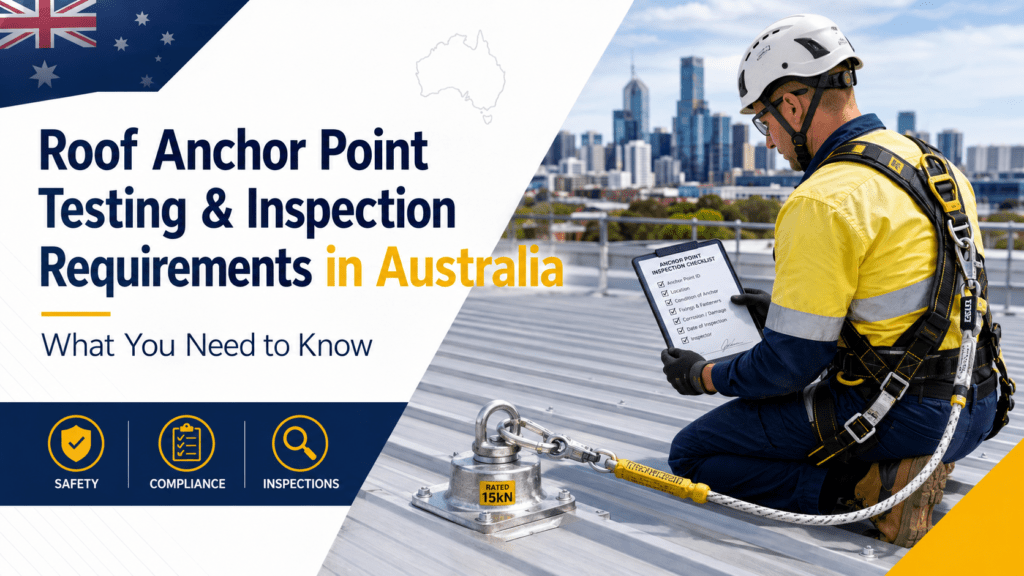
If you are responsible for roof access on a commercial building, the question is rarely just, “Have the anchors been tested?”
What you actually need to establish is whether the roof anchor system remains suitable for the work being carried out, has been inspected when required, is supported by appropriate records, and can be relied on as part of a safe work-at-height system.
That distinction matters because an anchor can look perfectly serviceable while having a concealed fixing or structural problem. Likewise, a visual inspection is not automatically equivalent to proof-load testing, engineering verification, or certification.
According to Safe Work Australia’s Model Code of Practice: Managing the Risk of Falls at Workplaces, fall risks need to be managed as part of the broader workplace safety system, with the applicable Code checked against the requirements of the relevant state or territory regulator.
Before relying on anchors, the broader hierarchy of controls also matters. Risks should be eliminated where reasonably practicable and otherwise minimised using appropriate controls.
For a building manager, this means the goal is not simply to obtain another certificate for the compliance folder. The goal is to know whether contractors can use the roof-access system safely and what evidence supports that decision.
Do Roof Anchor Points Need to Be Tested?
Roof anchor systems require appropriate inspection and verification, but that does not mean every anchor automatically receives the same physical pull test at the same interval.
A roof anchor device forms part of a broader anchorage and fall-protection system. Depending on the work method, that system may be intended for fall restraint, fall arrest, work positioning, or another work-at-height application.
A simplified load path can be represented as:
anchor device → fixing → supporting material → structure
The exact arrangement varies between systems, but the principle is important. Looking at—or mechanically testing—only the visible metal anchor does not necessarily establish the condition of everything supporting it.
Safe Work Australia’s guidance explains the broader requirements for managing fall risks and the role of fall-protection equipment within that process.
So when you review an existing system, the useful question is not:
“Has someone pulled on this anchor?”
It is:
“What evidence shows that this installed anchorage is suitable for the way our contractors need to use it?”
Depending on the system, that evidence can include visual inspection findings, manufacturer information, installation records, engineering documentation, proof-load results, and previous maintenance records.
Why Testing One Anchor Does Not Prove the Roof Is Safe

A serviceable anchor does not automatically make the complete roof-access system safe.
Workers may also rely on harnesses, lanyards, energy absorbers, horizontal lifelines, self-retracting lifelines, connectors, and other components.
The work method matters as much as the individual device.
A fall-restraint system is intended to prevent the user from reaching a position where a fall can occur.
A fall-arrest system operates after a fall begins and must manage the forces and clearance involved in arresting that fall.
That difference affects anchor position, equipment selection, available fall clearance, and the way workers move across the roof.
For example, an anchor may be structurally serviceable but still be poorly positioned for the work area. A contractor could be exposed while transferring between anchors, unable to reach the required plant safely or placed at risk of a swing fall.
The broader system selection and fall-risk principles are addressed in Safe Work Australia’s national falls Code of Practice.
That is why anchor inspection should answer two different questions:
Is the anchorage serviceable?
and:
Does the overall system support the proposed work method safely?
Testing cannot correct a poor system layout.
Which Australian Standards Apply to Roof Anchor Points?
Two principal current standards are particularly relevant to single-point roof anchors:
AS/NZS 1891.4:2025 — Personal equipment for work at height, Part 4: Selection, use and maintenance
and:
AS 5532:2025 — Manufacturing requirements for single-point anchor devices used for harness-based work at height
These standards deal with related issues, but they do not perform the same function.
Standards Australia’s overview of AS/NZS 1891.4:2025 explains that the Standard covers the selection, use and maintenance of personal equipment for work at height, including anchors, harnesses, lanyards, connectors, fall-arrest devices, horizontal lifelines and horizontal rail systems. The 2025 edition also includes clearer periodic inspection requirements and expanded technical guidance on anchors and fasteners.
AS 5532:2025 has a different role. Standards Australia’s explanation of the 2025 height-safety standards changes describes AS 5532 as addressing manufacturing requirements for single-point anchor devices, including how those anchor devices are designed and tested.
This distinction is important for an existing commercial building:
A product being manufactured and tested to an applicable standard is not the same as confirming that an installed anchor remains serviceable at your site.
Once installed, the system also depends on factors such as fixing method, supporting structure, installation quality, corrosion, alterations and intended use.
Other standards may apply where the roof-access system includes horizontal lifelines, fall-arrest devices, rope-access equipment or other specialist components. Standards Australia notes that the 2025 edition aligns with several related work-at-height standards.
Are Australian Standards Legally Mandatory?
Australian standards are not automatically legislation simply because they exist.
Their legal relevance depends on the applicable WHS legislation, regulations, codes of Practice and circumstances.
SafeWork NSW’s guidance on Australian Standards and WHS law states that Standards are not laws in themselves. Compliance with a particular standard becomes mandatory where legislation specifically requires conformity with it. Standards may nevertheless remain relevant when considering whether WHS duties have been satisfied.
This is why a statement such as
“AS/NZS 1891.4 is the law everywhere in Australia.”
is too broad.
For a property or facilities manager, the better sequence is:
jurisdiction → WHS duties → applicable Code of Practice → relevant Standards → manufacturer requirements → engineering and site-specific requirements
Jurisdiction also matters.
In NSW, SafeWork NSW confirms that from 1 July 2026, PCBUs must comply with an approved Code of Practice or use another method that provides an equivalent or higher standard of WHS. You can read the regulator’s explanation in its Australian Standards and WHS guidance and current Codes of Practice library.
A building portfolio operating in more than one state or territory should therefore not assume that every legal requirement is identical nationally.
How Often Should Roof Anchors Be Inspected?

Periodic inspection and mechanical proof-load testing are related but separate issues.
This is one of the most important distinctions for building managers because the words “inspection”, “testing” and “recertification” are often used as though they mean exactly the same thing.
Standards Australia’s AS/NZS 1891.4:2025 overview confirms that the revised standard contains clearer periodic inspection frequencies and criteria.
Because the detailed provisions of AS/NZS 1891.4:2025 sit inside the licensed standard, Standards Australia’s public summary does not reproduce every inspection interval and proof-testing condition.
For a more detailed interpretation, Core Inspection’s AS/NZS 1891.4:2025 changes guide reports that installed fall-arrest devices move to an annual inspection cycle under the 2025 edition and that the previous allowance for manufacturer-specified intervals of up to five years has been removed. This is secondary industry guidance, not a substitute for checking the licensed standard.
For a facilities manager, the practical point is:
An annual inspection does not automatically mean every anchor receives an annual physical pull test.
Inspection establishes condition, documentation, and serviceability requirements.
Proof testing is a particular mechanical verification method and is only one part of the possible assessment.
Environmental exposure, manufacturer requirements, system condition, or events affecting the anchor may also justify additional inspection or verification before the next scheduled date.
Does Every Roof Anchor Need an Annual Pull Test?
No. Annual inspection should not be confused with annual proof-load testing of every anchor.
This is particularly important under the 2025 edition of AS/NZS 18914.
Published industry interpretation from Core Inspection’s 2025 Standard changes guide reports that anchors with multiple fasteners may no longer require annual proof loading where specified documentation conditions are satisfied, including installation information, structural adequacy information and evidence of installation proof testing and maintenance.
That information should still be checked against the licensed current standard for the specific installed system.
For a building manager, the important consequence is that documentation can affect the verification pathway.
If you inherit a building with anchors but cannot locate installation drawings, manufacturer information, structural documentation, or earlier proof-test records, the problem is not solved simply by seeing that the anchors look clean.
The assessor first needs to establish what system is present and what verification basis applies.
This is also why copying a kN value from a product brochure or another contractor’s website is not a defensible way to select a field test load.
The correct sequence is:
Identify the system → establish the applicable test basis → select the test method → apply the required procedure → assess the result against defined acceptance criteria
The exact proof-load procedure should be confirmed against the current licensed standard, manufacturer instructions, and any applicable engineering documentation.
What Is a Proof-Load Test?
A proof-load test applies a defined force to an installed anchorage or fixing and assesses its response against specified acceptance criteria without intentionally loading the component to destruction.
That is different from an ultimate-load or destructive test.
It is also different from a visual inspection.
Where mechanical testing is required, appropriate calibrated equipment may be used to apply and measure the specified force. Depending on the procedure, the assessor may also evaluate movement, deformation, displacement or changes in the supporting material.
The important issue is not merely how much force appears on a test gauge.
It is whether that force was selected from a valid test basis and whether the result was assessed against the correct acceptance criteria.
Without those elements, a recorded force by itself tells the building owner very little.
What Happens During a Roof Anchor Inspection?
For an existing commercial building, a useful assessment should establish what is installed, what the system is intended to do, and what evidence supports continued use.
A defensible inspection process will generally:
- identify each anchor and its intended system use;
- review available manufacturer, installation, engineering and previous inspection records;
- inspect the anchor, accessible fixings and supporting materials;
- check for corrosion, deformation, movement, deterioration and identification problems;
- determine whether additional verification or mechanical testing is required;
- apply the specified test method where mechanical testing is required;
- assess findings against defined acceptance criteria;
- record defects, photographs and corrective actions; and
- Update the anchor register and future inspection information.
The broader inspection and risk-management framework can be checked against Safe Work Australia’s Model Code of Practice for falls.
The important point is the order.
The test basis should be established before a test force is applied, not selected afterwards to justify the result.
What Defects Can Put a Roof Anchor Out of Service?
An anchor can become unsuitable because of a problem with the anchor device, fixing, supporting material or surrounding structure.
Visible issues may include corrosion, deformation, damaged threads, cracked welds or movement.
But the less obvious defects can be just as important.
Concrete can crack or deteriorate around a connection. Steel can corrode. Timber can deteriorate. A purlin or other structural member may have been altered during later construction work. A concealed fixing may also be affected even where the exposed anchor appears intact.
That creates an important distinction:
Visible condition is evidence, but it is not proof of the complete structural condition.
A good inspection report should therefore describe the actual issue and where it occurs rather than simply labelling an anchor “non-compliant” without explanation.
Can Roof Works or Solar Installation Affect Existing Anchors?
Yes. Previous inspection or certification records should be reconsidered where later work changes the anchor, fixing, roof assembly, supporting structure, or safe-access layout.
This is particularly relevant when you manage buildings that undergo regular plant upgrades or refurbishment.
A roof replacement can disturb an anchor fixing or incorporate it into a different roof build-up.
Waterproofing work can alter penetration or flashing details.
Solar panels can change the route contractors use across the roof even if none of the anchors themselves have been moved.
Mechanical equipment can create new obstructions or change where workers need to connect.
Structural works may affect the member supporting an anchor.
The right question after a building modification is therefore not:
“Do we still have the old certificate?”
It is:
“Does the previous assessment still describe the roof-access system that exists today?”
If it does not, reassessment may be required.
Can Anchor Testing Damage the Roof or Waterproofing?
Inspection, testing and remediation need to consider the roof system as well as the height-safety system.
This is particularly important where anchors penetrate roof sheeting or waterproof membranes.
Mechanical test equipment can create reaction forces around the test location. Accessing concealed connections may require roofing materials to be disturbed. Replacement of a defective anchor may also affect flashing or waterproofing details.
For a building manager, this means a remediation scope should not end with:
“New anchor installed.”
It should also address the condition of the roof assembly that has been opened or disturbed.
A height-safety repair that creates a water ingress problem is not a complete maintenance outcome.
Does a Certified Anchor Mean the Whole Roof Is Safe to Access?
No. The condition of an individual anchor and the usability of the complete roof-access system are separate questions.
A contractor needs to be able to connect before entering a fall-risk position and remain adequately protected while moving between work areas.
The broader requirements for managing these risks are covered in Safe Work Australia’s Falls Code of Practice.
When reviewing a roof-access system, ask practical questions:
- Can the contractor connect before being exposed to a fall?
- Can the required equipment be reached while remaining protected?
- Does movement between anchors create an unprotected section?
- Could the connection geometry create a swing fall?
- Is there adequate clearance below the worker?
- How would a suspended worker be rescued after a fall?
An individual anchor can pass inspection while the overall system remains unsuitable for a particular task.
Who Can Inspect, Test or Certify Roof Anchors?
Competency should match the task being performed.
A person capable of carrying out a routine equipment inspection is not automatically competent to design an anchorage.
A technician capable of conducting a specified mechanical test is not automatically a structural engineer.
An installer is not automatically qualified to determine the capacity of an undocumented supporting structure.
Safe Work Australia’s guidance on managing falls can be reviewed through its official Model Code of Practice.
Depending on the issue, the assessment may require involvement from a height-safety inspector, competent installer, manufacturer, testing technician or structural engineer.
When appointing a provider, a more useful question than:
“Are you certified?”
is:
“Who will assess our system? What are they competent to assess, and what standard, manufacturer procedure or engineering basis will they use?”
That tells you much more about the quality of the assessment.
What Should Be Included in Your Roof Anchor Report?
Your report should allow another competent person to identify each asset, understand what was assessed, and know what happens next.
A certificate containing only the words “anchors passed” provides a weak audit trail.
For each relevant asset, the documentation should make the following information traceable:
| Record attribute | What should be identifiable |
| Anchor identity | Unique asset number or other traceable identifier |
| Location | Roof plan reference or clear physical location |
| Intended system | Fall restraint, fall arrest or other intended use |
| Product | Manufacturer and model where known |
| Rating | Applicable capacity where established |
| Inspection | Date, assessor and inspection findings |
| Testing | Method and recorded result where applicable |
| Test equipment | Relevant equipment identification and calibration evidence |
| Condition | Defects, damage, corrosion or structural concerns |
| Evidence | Photographs and supporting documentation |
| Action | Suitable for service, isolation, repair, replacement or further assessment |
| Scheduling | Next inspection or review requirement |
For property management, this turns a certificate into something more useful: a traceable safety-asset record.
The lifecycle becomes:
installation → inspection → test evidence where applicable → corrective work → verification → future inspection
That is far easier to manage than a folder containing unrelated contractor PDFs.
What If Your Building Has Roof Anchors but No Records?
Missing documentation does not automatically prove that an anchor has failed, but it means you may not have enough evidence to rely on it.
This is especially relevant when acquiring an older property or taking over facilities management from another provider.
You may find physical anchors on the roof but no reliable anchor schedule, installation drawing, manufacturer information, structural documentation, or inspection history.
Adding a new label does not resolve that evidence gap.
The system may first need to be reconstructed as far as reasonably possible.
That can involve identifying the anchor type, locating accessible fixings, determining the supporting structure, reviewing drawings, checking manufacturer information and deciding whether engineering assessment or additional mechanical verification is necessary.
The correct distinction is:
‘Unknown’ does not automatically mean ‘failed’
but:
‘Unknown’ also does not mean ‘demonstrated suitable for use ‘.
The importance of documentation under the 2025 regime is also discussed in Core Inspection’s technical summary of AS/NZS 1891.4:2025 changes.
What Happens If One Roof Anchor Fails?
A failed anchor should be treated as an identified safety defect and controlled until the issue has been resolved.
A useful report should explain why continued use cannot be supported.
That may involve corrosion, movement, damage, structural deterioration, inadequate documentation, or another defined issue.
The corrective process should then move from:
defect → isolation → investigation → repair or replacement → verification → updated records → return to service
One failed anchor does not automatically prove that every anchor on the roof has failed.
However, where the same product, installation method, supporting structure, or deterioration mechanism is present elsewhere, the finding may justify broader investigation.
Likewise, replacing only the visible anchor component will not solve a problem located in the fixing or supporting structure.
The repair needs to address the actual failure mechanism.
Can Older Roof Anchors Be Recertified?
Potentially. Age by itself is not enough to determine whether an anchor remains suitable.
What matters is the available evidence about the anchor’s condition, installation, supporting structure, product identification, current intended use and any building changes that have occurred since installation.
An older system with clear drawings, identifiable products, appropriate installation records and a sound supporting structure presents a very different assessment problem from an unidentified anchor with no records and an inaccessible fixing.
Where sufficient evidence cannot be established, further testing, engineering assessment, redesign or replacement may be more appropriate than attempting to create certainty from incomplete information.
Who Is Responsible for Managing Roof Anchor Compliance?
Responsibility should be established from the applicable WHS duties and the parties managing or controlling the workplace and work—not simply assumed from a person’s job title.
Under the WHS framework, a person conducting a business or undertaking (PCBU) may hold relevant duties.
SafeWork NSW’s explanation of Australian Standards and WHS obligations also explains the duties of PCBUs and how Standards can be relevant when assessing what is reasonably practicable.
For a commercial property, this can involve the owner, facilities manager, property manager, strata manager, tenant, maintenance contractor and height-safety provider.
The practical management question is simpler:
Who in your organisation owns the roof-safety asset register?
Someone should be able to determine which systems exist, when they were last assessed, which defects remain open, where the records are stored and when the next inspection is due.
Without clear ownership, the problem is usually discovered at the worst possible time—when a contractor is already on site and cannot verify whether the anchors can be used.
How Do You Choose a Roof Anchor Inspection Provider?
Compare the assessment process, not simply the price per anchor.
Two quotations can appear to cover the same number of anchors while describing very different services.
Before appointing a contractor, establish whether the proposed scope includes visual inspection, document review, mechanical testing where required, defect reporting, photographs, an updated asset register and engineering escalation where the supporting structure cannot be verified.
Also establish what happens when a defect is found.
Can the provider explain why the anchor failed?
Will the affected asset be clearly identified?
Can the provider distinguish a problem with the anchor device from one involving the fixing or structure?
Can an engineering assessment be arranged where necessary?
Will repaired or replaced anchors be verified before they are returned to service?
A clear answer to those questions is more valuable than a vague promise that the anchors will be “recertified.”
Should the Same Company Inspect and Repair the Anchors?
It can be appropriate for the same provider to inspect and remediate a system, provided the findings are transparent.
The concern is not necessarily that one company performs both services.
The concern is a report that says only:
“Failed — replacement required.”
without explaining the defect, applicable acceptance criterion or technical reason for the recommendation.
A defensible report should make the inspection finding understandable independently of the quotation for corrective work.
That gives you a clear separation between:
what was found
and:
what the provider recommends doing about it.
How Much Does Roof Anchor Inspection and Testing Cost?
There is no meaningful national “price per anchor” that describes every building.
The scope can change significantly depending on anchor quantity, system type, roof access, documentation, supporting structure, testing requirements, and whether engineering or remediation is needed.
The cost of assessing ten clearly identified anchors on an accessible roof is different from assessing an undocumented roof-access system where the supporting construction cannot readily be verified.
Access itself can also affect the inspection scope.
Before an inspector can assess the system, there still needs to be a safe method of reaching the components.
For a more accurate quotation, provide your site address, approximate anchor quantity, previous inspection records, roof or anchor drawings, and details of any recent roofing, solar, or structural work.
That information allows the provider to price the actual problem rather than making assumptions from the number of visible anchors.
What Should You Send Before Booking an Inspection?
The most useful starting information is whatever helps establish the history of the roof-access system.
Send previous inspection or certification reports, roof plans, anchor layouts, installation records, and manufacturer information where available.
Also explain why you are arranging the assessment.
For example, is the normal inspection due? Has a contractor refused to use the system? Has the roof recently been replaced? Are you missing historical records? Has an anchor been involved in arresting a fall? Was a defect identified during another maintenance visit?
That context can materially change what needs to happen on site.
What If a Contractor Needs Roof Access but the Records Are Out of Date?
Do not treat a quick visual check by the contractor as a substitute for an appropriate assessment.
If the current suitability of the anchors cannot be established, the immediate issue is the work method.
Depending on the site, the solution may involve arranging the required inspection, using another verified access system, or changing how the work is performed.
The broader legal and risk-management context can be checked through Safe Work Australia’s falls Code of Practice and the relevant state or territory regulator.
The wrong sequence is:
missing evidence → contractor accepts the uncertainty → work continues
For facilities managers, this is one of the strongest reasons to manage roof-safety inspections as scheduled asset maintenance rather than waiting until another contractor needs access.
Managing Roof Anchors Across Multiple Properties
For a property portfolio, individual anchors should be managed as traceable safety assets rather than simply as entries on separate certificates.
Each asset should remain connected to a persistent identifier, physical location, system type, inspection history, defect history, photographs, and current documentation.
Consistency matters.
If one report calls an asset “Anchor 12″, another calls it “A12, and a third identifies it only from a photograph, tracking its condition over several years becomes unnecessarily difficult.
A good register allows a facilities team to see which systems are current, which defects remain open, and which inspections are approaching without opening every historical report.
Roof Anchor Inspection Is About Evidence, Not Just a Certificate
For a building owner or facilities manager, the purpose of a roof anchor inspection is not simply to produce another PDF saying “pass.”
You need defensible evidence that explains:
- What system is installed
- what the anchors are intended to be used for;
- whether the anchors, fixings and supporting structure remain suitable at the level required by the applicable assessment;
- whether mechanical proof testing is required;
- What defects were found
- what corrective work remains outstanding; and
- when the system needs to be reviewed again.
A strong roof-safety record connects the complete asset lifecycle:
fall-protection system → anchor → fixing → structure → inspection → testing where required → defect management → corrective work → verification → ongoing records
That is the difference between simply testing an anchor and properly managing a life-safety asset.
Need Roof Anchor Point Testing or Recertification?
If your roof anchors are due for inspection, have incomplete records, have been affected by roof work, or cannot currently be verified for contractor use, the next step is a site-specific assessment.
A useful inspection scope should identify the installed system, review the available documentation, inspect the anchors and accessible supporting components, establish whether additional testing or engineering input is required, document defects, and leave you with records that can be used for future roof-access decisions.
When requesting an assessment, provide the site address, approximate number of anchors and any existing certificates, inspection reports or roof plans available.
Frequently Asked Questions
We Bought a Building With Roof Anchors but No Certificates. Can Contractors Use Them?
Not simply because the anchors are physically present.
The available evidence should first be reviewed to establish what the anchors are, their intended use, and whether their continued suitability can be demonstrated.
Missing records may require additional inspection, testing or engineering assessment.
One Anchor Failed. Does the Whole Roof Need to Be Closed?
Not automatically.
The effect depends on where the failed anchor sits within the access system and whether other anchors share the same product, installation method, supporting structure or defect mechanism.
The affected anchor should be controlled, and the implications for the complete work method should be assessed before roof access continues.
The Anchors Look New. Do They Still Need Inspection?
Appearance alone does not establish the condition of concealed fixings or the supporting structure.
For the broader national guidance on managing fall risks and fall-protection systems, see Safe Work Australia’s Model Code of Practice.
We Had Solar Panels Installed. Do the Anchors Need to Be Checked Again?
Potentially.
Even where the anchors were not physically altered, solar panels can change access routes, connection geometry, and the parts of the roof workers need to reach.
If the previous assessment no longer represents the current roof configuration, the access system should be reassessed.
Does Every Annual Inspection Include Pull Testing?
No.
Periodic inspection and proof-load testing are separate concepts.
For the public overview of the revised standard, see Standards Australia’s AS/NZS 1891.4:2025 guidance. For the more detailed secondary industry interpretation of annual inspection and multi-fastener proof-testing changes, see Core Inspection’s 2025 changes guide.
Can an Old Certificate Be Used Indefinitely?
No inspection record should be treated as permanent evidence of current physical condition.
The system should be reviewed according to the applicable inspection requirements and earlier where a fall event, deterioration, roof alteration, or another change may have affected it.


