

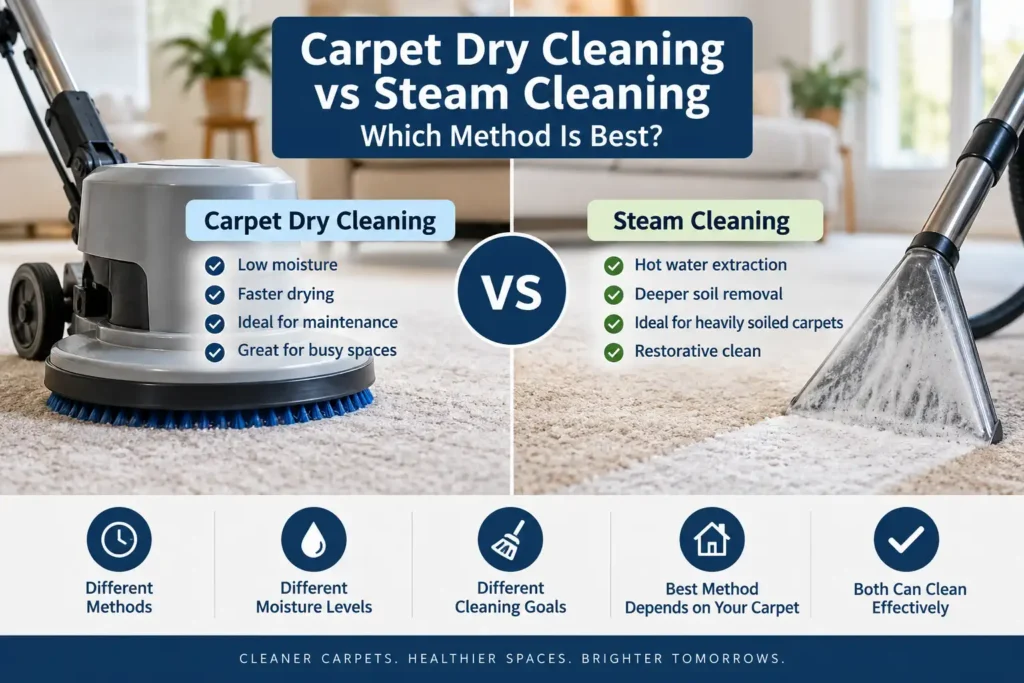
Carpet dry cleaning and steam cleaning can both clean carpet effectively, but they suit different conditions. Dry and low-moisture methods use limited moisture and generally allow faster return to use, while steam cleaning, commonly referring to hot water extraction, uses more water and extraction to remove loosened soil from the carpet pile.
In the carpet dry cleaning vs steam cleaning comparison, neither method is universally better. Steam cleaning is often better suited to restorative cleaning and heavier soil, while dry or low-moisture cleaning can be useful when faster drying and reduced moisture are priorities. The right method depends on carpet fibre, construction, condition, soil level and drying requirements.

What Is the Difference Between Carpet Dry Cleaning and Steam Cleaning?
The main differences are how much moisture each method uses, how soil is loosened and removed, and how quickly the carpet can normally return to use.
Despite the name, carpet dry cleaning is not necessarily completely dry. The term commonly covers low-moisture systems that use absorbent compounds, encapsulation solutions, controlled sprays, foam or similar processes with substantially less water than hot water extraction.
Steam carpet cleaning is the common consumer term for hot water extraction. Professional equipment applies heated water and suitable cleaning solution to the carpet and then extracts the liquid together with loosened soil.
| Factor | Carpet Dry / Low-Moisture Cleaning | Steam Cleaning / Hot Water Extraction |
|---|---|---|
| Moisture use | Low | Higher |
| Typical role | Maintenance and faster return to use | Restorative or deeper cleaning |
| Drying time | Generally shorter | Generally longer |
| Soil removal | Often suitable for surface and moderate soil, depending on the system | Can remove accumulated soil from deeper within the carpet pile |
| Heavy soiling | May not be the first choice for every heavily soiled carpet | Often suitable when carpet construction and conditions allow |
| Moisture-sensitive situations | Can be advantageous | Requires careful moisture management |
| Commercial applications | Useful where downtime needs to be limited | Useful where deeper restorative cleaning is required |
| Method selection | Depends on fibre, construction, soil and system | Depends on fibre, construction, soil, extraction and drying conditions |
The important distinction is not simply “dry versus wet”. The cleaning method should match the carpet, its condition, and the required result.

How Does Steam Carpet Cleaning Work?
Professional steam carpet cleaning generally refers to hot water extraction rather than cleaning carpet with steam alone.
A typical professional process may include:
- Inspecting the carpet fibre, construction and condition.
- Removing loose dry soil.
- Pre-treating appropriate stains and heavily soiled areas.
- Allowing the treatment suitable contact time.
- Applying heated water through professional extraction equipment.
- Recovering water, cleaning solution, and loosened soil.
- Performing additional extraction passes where required.
- Providing ventilation and drying guidance.
Water volume, temperature, pressure, cleaning chemistry, and agitation should be matched to the carpet rather than applied identically to every job.
If you are preparing for a professional clean, our guide on whether you need to vacuum before carpet cleaning explains why dry-soil removal matters before deeper cleaning.
Is Steam Cleaning Really Steam?
Usually not in the way the name suggests.
Professional carpet “steam cleaning” commonly describes hot water extraction. Heated water is applied to the carpet and then recovered through suction.
Visible vapour may sometimes be present because of the water temperature, but the cleaning process primarily relies on water, suitable cleaning chemistry, agitation where required, and effective extraction.

How Does Carpet Dry Cleaning Work?
Carpet dry cleaning is a broad term covering professional systems that introduce much less moisture than hot water extraction.
The main approaches include:
- Absorbent Compound Cleaning
- Encapsulation Cleaning
- Dry Foam and Other Low-Moisture Systems
The WoolSafe Organisation’s carpet maintenance guidance discusses low-moisture methods such as absorbent compounds and encapsulation alongside restorative cleaning processes. The guidance also reinforces that cleaning-system selection should consider the carpet and its soiling conditions rather than assuming one technique is always best.
Which Carpet Cleaning Method Is Best?
There is no single carpet cleaning method that is best for every carpet.
A better question is:
Which cleaning method best matches the carpet, its condition, and the required result?
Steam Cleaning May Be Better When:
- The carpet contains substantial accumulated soil;
- High-traffic areas require restorative cleaning;
- Deeper whole-room cleaning is required;
- The carpet construction permits water-based extraction;
- Previous cleaning residues need to be rinsed and recovered;
- Suitable extraction and drying conditions are available.
Dry or Low-Moisture Cleaning May Be Better When:
- Rapid return to use is important;
- The carpet mainly requires maintenance cleaning;
- Moisture needs to be carefully controlled;
- Extended drying would create inconvenience;
- A commercial area requires minimal downtime.
Method selection should follow inspection rather than a blanket assumption that one cleaning system is superior.
Carpet Cleaning vs Steam Cleaning: Are They the Same Thing?
No. Carpet cleaning is the broader category, while steam cleaning is one carpet-cleaning method.
Professional carpet cleaning methods can include:
- Hot water extraction;
- Dry compound cleaning;
- Encapsulation;
- Low-moisture cleaning;
- Carpet shampooing;
- Foam cleaning;
- Surface-maintenance systems;
- Targeted stain treatments.
“Steam cleaning” is therefore one possible approach within professional carpet cleaning rather than a separate category competing with carpet cleaning as a whole.

Carpet Dry Cleaning vs Steam Cleaning: Which Dries Faster?
Dry and low-moisture carpet cleaning generally dries faster because less liquid is introduced into the carpet.
Hot water extraction requires greater moisture recovery and subsequent evaporation. Actual drying time depends on more than the cleaning method itself.
Important factors include:
- Carpet fibre;
- Pile density;
- Carpet thickness;
- Amount of moisture applied;
- Extraction efficiency;
- Room temperature;
- Ventilation;
- Airflow;
- Humidity.
Two carpets cleaned using the same method can therefore have different drying times.
Faster drying does not automatically make dry cleaning the better method, just as using more water does not automatically make steam cleaning more effective. Drying time is one factor in method selection, not the only one.
Which Method Is Better for Heavily Soiled Carpet?
Hot water extraction is commonly used for restorative cleaning when carpet contains substantial accumulated soil and the fibre and construction permit the process.
Pre-treatment can loosen oily or bonded soil before extraction removes suspended soil, cleaning solution and moisture from the carpet.
Successful restorative cleaning also depends on:
- Effective pre-vacuuming;
- Suitable cleaning chemistry;
- Adequate dwell time;
- Appropriate agitation where required;
- Controlled moisture application;
- Effective extraction;
- Proper drying.
Dry and low-moisture systems can still perform well for moderate soil or planned maintenance, but a heavily loaded carpet may require a more restorative approach.
What About Pet Urine Contamination?
Pet urine is different from ordinary surface soil because liquid can penetrate the carpet backing and underlay.
Choosing steam cleaning instead of dry cleaning does not automatically resolve urine contamination. Targeted treatment may be required if urine has travelled below the carpet pile.
For that specific problem, see our previous guide on how to get pet urine out of carpet.

Which Method Is Better for Wool Carpet?
Wool requires more careful assessment than simply choosing between “steam” and “dry” cleaning.
Carpet construction, dye stability, pile type, previous treatments, soil level, and moisture sensitivity can all affect the appropriate cleaning process.
Hot water extraction can be suitable for some wool carpets when correct chemistry, temperature, moisture control and extraction are used. Low-moisture methods may suit other circumstances.
The method should therefore be selected after inspecting the individual carpet rather than assuming all wool carpets require the same treatment.
Our guide on whether you can steam clean wool carpet covers the fibre-specific considerations in more detail.
Can a Steam Cleaner Clean Carpets?
It depends on what type of machine you mean.
A professional hot water extraction machine designed for carpet can clean suitable carpet effectively.
A household vapour steam cleaner or steam mop is different. Equipment intended mainly for hard flooring should not automatically be used on carpet simply because it produces steam.
Before using a household machine, check:
- Whether the equipment manufacturer approves it for carpet;
- Whether the carpet manufacturer’s care guidance permits the method;
- Whether the carpet fibre is sensitive to heat or moisture;
- Whether the machine can recover the moisture it introduces.
Applying heat without effective moisture recovery is not equivalent to professional hot water extraction.
Which Method Is Better for Homes and Commercial Properties?
The appropriate method can change according to the property, carpet use, and the amount of downtime available.
Homes
Residential carpet may benefit from hot water extraction when accumulated soil, traffic lanes, or deeper cleaning are the main concern.
Where the carpet is being maintained regularly, or rapid drying is important, a low-moisture system may be appropriate.
Offices and Commercial Properties
Commercial environments often need to balance soil removal with operational disruption.
Low-moisture or encapsulation cleaning can be useful for routine maintenance because areas can generally return to use sooner. Restorative extraction may then be used periodically where deeper accumulated soil needs to be removed.
This is why a professional carpet-maintenance program may use more than one cleaning method over the life of the carpet.
Cleaning frequency also depends on foot traffic, carpet type, and use. See how often you should clean your carpets for more detail.

How Do Professionals Choose the Right Carpet Cleaning Method?
Professional method selection should begin with inspection rather than equipment preference.
A cleaner should consider:
- Carpet fibre and construction;
- Carpet condition;
- Dry-soil level;
- Stains and contamination;
- Traffic patterns;
- Previous cleaning treatments;
- Moisture sensitivity;
- Drying conditions;
- How quickly the space needs to return to use.
The appropriate method may then be hot water extraction, low-moisture cleaning, dry compound cleaning, encapsulation or another suitable process.
Westlink Cleaning Services provides professional cleaning across Sydney and selects the cleaning approach according to the carpet and job requirements.
For professional assistance, see our carpet cleaning services in Sydney.
If you are comparing providers as well as cleaning methods, our guide on how to choose a carpet cleaning company explains what to assess before booking.
What Should You Ask Before Choosing a Carpet Cleaning Method?
Ask the carpet cleaner:
- What fibre and construction is my carpet?
- Why are you recommending this cleaning method?
- Is the job maintenance cleaning or restorative cleaning?
- How will loose dry soil be removed?
- How will stains be assessed and treated?
- How much moisture will be introduced?
- How will moisture and cleaning solution be recovered?
- What drying conditions are required?
- Are there stains or wear that cleaning cannot reverse?
- When can the carpet return to normal use?
A professional recommendation should be based on the carpet and cleaning objective rather than a claim that one machine or method is always best.
Conclusion
Carpet dry cleaning and steam cleaning each have legitimate uses. Hot water extraction is often better suited to restorative cleaning and deeper accumulated soil, while dry and low-moisture methods can be more practical for maintenance, faster drying and situations where moisture needs to be limited.
The best method is the one that matches the carpet fibre, construction, condition, soil level and practical drying requirements. For Sydney homes and businesses, method selection should follow a proper carpet assessment rather than a blanket preference for either “dry” or “steam” cleaning.
Frequently Asked Questions
Is Carpet Dry Cleaning Better Than Steam Cleaning?
Not universally. Carpet dry cleaning may be preferable when lower moisture and faster drying are priorities, while steam cleaning or hot water extraction is often better suited to deeper restorative cleaning. Carpet fibre, construction, soil level and drying requirements should determine the choice.
Which Carpet Cleaning Method Should You Choose?
Choose the method that best matches the carpet fibre, construction, condition, soil level and moisture tolerance. Heavily soiled carpet may benefit from restorative extraction, while low-moisture cleaning may be more practical for maintenance or rapid return to use.
How Does Steam Cleaning Work on Carpet?
Professional steam carpet cleaning usually means hot water extraction. Heated water and a suitable cleaning solution are applied to the carpet, soil is loosened, and the moisture, cleaning solution, and suspended soil are recovered through extraction.
Does Dry Carpet Cleaning Remove Deep Dirt?
It depends on the dry-cleaning system and the carpet condition. Low-moisture methods can work effectively for maintenance and moderate soiling, while deeper accumulated soil may require a restorative cleaning process.
Is Steam Cleaning Better Than Carpet Shampooing?
Neither method is automatically better. Hot water extraction combines water application with extraction, while traditional shampooing relies more heavily on detergent and agitation. The appropriate method depends on carpet construction, soil level, and the required result.
Can You Steam Clean Every Type of Carpet?
No. Carpet fibre, construction, dye stability, moisture sensitivity and manufacturer guidance should be considered before using hot water extraction. Wool and other sensitive carpets require particularly careful chemistry and moisture management.
How Long Does Carpet Take to Dry After Professional Cleaning?
Drying time depends on the cleaning method, carpet fibre, pile density, moisture level, extraction efficiency, airflow, ventilation, temperature and humidity. Low-moisture methods generally dry faster than hot water extraction.


