

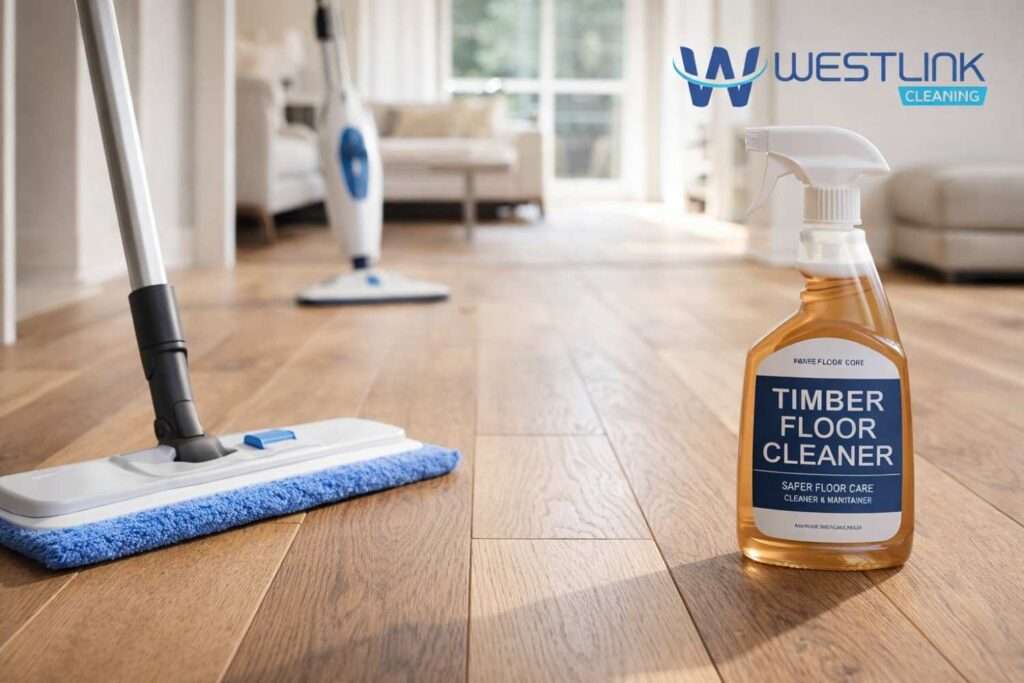
No. Steam cleaning is usually not the safest method for timber floors because heat and moisture can enter joins, edges, and worn finishes, which increases the risk of swelling, cupping, coating damage, and possible warranty issues.
Timber floors need controlled cleaning. They do not respond well to excess moisture, heat, or unsuitable household cleaners. Industry guidance and manufacturer care documents consistently recommend dry soil removal first, followed by low-moisture cleaning with a microfiber mop and an approved wood-floor cleaner.
Quick Comparison Table
| Cleaning Method | Moisture Level | Heat Exposure | Main Risk for Timber Floors | Recommended |
| Steam mop | High | High | Swelling, coating stress, residue, and delayed drying | No |
| Wet mop | High | Low | Swelling, coating stress, residue, delayed drying | No |
| Lightly damp microfiber mop | Low | None | Lower risk when used with an approved cleaner | Yes |
| Dry dust mop or soft vacuum head | None | None | Very low risk | Yes |
The safer approach is low-moisture cleaning, not steam. That matches guidance from the National Wood Flooring Association, Bona, and Bruce Flooring.
Why can steam cleaning damage timber floors?

Steam cleaning can damage timber floors because wood reacts to moisture and temperature. Wood is hygroscopic. That means it gains and loses moisture as surrounding conditions change. When timber absorbs moisture unevenly, dimensional change can occur. That movement is one reason wood products can cup, gap, split, or distort when moisture control is poor.
Finished timber is still not fully protected from steam. Surface coatings reduce exposure, but they do not make the floor waterproof. Steam and moisture can still enter micro-gaps, joints, edges, scratches, and worn-finish zones. Repeated exposure can weaken the coating and increase the chance of moisture reaching the timber below.
Warranty risk is also real. Some manufacturer guidance states that steam cleaning is not recommended and that steam-related damage is not covered under warranty.
Why do timber floors need a different cleaning method?

Timber floors need low-moisture cleaning because they behave differently from tile, vinyl, and sealed concrete. Timber is a natural material with moisture sensitivity. It can expand and contract as humidity changes. It can also show finish wear faster when too much water, abrasive tools, or unsuitable chemicals are used.
The safe cleaning priorities are consistent:
- remove dry dirt first, such as dust, grit, and sand
- use as little moisture as possible
- use a wood-floor cleaner approved for the finish or recommended by the manufacturer
That method is more accurate, safer, and more aligned with professional floor care guidance.
Is steam cleaning ever safe on timber floors?
Usually no. Only follow steam-cleaning advice when the exact flooring manufacturer allows it in writing for that exact product. A general assumption is not safe enough. Even engineered timber is not automatically suitable for steam. The finish type, join design, wear level, and manufacturer rules still matter.
What should you do instead of steam cleaning timber floors?

Use dry soil removal first, then clean with a lightly damp microfiber mop and an approved timber-floor cleaner. That is the safer routine for most timber floors.
1) Remove loose dirt and grit first
Dry soil removal is the first step because loose grit scratches timber finishes under foot traffic. Sweep, dust mop, or vacuum using a soft floor attachment. Turn off any rotating beater bar. Common dry debris includes dust, sand, pet hair, and fine grit.
2) Clean spills quickly
Spills should be removed immediately because standing moisture raises the same moisture risk that makes steam a poor choice. Wipe the spill with a dry or slightly damp cloth, then dry the area fully. Common spill examples include water, juice, coffee, and pet accidents.
3) Use a microfiber mop with very low moisture
A lightly damp microfiber mop is safer than steam because it gives better moisture control. The mop should be damp, not wet. The goal is to remove light film, footprints, and minor marks without pushing moisture into joins or worn coating areas.
4) Use a timber-floor cleaner, not a homemade mix
Use a cleaner made for wood floors because homemade mixes can damage finishes or leave residue. Manufacturer guidance warns against vinegar, waxes, oil soaps, bleach, abrasive cleaners, and other non-approved products. Examples include vinegar-and-water mixes, lemon-based solutions, oil polishes, and wax-heavy cleaners.
5) Dry the floor promptly
The surface should dry quickly after cleaning. Visible moisture should never remain on the floor. Faster drying means less chance of moisture moving into board edges, joins, or weak finish areas.
Safe step-by-step method to clean timber floors without steam

The correct method is simple: dry clean, inspect, apply an approved cleaner, mop lightly, spot clean gently, and let the floor dry fully.
- Dry clean the floor first. Sweep, dust mop, or vacuum with a timber-safe attachment. Focus on corners, edges, and traffic lanes where grit builds up.
- Check the floor condition. Look for worn coating areas, open joins, dull patches, raised edges, and signs of moisture exposure. A worn floor needs even more caution.
- Apply an approved timber-floor cleaner. Follow the product label. Do not flood the surface. Do not overspray. Do not use a dripping mop.
- Mop with a lightly damp microfiber pad. Work in small sections. Follow the grain where possible. This improves control and helps the floor dry faster.
- Spot clean marks carefully. Use a soft cloth for sticky spots, shoe marks, and light grime. Avoid harsh pads, bleach products, and abrasive tools.
- Let the floor dry fully. Resume regular foot traffic only after the surface is dry.
What should never be recommended on timber floors?
Do not recommend steam, excess water, or non-approved household cleaners on timber floors. These recommendations weaken the article’s accuracy and reduce commercial credibility.
Avoid all of the following:
- steam mops
- soaking wet mops
- Vinegar-and-water cleaning as a broad recommendation
- lemon juice or oil-based homemade polish mixes
- wax-heavy or oil-soap products
- harsh degreasers unless the manufacturer permits them
- abrasive pads and stiff brushes
- vacuum heads with rotating beater bars
Manufacturer and brand guidance specifically warns against many of these products because they can dull the finish, leave residue, affect recoating, or damage the wood surface.
What signs show possible moisture or steam damage?
Early warning signs include cupping, gapping, swelling, patchy finish wear, and raised joins. These signs do not prove steam is the only cause, but they do show that the floor needs careful handling.
Common warning signs
- Cupping: board edges sit higher than the center, which often points to a moisture imbalance.
- Gapping: boards pull apart as moisture conditions change. Small seasonal movement can occur, but wide or sudden gaps deserve attention.
- Dull or patchy finish: excess moisture and unsuitable cleaning can stress the coating, especially in high-traffic areas.
- Swelling or raised joins: this can occur when moisture reaches the timber or the substrate below.
- Surface roughness or minor edge lift: this may indicate finish breakdown or moisture-related fiber disturbance.
What should you do if you already steam-cleaned the floor?
Stop using steam immediately, let the floor dry fully, and monitor the boards for visible change over the next 24 to 48 hours. Then check the manufacturer care guide and seek professional advice if the boards lift, swell, cup, or change appearance.
Use this response sequence:
- let the floor dry fully
- avoid adding more moisture
- watch for cupping, swelling, dull patches, or board movement
- check the manufacturer’s written care guide
- arrange professional assessment if a visible change appears
This is where Westlink Services can enter the article naturally. Not every floor needs sanding or replacement, but incorrect follow-up cleaning can make the problem worse.
What is the best maintenance routine for timber floors?

The best routine combines dry cleaning, low-moisture maintenance, rapid spill control, and stable indoor humidity. That routine protects the finish and reduces moisture stress in the wood.
Recommended schedule
| Frequency | Action | Purpose |
| Daily or as needed | Dry mop, sweep, or vacuum dust and grit | Reduces scratching and surface wear |
| Weekly | Lightly damp microfiber mop with approved timber-floor cleaner | Removes light film and marks safely |
| As needed | Wipe spills immediately and dry the area | Limits moisture exposure |
| Periodically | Inspect joins, edges, finish wear, and traffic lanes | Identifies issues early |
| Long term | Use mats, felt pads, and controlled indoor humidity | Reduces wear and dimensional stress |
Wood-floor and maple-floor guidance commonly recommends keeping indoor relative humidity in a controlled range, often around 35% to 50%, to reduce expansion and shrinkage problems.
Why does professional help matter for timber floors?
Professional help matters because timber floors are easy to over-wet and easy to treat with the wrong product. The risk usually comes from three errors: too much water, the wrong chemical, and cleaning the floor as if it were tile.
Westlink Services should position the service around specific outcomes:
- low-moisture timber floor cleaning
- finish-conscious cleaning methods
- safer product selection
- removal of built-up soil without over-wetting
- support for homes, offices, and commercial interiors with delicate hard floors
That keeps the page educational and commercially aligned. It answers the user’s question and also explains why professional cleaning matters when the floor needs more than routine surface care.
When should someone call a professional timber-floor cleaning service?
Call a professional when the floor has heavy soil build-up, visible residue, patchy finish wear, or possible moisture damage. Professional help is also appropriate when the user does not know which cleaner suits the floor type.
Common cases include:
- heavy soil build-up
- residue or streaking from past cleaning
- dull traffic lanes
- patchy finish areas
- concern about moisture damage
- the need for a safer deep clean without steam
- uncertainty about the right cleaner for the finish
Conclusion
Steam cleaning is not the recommended way to clean timber floors safely. Heat and moisture can affect the finish, enter joins and board edges, and increase the risk of cupping, swelling, coating failure, and long-term damage. The safer method is dry soil removal, followed by low-moisture microfiber cleaning with an approved timber-floor product and fast spill control. That is the approach Westlink Cleaning Services should promote throughout the article because it is more accurate, more service-relevant, and more useful for the reader.
Frequently Asked Questions
Can you steam clean sealed timber floors?
In most cases, no. A sealed finish reduces risk but does not remove it, and manufacturer guidance still matters most.
Can steam mops void a timber-floor warranty?
Yes, they can. Some manufacturer guidance states that steam-related damage is not covered under warranty.
What is the safest way to clean timber floors?
Dry soil removal first, then low-moisture cleaning with a microfiber mop and an approved timber-floor cleaner.
Is engineered timber safer with steam than solid timber?
Not automatically. Engineered timber may be more dimensionally stable, but steam can still introduce excess moisture and damage the floor.
Can vinegar be used on timber floors?
It is better not to recommend it as a general cleaner. Official brand guidance warns that vinegar and other non-approved household products can harm the finish or leave problems over time.
What causes timber floor cupping?
Cupping is usually linked to uneven moisture conditions in the boards. Spills, wet cleaning, humidity imbalance, and aggressive cleaning methods can all contribute.


