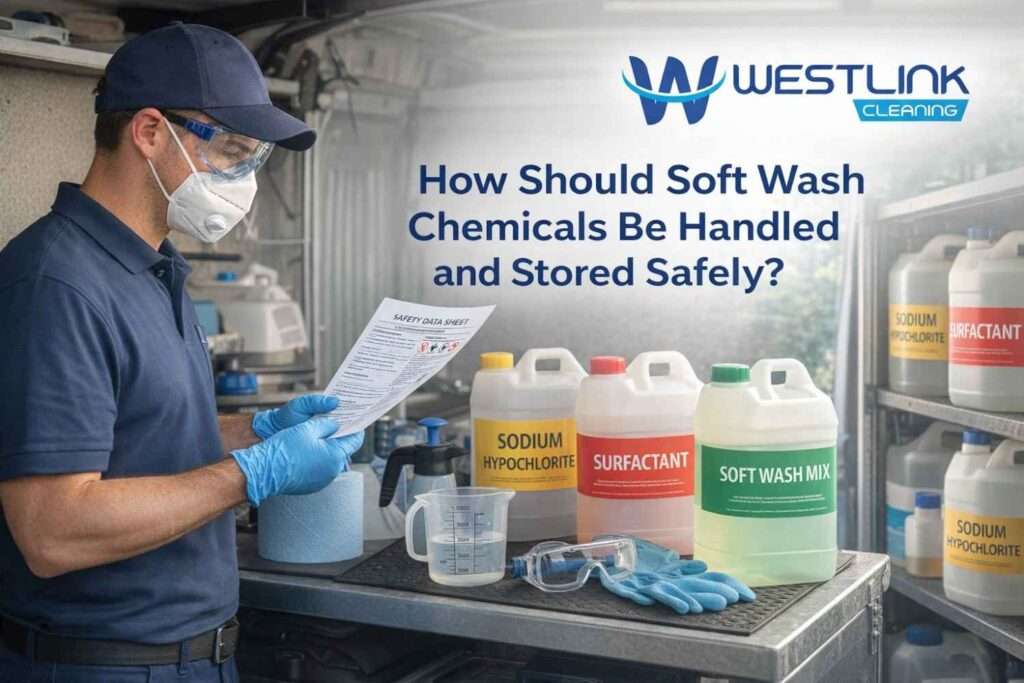
Soft wash chemicals should be handled by reading the label and SDS first, using suitable labeled containers, wearing appropriate PPE, avoiding unsafe mixing, controlling the work area, and storing products sealed in a cool, ventilated, secure location away from heat, sunlight, and incompatible materials.
Safe Work Australia states that safety data sheets must provide information about hazards, safe handling, storage, and disposal, and its hazardous chemicals guidance also stresses suitable containers, storage systems, and signage.
What are soft wash chemicals used for?
Soft wash chemicals are used to treat organic contamination on exterior surfaces that need a low-pressure cleaning method.
In exterior cleaning, these chemicals are commonly used to treat 6 main contamination types:
- mould
- mildew
- algae
- moss
- lichen
- organic staining
These treatments are commonly used on sensitive exterior surfaces, including roofs, rendered walls, painted walls, weatherboards, cladding, fences, and coated facades. The purpose is to remove biological growth and surface buildup with chemical action instead of relying on aggressive pressure.
Why does chemical safety matter in soft washing?
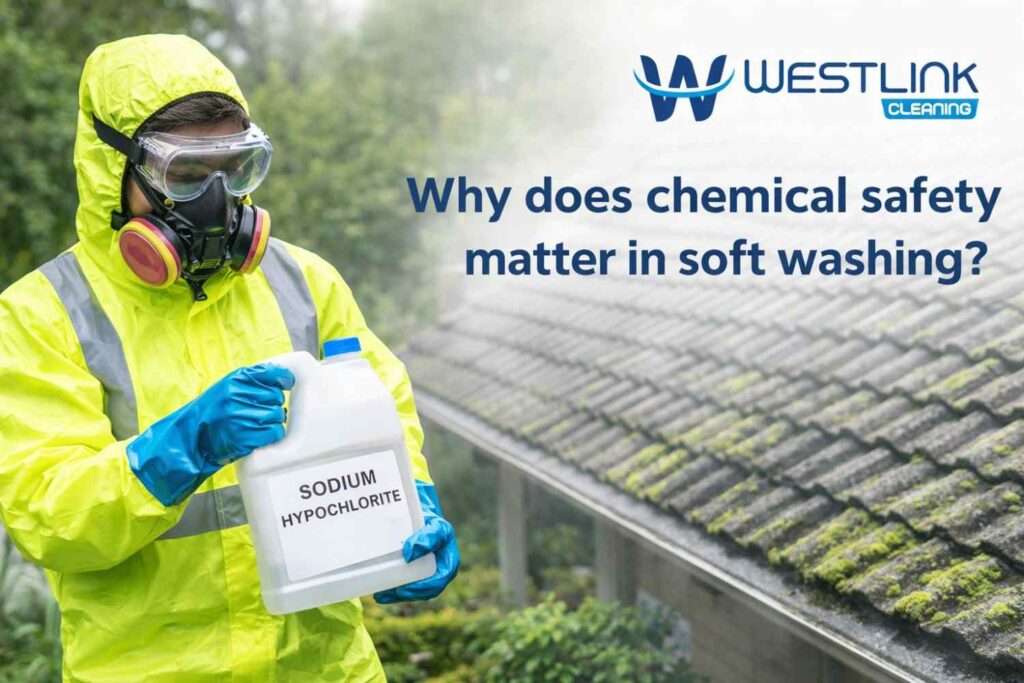
Chemical safety matters in soft washing because the cleaning solution performs most of the treatment work, so any mistake in handling, mixing, transfer, application, transport, or storage can affect safety, surface condition, and service quality at the same time. In other words, the chemical is not a minor part of the job. It is one of the main factors that determines whether the treatment is safe, controlled, and effective. Safe Work Australia states that the handling and storage section of a safety data sheet should explain how to minimise release and exposure, which shows that chemical control is a core part of safe use, not an optional extra.
What does safe handling mean in a soft washing service?
Safe handling means controlling the chemical from preparation to storage through a defined process instead of guesswork.
Safe handling usually includes 8 control points:
- review the product label
- review the SDS
- confirm surface compatibility
- use suitable PPE
- keep containers clearly labelled
- avoid unsafe mixing
- control the work area
- store the product correctly after use
This process matters because the correct method depends on 4 variables:
- product type
- surface type
- weather conditions
- site risk profile
Why must the label and SDS be checked first?
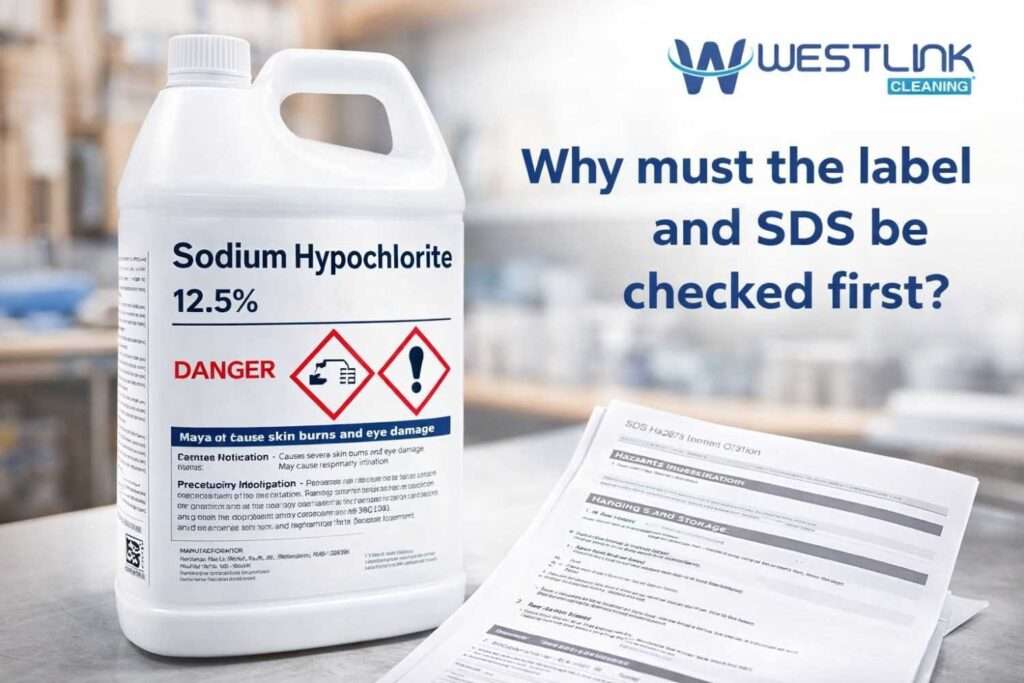
The label and SDS should be checked first because they explain the product hazards, handling requirements, storage conditions, and disposal precautions.
Safe Work Australia states that an SDS must provide accurate information about a chemical’s hazards and how to handle, store, and dispose of it safely. This means the label and SDS are not optional reading. They are primary control documents for workplace chemical use.
Why should soft wash chemicals stay in clearly labelled containers?
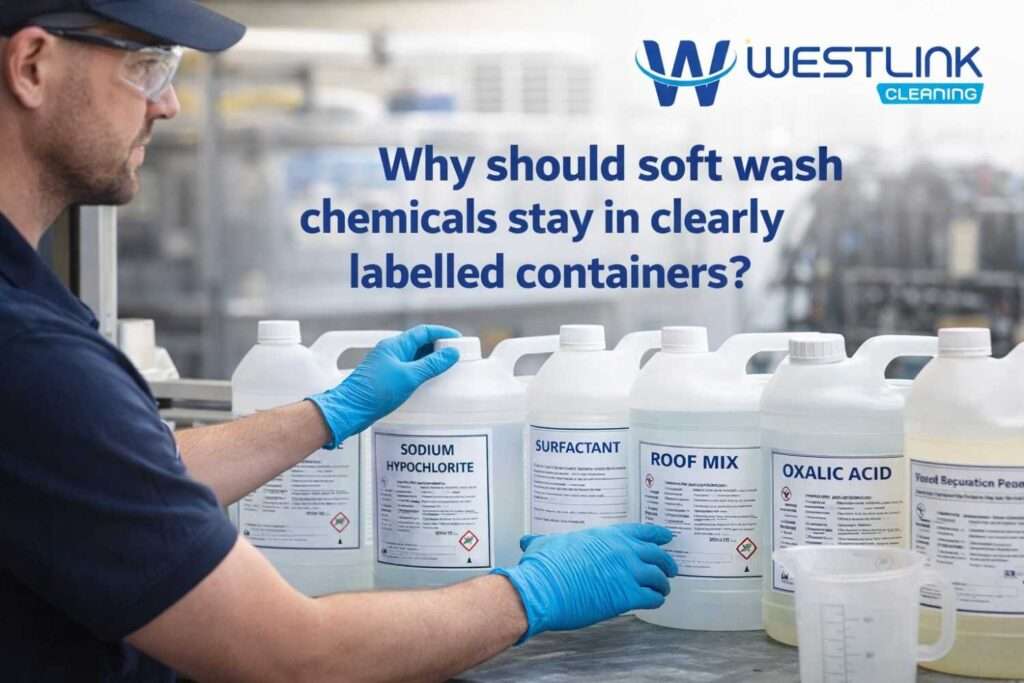
Soft wash chemicals should stay in clearly labeled containers because labels reduce the risk of wrong-product use, unsafe transfer, and accidental exposure.
Safe Work Australia’s hazardous chemical labeling guidance exists because chemical identity and hazard information must remain clear during use, handling, and storage. In practice, this means original manufacturer containers are preferred, and any secondary container must still be suitable, secure, and properly identified.
Why should chemicals never be mixed casually?
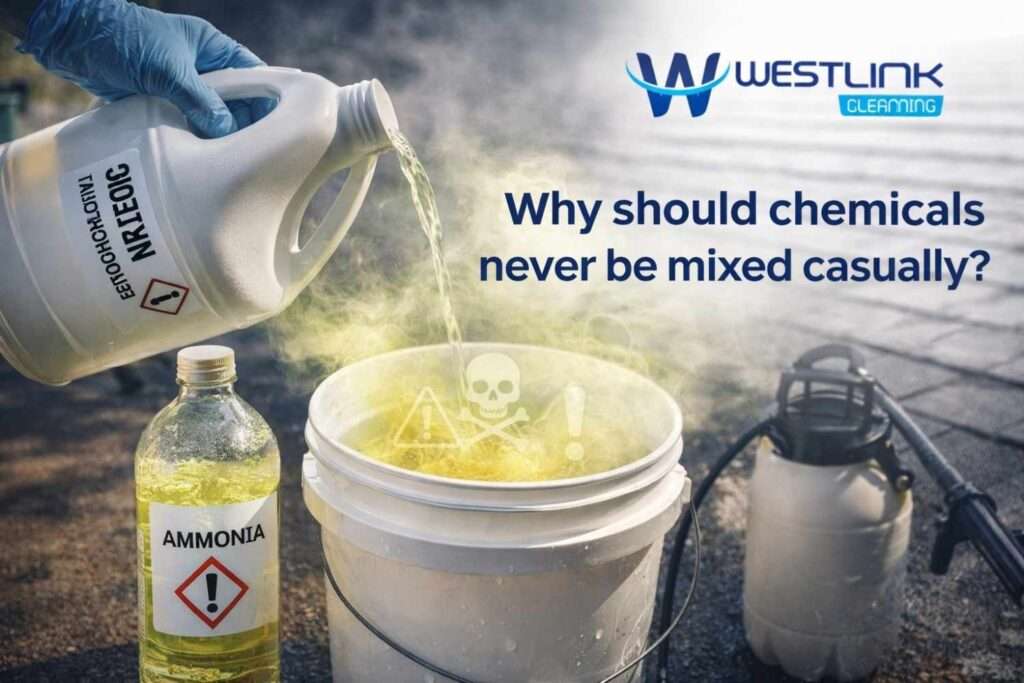
Chemicals should never be mixed casually because incompatible products can create toxic gases, reduce performance, or damage the target surface.
This is especially important for bleach-type products. CDC and ATSDR guidance state that mixing sodium hypochlorite with acids can release chlorine gas, and mixing bleach with ammonia can release dangerous chemicals into the air. In soft washing, this means mixing decisions must follow product instructions and compatibility rules, not habit or trial and error.
Why is PPE required during soft wash chemical handling?
PPE is required because it reduces direct exposure during preparation, transfer, spraying, rinsing, and pack-down.
The PPE requirement depends on the product and task, but the control goal is consistent. It is to reduce risk to the eyes, skin, and breathing zone. Safe Work Australia states that suitable PPE must be selected for the worker and the task, and chemical labelling guidance also refers to protective gloves and eye or face protection where required.
Why must preparation and application happen in a controlled area?

Preparation and application should happen in a controlled area because soft wash chemicals can affect more than the intended surface if drift, splashes, or runoff is not managed properly. Before work begins, the operator should assess the surrounding site, including nearby plants, adjacent surfaces, drainage points, weather conditions, pedestrian access, traffic movement, and ventilation where relevant. This helps reduce unnecessary exposure, protect surrounding areas, and keep the soft washing process safer and more controlled.
Why does transport matter?
Transport matters because unsafe transport can cause leaks, tipping, heat exposure, and container damage before the job starts.
A professional setup should keep containers upright, secure, closed, and separated from tools or loose equipment that could damage them in transit. Chemical safety starts before application. It begins when the product leaves storage.
How should soft wash chemicals be stored safely?
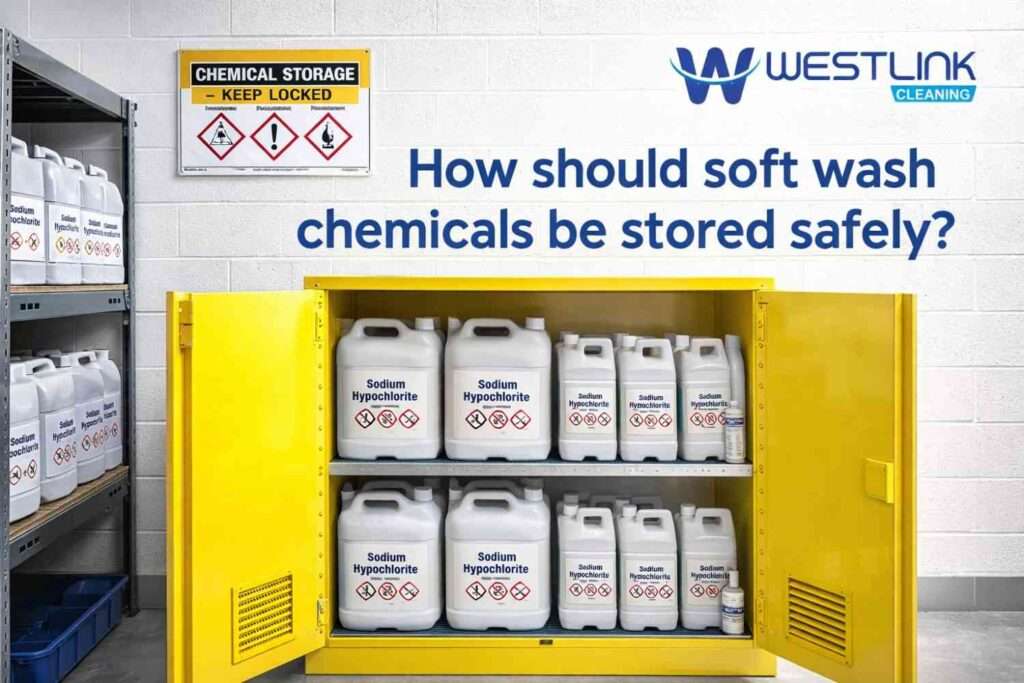
Soft wash chemicals should be stored sealed, cool, dry, ventilated, secure, and separated from incompatible materials.
Safe Work Australia states that storing hazardous chemicals safely includes using appropriate containers, storage and handling systems, and signs. For soft wash chemicals, good storage usually means 8 conditions:
- cool
- dry
- ventilated
- out of direct sunlight
- sealed when not in use
- secure from unauthorised access
- separated from food and drink areas
- separated from incompatible materials
Why must containers stay sealed and secure?
Containers must stay sealed and secure because open or damaged containers increase the risk of spills, contamination, vapor
release, and accidental contact.
Secure storage also limits unauthorised access. That matters in service environments, workshops, and mixed-use storage areas where products can otherwise be knocked over, misused, or handled by the wrong person.
Why must soft wash chemicals be protected from heat and sunlight?
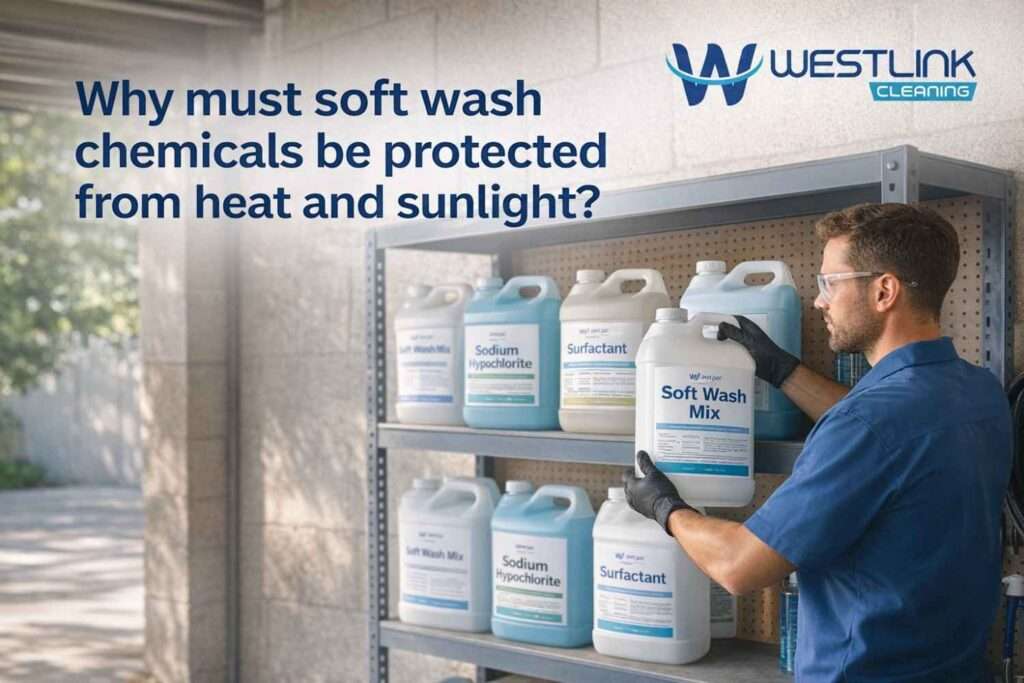
Soft wash chemicals must be protected from heat and sunlight because product stability can decline when sodium hypochlorite solutions are exposed to higher temperatures and ambient light.
A published study on dilute sodium hypochlorite stability states that decomposition is influenced by temperature and light exposure and that stability is improved under cooler conditions and with little to no ambient light exposure. In practical terms, poor storage can reduce reliability and create inconsistent treatment results.
Why does organised storage improve service quality?
Organised storage improves service quality because it reduces errors and makes inspection, stock rotation, and daily handling easier.
An organised storage area helps with 5 routine tasks:
- product identification
- container inspection
- stock rotation
- housekeeping
- spill response
This is not only a safety issue. It is also a service control issue. A disorganised chemical area makes operator error more likely.
What service problems come from poor handling and storage?

Poor handling and storage can weaken results, increase site risk, and create avoidable damage.
Common service problems include:
- inconsistent cleaning performance
- surface marking or discolouration
- equipment contamination
- overspray incidents
- runoff problems
- product waste
- operator error
When chemical control drops, service reliability also drops.
How does safe chemical practice protect exterior surfaces?
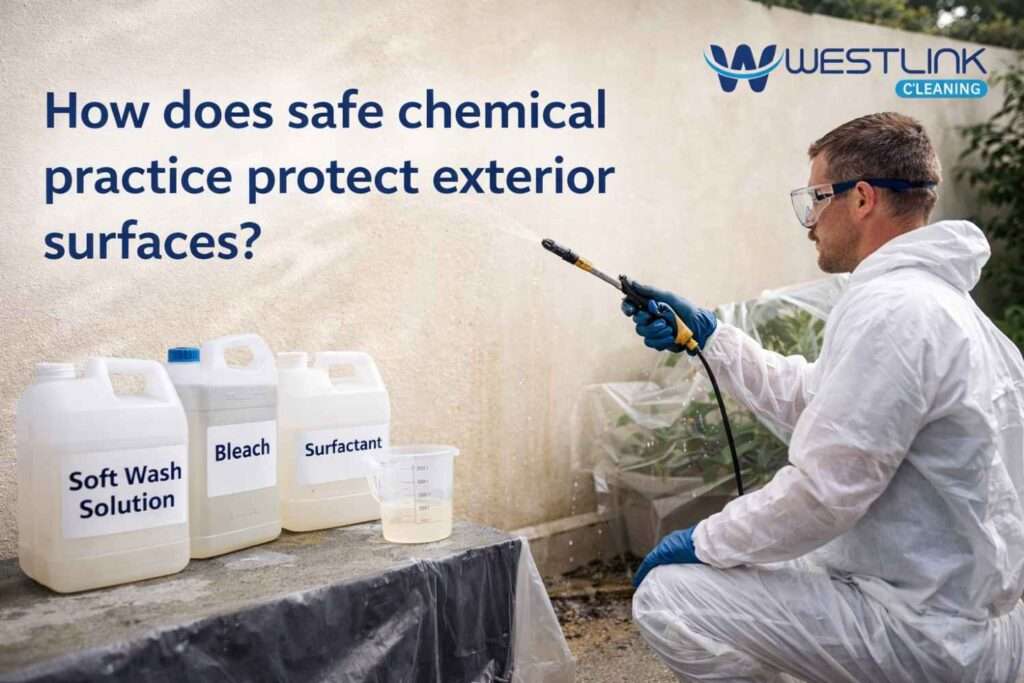
Safe chemical practice protects exterior surfaces because it improves product selection, dilution control, and application accuracy.
This matters for multiple exterior materials, including painted walls, render, roof tiles, weatherboards, cladding, and fences. Surface protection improves when the operator controls 5 variables:
- product choice
- dilution
- dwell management
- application spread
- contact with non-target areas
Soft washing is often selected because it is more suitable for delicate or coated surfaces than aggressive pressure cleaning. That advantage depends on correct chemical management.
Why is professional soft washing safer than DIY chemical use?
Professional soft washing is generally safer than DIY chemical use because trained operators follow a controlled, surface-specific process. This usually includes surface assessment, correct product selection, controlled mixing, labelled handling, PPE use, site protection, runoff awareness, and proper storage after use. In contrast, DIY chemical use often lacks this level of control, which increases the chance of safety issues, application errors, and unreliable cleaning results.
Soft Wash Chemical Safety Control Table
The table below summarises the main control points supported by hazardous chemical guidance, SDS requirements, PPE duties, runoff protection principles, and sodium hypochlorite stability evidence.
| Stage | Required control | Main risk if ignored |
| Product review | Check the label and SDS before use | Wrong handling, wrong storage, wrong response to exposure |
| Container control | Use suitably labeled containers | Misidentification, misuse, transfer mistakes |
| Mixing control | Do not mix incompatible chemicals | Toxic gas release, poor performance, surface damage |
| PPE | Use task-appropriate PPE | Eye, skin, and inhalation exposure |
| Site preparation | Control drains, plants, traffic, and adjacent surfaces | Overspray, runoff, property impact |
| Transport | Keep containers upright, closed, and secured | Leaks, tipping, packaging damage |
| Storage | Store sealed, cool, dry, ventilated, and secure | Product degradation, spills, access risk |
| Housekeeping | Keep storage organised | Handling errors and slower response to incidents |
Conclusion
Soft wash chemicals should never be handled casually because they affect operator safety, surface condition, environmental control, and cleaning performance all at once. A safe soft washing process starts with checking the product label and SDS, then continues through correct container use, PPE, safe mixing practices, controlled application, secure transport, and proper storage. When chemicals are kept sealed, labelled, cool, ventilated, and away from heat, sunlight, and incompatible materials, they remain safer to use and more reliable on the job. In practical terms, good chemical control protects people, protects exterior surfaces, reduces service errors, and helps deliver more consistent soft washing results.
FAQs
1. What chemicals are commonly used in soft washing?
Soft washing commonly uses sodium hypochlorite, surfactants, water, and sometimes neutralisers or rinse aids.
2. Can soft wash chemicals damage exterior surfaces?
Yes, the wrong product, strength, or application method can damage surfaces.
3. Is sodium hypochlorite the same as bleach?
Sodium hypochlorite is the active ingredient in many bleach-based cleaning products.
4. How long can soft wash chemicals be stored safely?
It depends on the product and storage conditions. Heat and sunlight can reduce product strength.
5. Should soft wash chemicals be diluted before use?
Many do, but the correct dilution depends on the product and task.
6. Can soft wash chemicals go into stormwater drains?
No, runoff should be controlled to stop chemicals entering stormwater drains.
7. What PPE is usually required for handling soft wash chemicals?
Common PPE includes gloves, eye protection, protective clothing, and sometimes respiratory protection.
8. Why should soft wash chemicals stay in their original containers?
Original containers keep product identity, hazard warnings, and instructions clear.
9. What happens if soft wash chemicals are stored incorrectly?
Poor storage can cause leaks, spills, contamination, reduced performance, and safety risks.
10. Why is professional handling important in soft washing?
Professional handling improves safety, surface protection, and treatment consistency.