

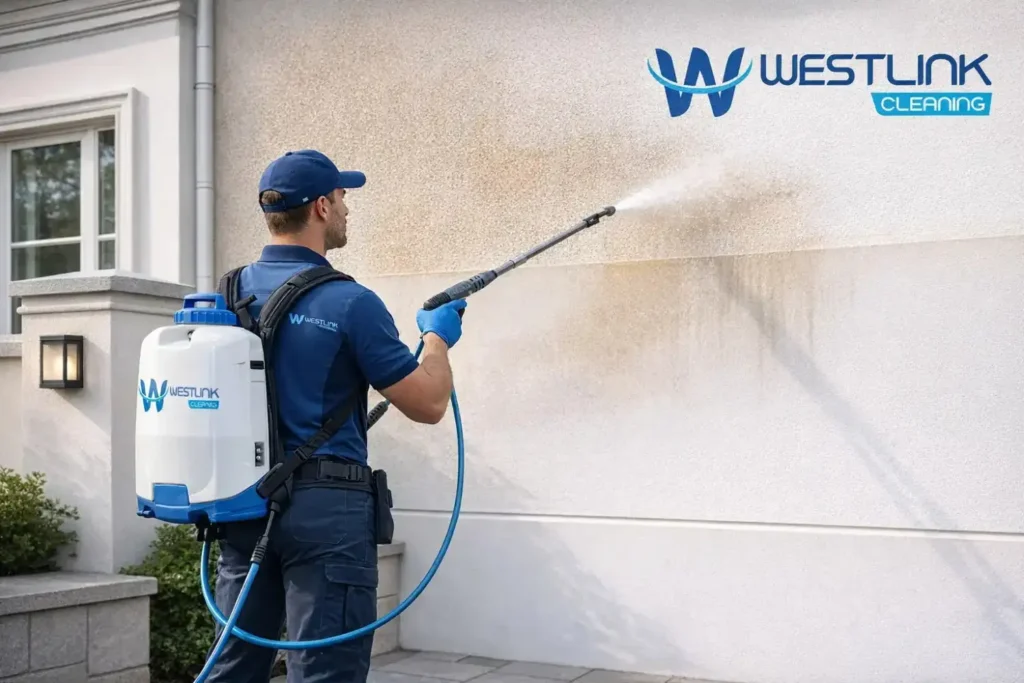
Soft wash wall cleaning is a low-pressure exterior cleaning method that uses water and suitable cleaning agents to remove mould, algae, dirt, staining, and surface grime from render and painted walls without the force of high-pressure washing. It is generally safer for delicate exterior finishes because it relies on chemical action, dwell time, and a controlled rinse instead of aggressive water pressure.
Soft wash wall cleaning for render and painted walls is not just about using less pressure. It also involves understanding how it differs from pressure washing, why render and painted walls need the right treatment, what kinds of contamination it removes, how the method works, what risks need to be avoided, how often cleaning is needed, and how defects such as cracks, peeling paint, or loose render affect the correct cleaning approach.
What Is Soft Washing?
Soft washing is a cleaning method that removes contamination mainly through chemistry rather than force. The cleaning solution is applied to the wall, allowed to sit for a controlled period, and then rinsed away gently. During that dwell time, the solution helps loosen dirt, break down organic build-up, and treat biological growth such as mould, mildew, and algae.
Soft washing is designed for finish-sensitive surfaces. It cleans the wall while reducing the risk of stripping paint, roughening textured render, or forcing water into weak points.
How Is Soft Washing Different from Pressure Washing?
Pressure washing cleans mainly through water force. Soft washing cleans mainly through suitable chemistry, dwell time, surface compatibility, and a gentle rinse.
That difference matters because render and painted walls are not hard, bare surfaces. High-pressure washing can:

- strip paint from weak areas
- roughen textured render
- erode softer finishes
- damage sealant lines and joints
- force water into cracks and weak edges
- leave uneven cleaning marks
Soft washing reduces these risks because the cleaner does most of the work.
Why Does Render Need Special Treatment?
Render is not one single finish. Some walls are cement-based. Some use acrylic texture systems, and some are coated with protective membranes or elastomeric coatings. These surfaces can be porous, textured, flexible, or crack-bridging, so the cleaning method has to protect both the visible finish and the system underneath.
Render also holds dirt and moisture more easily than smoother surfaces. That makes it more likely to develop algae, dark staining, and grime build-up over time. If the render already has hairline cracks, loose sections, or weak edges, harsh cleaning can make those problems worse.
Why Do Painted Walls Need Special Treatment?
Paint is a coating film, not the wall itself. That film has its own condition, age, adhesion, sheen level, and washability. A painted wall may look sound from a distance but still have weak areas where the coating is chalking, peeling, blistering, or losing adhesion.
A stable painted wall can often be cleaned gently and successfully. A failing painted wall needs more caution because cleaning cannot fix coating failure. It can only remove surface contamination.
When Is Soft Washing Suitable?
Soft washing is suitable when the wall is sound and the contamination is mainly removable surface build-up. Good candidates include:
- mould
- mildew
- algae
- dirt
- dust
- cobwebs
- pollution residue
- bird droppings
- light runoff staining
- organic surface grime
It is especially useful on walls that stay damp, shaded, or dirty for long periods.
When Is Soft Washing Not Suitable?
Soft washing is not suitable as the first step when the wall has active defects that need repair. Cleaning does not fix structural or coating problems.
Use caution or delay cleaning when there is:
- peeling paint
- loose render
- open cracks
- failed sealants
- unstable edges
- severe chalking
- deep rust or mineral staining
- moisture-entry points
Some marks are not biological growth. Rust staining, deep mineral deposits, and some runoff marks may need a different treatment.
What Contaminants Does Soft Washing Remove?
Soft washing mainly removes biological growth, deposited soil, and environmental residue. Common examples include:

- mould
- mildew
- algae
- dirt
- dust
- cobwebs
- pollution residue
- organic staining
- runoff marks
- bird droppings
These contaminants do not all behave the same way. Green or black staining is often biological growth. Brown or orange staining may be runoff or rust related. Knowing the stain type helps determine the right cleaner.
How Do Soft Wash Chemicals Work?
Soft wash chemicals work by loosening contamination and helping treat biological growth. Instead of depending on high pressure, the cleaner does most of the work.
A good soft wash solution usually helps in three ways:
- it loosens dirt and surface grime
- it helps break down or treat biological growth
- it makes rinsing easier with lower pressure
There is no single formula that suits every wall. Product choice depends on the coating type, contamination level, age of the finish, nearby materials, and environmental conditions.
What Pressure Is Safe for Render and Painted Walls?
The safest pressure is the lowest pressure that can rinse the wall effectively after the cleaner has done its work.
Safe pressure use depends on:
- stand-off distance
- spray angle
- fan pattern
- coating condition
- whether the wall is textured or smooth
A wide fan pattern is safer than a concentrated jet. More distance is safer than spraying too close. If the cleaner is correct and has enough dwell time, the rinse does not need to be aggressive.
What Should Be Checked Before Cleaning Starts?
Inspection should always happen before spraying begins. Look for:
- peeling paint
- chalking
- cracks
- loose render
- failed sealants
- open joints
- rust marks
- heavy shade
- persistent wetness
- blocked drainage points
- staining below sills and caps
This helps separate simple dirt problems from repair problems.
What Preparation Is Needed Before Soft Washing?
Preparation protects the building and improves consistency. Before cleaning starts:
- remove loose dust and debris
- move or protect nearby items
- protect trims and fixtures
- wet nearby plants if needed
- test a small hidden area
- work in manageable sections
- avoid overheated wall surfaces
Good preparation prevents patchy results and accidental damage.
How Does Soft Wash Wall Cleaning Work Step by Step?

- Identify the wall type and coating condition.
- Inspect for cracks, peeling paint, loose render, and moisture-entry points.
- Protect nearby plants, trims, fittings, and sensitive surfaces.
- Test the cleaner on a small hidden area.
- Apply the cleaning solution evenly in manageable sections.
- Allow the solution to dwell for the required time.
- Lightly agitate stubborn areas only if needed.
- Rinse with a wide fan at low pressure.
- Allow the wall to dry fully.
- Reinspect the wall and separate remaining stains from repair issues.
How Long Does the Surface Take to Dry?
Drying time depends on:
- porosity
- weather
- airflow
- wall orientation
- texture level
- how much water the wall retains
Textured render usually takes longer to dry than smoother painted walls. Shaded walls also stay wet longer than walls in direct sun and airflow.
What Aftercare Helps Keep the Surface Clean Longer?
Cleaning does not stop regrowth by itself. Useful aftercare includes:
- keeping gutters and flashings clear
- trimming back foliage
- reducing leaf build-up
- monitoring shaded areas
- checking joints and sealants
- cleaning before heavy build-up becomes embedded
The cleaner the environment stays, the slower contamination tends to return.
How Often Should Render and Painted Walls Be Cleaned?
There is no single interval that suits every building, but annual inspection and cleaning is a strong baseline for many exterior walls, especially where dirt, moisture, and organic growth build up over time.
More frequent cleaning may be needed where walls are:
- shaded for long periods
- exposed to heavy rain splash
- close to trees
- near busy roads
- in coastal locations
- in polluted urban areas
- prone to mould or algae regrowth
What Signs Show That a Wall Needs Cleaning?
Common signs include:
- green or black biological staining
- dark runoff lines
- dirt bands in sheltered areas
- dull colour
- spider webs and insect residue
- surfaces that stay damp longer than surrounding areas
These signs often appear before more obvious maintenance issues develop.
What Happens If High Pressure Is Used?
High pressure can damage the finish faster than it removes contamination.
On render and painted walls, excessive pressure can:
- strip paint
- roughen textured finishes
- erode weak areas
- break sealant lines
- force water into cracks
Sometimes the damage is not obvious immediately. The wall may look fine at first but perform worse later.
What Happens If the Chemical Choice or Dilution Is Wrong?
Incorrect chemical choice creates both surface risk and safety risk.
If the mix is too weak:
- contamination may remain
- the operator may over-rinse with pressure
- results may look uneven
If the mix is too strong or incompatible:
- colour may be affected
- coatings may be damaged
- paint films may weaken
- nearby plants may be stressed
- user safety risks may increase
Can You Soft Wash Render and Painted Walls Yourself?
DIY cleaning is only suitable for simple, low-risk situations. Small accessible areas with light soiling and stable finishes can sometimes be cleaned carefully.
DIY becomes a poor choice when there are:
- high elevations
- heavy mould or algae build-up
- peeling paint
- loose render
- open cracks
- uncertain chemical compatibility
The more sensitive the wall, the more important inspection and method control become.
What Are the Best Practices for Soft Washing?
- inspect before cleaning
- match the cleaner to the material
- use the least pressure needed
- work in sections
- allow proper dwell time
- rinse fully
- protect nearby surfaces and plants
- do not clean over defects that need repair
Good soft washing is controlled cleaning, not forceful cleaning.
What Mistakes Should Be Avoided?
- using high pressure on coated walls
- skipping the inspection
- cleaning over cracks, peeling paint, or failed joints
- using an untested cleaner
- letting product dry on the surface
- ignoring dwell time
- ignoring runoff and plant protection
- treating all stains as if they are the same
Which Is Better: Soft Washing or Pressure Washing?
| Method | Water Pressure | Surface Suitability | Risk Level | Best Use Case | Potential Damage Risk | Skill Requirement |
| Soft washing | Low | Render, painted walls, coated exterior finishes | Lower | Organic growth, light-to-moderate grime, maintenance cleaning | Lower when chemistry is compatible | Moderate |
| Pressure washing | Medium to high | More durable hard surfaces | Higher | Heavy dirt on robust surfaces | Higher on coatings and textured finishes | Moderate |
| High-pressure blasting | High | Poor choice for sound render and painted walls | High | Generally unsuitable for delicate wall finishes | Very high | High |
For render and painted walls, soft washing is usually the safer and more appropriate choice.
Conclusion
Soft washing is usually the correct cleaning method for sound render and painted walls because it relies on compatibility and control rather than force. Its success depends on the right cleaner, low pressure, correct dwell time, full rinsing, and a wall surface that is still intact.
Where cracks, peeling paint, loose render, or moisture defects are present, inspection and repair should come before cleaning becomes the main task.
Frequently Asked Questions
1. Does soft washing strip paint?
Ans. Not usually. Soft washing is designed to reduce stripping risk compared with aggressive pressure washing.
2. Can soft washing fix chalking paint?
Ans. No. Chalking is coating breakdown, not just surface dirt.
3. Is render cleaning the same as painted wall cleaning?
Ans. No. Both need gentle cleaning, but render and paint films have different sensitivities.
4. How often should painted exterior walls be cleaned?
Ans. That depends on exposure and contamination build-up. Shaded, coastal, and polluted areas usually need more frequent cleaning.
5. Can soft washing remove mold from render?
Ans. Yes, if the render is sound and the cleaner is suitable.
6. Can soft washing remove algae from painted walls?
Ans. Yes, in many cases. The result depends on coating condition, stain severity, and correct chemical choice.
7. Is high pressure safe for painted walls?
Ans. Usually no. High pressure increases the risk of stripping paint and forcing water into weak points.
8. What is the biggest mistake with rendered walls?
Ans. Using too much pressure and treating render like a hard bare surface.
9. Should cracks be repaired before cleaning?
Ans. Yes. Cleaning should not replace inspection and repair.
10. Why does contamination come back after cleaning?
Ans. Because moisture, dirt, shade, and poor maintenance still support regrowth.


