

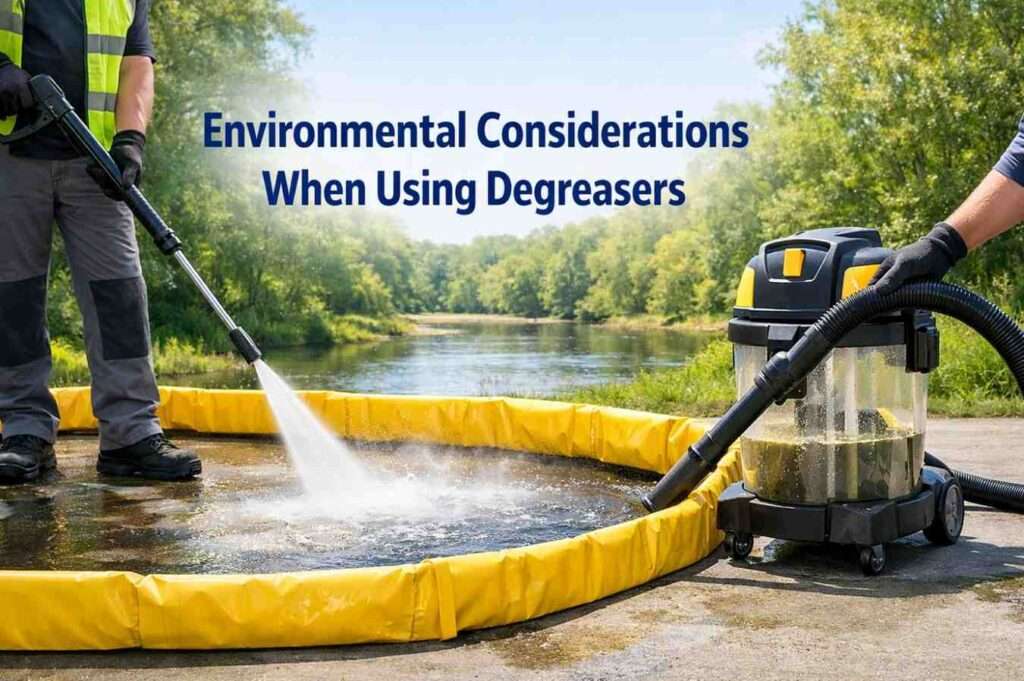
Environmental considerations when using degreasers come down to one thing: where the dirty rinse water goes. Degreasers lift oil so it can move with rinse water, which raises runoff risk. The safe approach is to prevent flow, contain it, capture wastewater, and use oil separation or pre-treatment before disposal. Never let wash water reach stormwater. Dispose of through an approved pathway, such as sewer with permission or licensed pump-out.
Degreasers feel simple, but they can turn a small oil patch into a wider pollution problem. On active wash sites, crews often see oil “travel” the moment rinsing starts, especially on sloped concrete near a pit. That is why runoff control matters more than the brand of chemical.
This guide explains why degreasers increase runoff risk in pressure washing, the key stormwater vs sewer mistake, and a simple control method: prevent, contain, capture. It covers real-site wastewater capture for driveways, car parks, and loading docks, what oil-water separators can and cannot do, safe disposal options, how dilution, dwell time, heat, and flow rate change risk, and what records to keep if runoff escapes.
Why Degreasers Raise Environmental Risk During Pressure Washing
Degreasers boost cleaning power but create polluted wastewater that harms waterways if not controlled. Types like alkaline, solvent-based, citrus, and surfactant-based dissolve hydrocarbons and grease. This forms emulsified or free oil in rinse water. Suspended solids mix in, too. Without capture, this enters stormwater and causes an oil sheen or toxicity.

On active wash sites, crews often see greasy loading docks near stormwater pits. Degreasers with high pH or dwell time loosen contaminants fast. But hot water speeds this up. Research shows surfactants increase toxicity to aquatic life by damaging gills and reducing oxygen. For instance, studies on surfactant wastewater highlight LC50 values showing harm at low levels. Another review notes surfactants from cleaning persist in water, aiding pollutant spread.
Risks grow with volume. High flow rates (GPM) create more wastewater. Nozzle choice affects the spray. To learn about PSI and flow rates for power washing, check the basics. Poor control leads to slips or incidents. Focus on prevention to cut these risks.
Stormwater vs sewer: the one mistake that causes most incidents
Most incidents happen when wash water reaches stormwater. Stormwater systems often flow to creeks, rivers, and the ocean with little or no treatment, so pollutants move fast and spread far. That is why councils and regulators treat wash water, detergents, and oily runoff as a pollution risk.

Many councils spell it out for pressure cleaning. One example is Toowoomba Regional Council, which states it is unlawful to allow wastewater from pressure cleaning to enter roadside gutters and stormwater systems, and it notes significant fines apply under Queensland law. Even if you work elsewhere, the risk logic is the same: do not discharge to stormwater.
Good operators plan for “where water goes” before they spray. A simple way to start is to identify every pit, gutter, downpipe, and flow path, then set up control gear before chemicals hit the ground. If you want a plain explanation of power washing vs pressure cleaning, so teams use the right method and volume, link your crew to power washing vs pressure cleaning as a quick refresher.
Stormwater vs sewer comparison table
Stormwater and sewer are not the same system. Use this table in your training and pre-start checks.
| Topic | Stormwater | Sewer (sanitary sewer) |
| Main purpose | Carry rainwater away | Carry wastewater to treatment |
| Typical destination | Local waterways | Treatment plant |
| Can you send pressure wash water here? | No, this is where most pollution incidents happen | Only if allowed and controlled |
| Main risk with degreasers | Oil sheen, chemical harm, and spread of pollution | Blockages, treatment upset, trade waste non-compliance |
| Your control goal | Keep wash water out, always | Discharge only via approved pathway with pre-treatment when required |
Councils and water authorities often treat oily wash water as trade waste and set conditions. Trade waste controls commonly focus on pre-treatment, limiting pollutants, and keeping stormwater out of sewered wash bays.
Field observations show sites near stormwater pits face high risks. A greasy car park wash can send oil directly to drains. Regulators like the EPA ban this for industrial cleaning. In Australia, councils like Sydney enforce rules against stormwater entry. See stormwater pollution guidance for outdoor cleaning for details.
The Runoff Control Triangle: Prevent, Contain, Capture
Runoff control works best when you use three steps in order: prevent, contain, and then capture. Prevention reduces how much dirty water you create, containment keeps it inside the work zone, and capture removes it so it cannot escape. If you only do one step, you leave gaps.

Prevent means you remove as much soil as possible before you rinse. Prevention starts with product choice. Use low-foam degreasers. Dilute per SDS. Short dwell time reduces rinse needs. Hot water versus cold water power washing affects this—hot water cuts grease faster, reducing the volume. Weather checks help: avoid rain to prevent spread.
Contain means you block the pathways water uses. Use drain covers, berms, bunding, booms, or silt socks to stop flow to gutters and pits. Portable berm systems and containment mats are a common industry method for keeping wash water inside a defined zone.
Capture means you physically remove the wastewater. Use a wet vac, sump pump, or recovery vacuum into an IBC tank or holding tank, then manage solids and oil before disposal. Vacuum recovery surface cleaners can reduce splash and help collect water as you clean.
Wastewater Capture Methods That Work on Real Sites (Driveways, Car Parks, Loading Docks)
Practical capture methods like vacuum recovery and berms handle degreaser wastewater on sites like driveways and car parks. Vacuum systems suck up water fast. Berms create pools for pumping. These fit mobile workflows.

For a loading dock, block drains first. Use drain covers. Then the berm edges. Apply degreaser. Rinse with controlled flow. The vacuum collects the mix. On driveways, surface cleaners reduce overspray. Power washing surface cleaners help here—they spin water inward.
Field-tested tools include wet vacs for small jobs. Sumps for larger. Filtration bags remove solids. For choosing nozzles and lances for power washing, pick wide angles to cut splash. These methods keep sites compliant.
Larger car parks need zones. Divide areas. Capture per section. This avoids overload. Always have spill kits ready.
Oil-water separators: what they do, what they cannot do
Oil-water separators help by removing free oil, not by making wastewater “safe” by default. Many separators rely on gravity and coalescing media to bring oil droplets together so oil can rise and be collected. They work best when the flow is steady, and the oil is not heavily emulsified.

Separators struggle when surfactants create stable emulsions. When degreasers break oil into tiny droplets, oil can stay suspended and pass through basic separation, which is why oily wastewater treatment often uses more than one step. Reviews of oily wastewater treatment describe multiple technologies because oil can appear in different forms.
Wash bays and trade waste programs often require pre-treatment and good design. Trade waste guidance commonly points to wash bays being sealed and bunded, with controls to keep stormwater out, and with rules around what can enter the sewer. Guidance documents for wash bay and equipment cleaning discuss bunding, roofing, and controlled discharge, plus off-site handling for certain wastes like spent solvents.
Separator performance depends on maintenance and records. If oil is not pumped out, solids build up, and the unit stops working as intended, you risk non-compliance and poor discharge quality. That is why many trade waste documents stress design, upkeep, and controlled discharge conditions.
Safe disposal pathways: sewer with approval, pump-out, and licensed disposal
Safe disposal means you use a pathway that is allowed and controlled. In many places, sewer acceptance is not automatic because water authorities manage what goes into the system to protect pipes and treatment plants. Trade waste programs exist for this reason.

Sewer disposal may be possible only under certain conditions. Water authority and council trade waste documents often describe wash bay requirements like bunding and roofing, keeping stormwater out, and using pre-treatment equipment before discharge. In simple terms, you may need approval, and you often need pre-treatment like an oil-water separator or similar device.
Pump-out disposal reduces risk when sewer discharge is not approved. If you cannot legally discharge to sewer, capture wastewater into a tank, and arrange licensed removal and disposal. This method also helps when the job is mobile, such as a car park wash or loading dock clean.
Solids and sludge need controlled handling, too. Settled grit, oily sludge, and absorbents can hold pollutants, so bag them, label them, and send them through the right waste stream. Oily wastewater treatment reviews highlight that oil and grease removal often uses multiple steps and generates residues that need proper management.
Product Choice and Dilution: How to Reduce Harm Without Losing Cleaning Power
Choosing degreasers and diluting them right reduces environmental harm while keeping cleaning power in pressure washing. Pick surfactant-based or citrus types over solvents. They break down better. Dilute per SDS to cut the concentration.

Alkaline degreasers work on heavy grease. But high pH risks corrosion. Citrus options are milder. Pressure washing chemicals guide selection. Research shows surfactants pose toxicity but biodegrade if chosen well.
Dilution lowers runoff strength. Test on small areas. Dwell time matters—longer means less rinse. This cuts volume. Balance power and safety.
Weather, Slope, and Flow Rate: Why Volume Control Matters (PSI vs GPM)
Weather, slope, and flow rate control wastewater volume in degreaser pressure washing, reducing escape risks. Rain spreads runoff. Slopes speed flow. High GPM creates excess.

Check the weather first. Dry days help containment. On slopes, berm downhill. Flow rate (GPM) trumps PSI for volume. Understanding PSI GPM cleaning power explains this. Low GPM nozzles cut water.
How temperature affects power cleaning ties in—hot boosts efficiency, lowering GPM needs. Field crews map slopes. Adjust for control.
Risk event and control table
This table helps supervisors explain risk in one minute. Keep it on the job sheet.

| Risk event | Common triggers | Likely impact | Controls | Proof and records |
| Wash water enters the stormwater | No drain covers, slope to pit, too much water, rain, poor edge control | Pollution complaint, fines, cleanup cost, brand damage | Prevent solids, contain edges, capture with vac, block drains, stop work if control fails | Site photos, setup photos, equipment checklist, and incident log |
| Separator overload or failure | High surfactant degreaser, high flow, no maintenance | Oil passes through, non-compliant discharge | Reduce chemical, slow flow, staged settling, and clean separator | Maintenance log, pump-out dockets, inspection notes |
| Unsafe discharge to sewer | No approval, no pre-treatment, high oil load | Blockages, enforcement, shutdown | Confirm allowed path, use wash bay controls, pre-treat | Approval records, trade waste docs, discharge logs |
| Slip hazard and public risk | Overspray, dirty film, no signage | Injury, claims, rework | Use surface cleaner, control nozzle, signage, and barriers | Safety checklist, photos, toolbox talk notes |
Councils and regulators highlight that wastewater from cleaning should not enter stormwater drains, and some councils cite penalties and fines.
Records and Proof: How to Document Compliant Disposal and Avoid Disputes
Records like waste dockets and checklists prove compliant disposal in pressure washing, avoiding disputes. Log degreaser use, volumes, and methods. Photo sites before and after.
Keep SDS copies. Note approvals. For sewer, save permits. Licensed hauls need dockets. Basic risks of pressure cleaning surfaces include record tips.
Field observations show regulators ask for proof. Digital apps help. This builds trust with owners.
What to Do If Runoff Escapes (Simple Incident Response Steps)
If runoff escapes during degreaser pressure washing, stop work, contain the spread, notify authorities, and clean up fast. Block further flow. Use absorbents.
Assess impact. Report to the council if needed. In Sydney, contact the water authority. Document steps. Safety basics for DIY pressure cleaning aid response.
Follow up with better controls. This limits damage.
Where Will the Wash Water Go? (Decision Tree)

- Is the site sloped toward stormwater? → Yes: Use berms and covers first.
- No: Check sewer access.
- Can you get sewer approval? → Yes: Pre-treat with separator, discharge.
- No: Capture all for pump-out.
- Volume over 100L? → Yes: Use a licensed contractor.
- No: Store in IBC, settle.
- Rain forecast? → Yes: Delay job.
- No: Proceed with capture.
Councils often warn that even small amounts of dirty water entering stormwater can trigger enforcement or fines.
Pre-Start Runoff Control Checklist for Pressure Washing Crews
- Map drains and slopes.
- Check the weather forecast.
- Prepare berms, covers, and vacs.
- Dilute degreaser per SDS.
- Test nozzles for low overspray.
- Have spill kits and signage.
- Confirm disposal path.
- Log start details
FAQs: Frequently Asked Questions
1) Can I let the degreaser rinse water go into a storm drain?
No, you should not let it enter stormwater. Stormwater often flows straight to waterways, and councils treat wash water as a pollution risk. Set up containment and capture before you rinse.
2) Is “biodegradable” safe to discharge outside?
No, “biodegradable” does not mean “safe to discharge.” The rinse water still carries oil, metals, and solids, and it can still harm waterways. Capture and dispose of through an approved path.
3) Do I need an oil-water separator for pressure washing?
You may need one if you discharge to sewer under controlled conditions and your wash water contains oil. Separators help with free oil, but they do not solve every case, especially when oil is emulsified by surfactants. Match the system to your waste stream.
4) What is the simplest way to capture pressure washing wastewater?
The simplest way is to contain the area with berms and drain covers, then use a wet vac or recovery vacuum to pull water into a tank. Vacuum recovery surface cleaners can help reduce splash and collect water as you clean.
5) Can I send wash water to the sewer?
Sometimes, but only under rules and conditions. Many water authorities treat this as trade waste and may require wash bay controls and pre-treatment. If you do not have approval, use pump-out and licensed disposal.
6) What contaminants are in degreaser wash water?
Degreaser wash water can carry oil, grease, suspended solids, and sometimes metals from traffic areas. It can also carry surfactants that keep oil mixed in water. That mix is why capture and treatment matter.
7) How do hot water and dwell time change runoff risk?
Hot water and longer dwell can lift more oil faster, which can create more oily rinse water that must be captured. Hot surfaces can also dry fast and tempt crews to add more rinse water. Work in small sections and keep recovery running.
8) What tools reduce overspray and runoff the most?
Surface cleaners reduce splash and keep water on the ground, and recovery vac systems remove wastewater as it forms. Drain covers and berms stop water from reaching pits and gutters. Use them together for the best control.
9) What proof should I keep after disposal?
Keep photos of your containment setup, photos of recovery in use, and disposal dockets or pump-out receipts. Keep separator maintenance logs if you use one. A simple proof can prevent disputes.
10) What should I do if a neighbour reports me?
Stay calm and show your controls and records. Photos of drain covers, berms, and recovery gear help, and disposal records help too. The best defence is a repeatable process that prevents runoff in the first place.


