

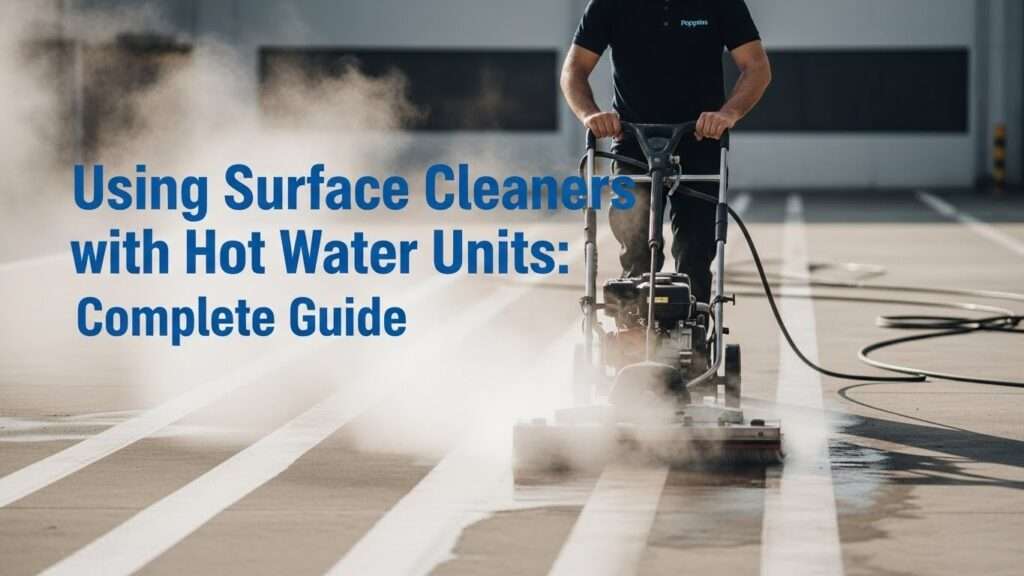
Surface cleaners pair effectively with hot water pressure washer units when the equipment matches in pressure, flow rate, and temperature ratings. The heated water reduces the viscosity of oils and grease, speeds emulsification, and cuts the dwell time needed for soil removal. This combination excels on large flat areas like car parks, warehouse floors, loading docks, and workshops where heavy grease, oil stains, algae, and embedded dirt build up over time. Operators achieve faster cleaning, better results, and often reduced chemical use compared to cold water alone.
Key Takeaways
- Hot water accelerates grease and oil removal by lowering viscosity and improving detergent action.
- Always verify the surface cleaner’s temperature rating (typically 60–100°C maximum) before connecting to a hot water unit.
- The setup shines on large concrete areas with petroleum-based soils.
- Proper nozzle sizing and flow balance prevent rotation issues and maintain performance.
- Safety demands full PPE, burn awareness, and runoff control on big jobs.
This guide explains surface cleaner mechanics, the role of heat in cleaning physics, correct equipment pairing, ideal applications on car parks and warehouses, surface compatibility, a step-by-step workflow, troubleshooting, safety essentials, efficiency strategies, and answers to common questions.
Read More In Detail: Hot Water VS Cold Water Power Washing
How Surface Cleaners Work

Surface cleaners use a rotating spray bar or rotary arm inside a hooded housing to deliver consistent high-pressure water across a wide path. Multiple nozzles mounted on the arm spin rapidly from the water force, creating mechanical agitation while the skirt contains the splash. A swivel connects the trigger gun or lance, and bearings allow smooth rotation.
The operator pushes or pulls the unit like a lawnmower. Water exits the nozzles at an angle, hitting the surface evenly. This design prevents zebra striping common with wand work and reduces operator fatigue on large areas. Most models clean 30–60 cm wide paths, though professional units reach 90 cm or more.
Key components include quick-connect fittings, a trigger gun for flow control, and a durable skirt that traps water and debris. Vacuum-port models add recovery capability for indoor or environmentally sensitive jobs.
Read More In Detail: High-Pressure Cleaning
Step-by-Step Workflow for Using a Surface Cleaner with Hot Water

A practical, safety-first guide that explains how to use a surface cleaner with a hot water pressure washer. It covers pre-checks, compatibility, test patching, detergent pre-treatment, correct overlap passes to avoid streaks, edge work, rinsing, and proper cool-down shutdown for longer equipment life and consistent results.
Step 1: Inspect the equipment before you even start the engine
A quick pre-start check to spot worn hoses, leaking fittings, damaged skirts, or clogged nozzles before hot water and pressure turns small issues into breakdowns or streaky results.
What to check
- Hoses and fittings:
Look for cuts, bulges, soft spots, loose crimps, and weeping at couplers. Hot water makes weak hoses fail faster. - Surface cleaner skirt:
If the skirt is torn or stiff, you lose suction control, and you will spray slurry everywhere. - Swivel and bearings:
Spin the bar by hand (unit off). It should rotate smoothly with no grinding. A sticky swivel causes slow rotation and zebra striping. - Nozzles and spray bar:
Confirm both tips are the same size and not partially blocked. One clogged tip makes the bar wobble and leaves “half-cleaned” arcs. - Trigger gun and wand:
Confirm the trigger returns cleanly and the safety lock works.
Why it matters
Most “hot water problems” are really flow restriction problems. A small blockage reduces flow, reduces rotation speed, and makes heat concentrate longer on the surface.
Step 2: Verify compatibility
Confirm your surface cleaning matches the machine’s flow rate, pressure, and temperature rating so it spins correctly, cleans evenly, and avoids damage to the tool or the surface.
- Minimum flow (LPM or GPM):
If your machine is under the minimum, the bar will not maintain consistent RPM. That is the fastest way to get streaks. - Max temperature rating:
Many residential or light-duty surface cleaners are not designed for sustained high temperatures. - Pressure rating:
Keep the washer within the surface cleaner’s rating.
Quick rule of thumb
- Flow controls cleaning speed and rotation stability.
- Pressure controls how aggressively you can cut grime, but also how easily you can etch concrete.
Step 3: Prep the area like a pro
Clear loose debris, plan runoff, and protect nearby areas so grit does not scratch the surface, dirty water does not re-soil cleaned sections, and the job finishes faster with a more even result.
- Sweep or blow off loose grit
(sand, stones, mulch). Grit under the skirt acts like sandpaper and can leave circular scuffs, especially on softer concrete, coatings, or pavers. - Pre-wet nearby landscaping
If runoff might touch plants. - Plan runoff direction
So you are not pushing dirty water back onto cleaned sections.
Step 4: Do a test patch the right way
Start on a small hidden spot using cold water first, then slowly add heat to confirm safe temperature, stable rotation, and an even finish without streaks, etching, or surface damage.
How to test
- Choose a low-visibility area.
- Start with cold water at normal pressure and confirm:
- The bar spins smoothly.
- No leaks.
- The finish looks even (no “tiger stripes”).
- The bar spins smoothly.
- Increase the temperature gradually in steps while watching:
- Surface response (softening, colour change, hazing).
- How fastdoes grime release?
- Whether runoff turns milky (common with oils and detergents).
- Surface response (softening, colour change, hazing).
Why cold first
Cold start reduces thermal shock, especially on:
- Painted or coated concrete
- Asphalt
- Fresh concrete
- Pavers with jointing sand or polymeric sand
How Hot Water Units Change the Cleaning Outcome

Heat transforms cleaning physics. Cold water relies mainly on pressure and mechanical force. Hot water adds thermal energy that lowers oil and grease viscosity, allowing faster penetration and emulsification.
Grease thickens in cold conditions and resists removal. At 60–80°C, viscosity drops sharply, letting soils lift with less dwell time and lower chemical concentrations. Biofilms and algae also release faster as heat disrupts their structure.
Studies show temperature increases cleaning speed 30–50% on petroleum soils. Heat activates alkaline detergents better and improves rinsing by reducing surface tension. The result: cleaner surfaces in fewer passes.
Setup and Pairing: Matching Equipment Correctly

Successful pairing starts with matching specifications.
Hot water units produce pressure (PSI/bar) and flow (GPM/LPM) similar to cold units, but the burner coil adds a slight flow restriction. Check the surface cleaner’s minimum flow requirement; most need 8–15 LPM for proper rotation.
Nozzle sizing matters. Larger orifices maintain pressure when flow increases. Undersized nozzles cause excessive pressure spikes and slow rotation. Oversized ones drop pressure and weaken cleaning.
Hose ratings must handle temperature. Standard hoses fail above 60°C; use rated hot-water hoses (often red or marked 100°C+).
Pro insight: Many operators overlook coil back-pressure in hot units. Increase the nozzle orifice size by one step compared to the cold water setup to restore balance.
Connect using quick-connects. Start the unit in cold mode, verify rotation, then engage the burner once flow stabilises.
Best Use Cases for Large Flat Areas with Hot Water Units

Car parks accumulate oil drips, tyre marks, gum, and atmospheric dirt. Hot water melts and emulsifies petroleum residues that cold water leaves behind. A 50 cm surface cleaner with an 80–90°C unit clears 500 m² per hour on heavy soils.
Warehouse floors and loading docks see forklift traffic, grease spills, and pallet debris. Heat cuts through hydraulic oil and food-grade lubricants quickly, restoring slip resistance.
Workshop floors with machining oils and swarf clean faster with heat, reducing chemical volumes needed for compliance.
Food processing areas gain hygiene advantages from the thermal sanitising effect, though they always follow site protocols.
Read More In Detail: Commercial Flooring Types Explained
Surface Compatibility Guide for Hot Water Surface Cleaning

A practical reference that shows which surfaces can safely handle hot water surface cleaning, including recommended temperature ranges and key risks like etching, sealer softening, paint lift, grout erosion, asphalt softening, and timber damage.
| Surface Type | Hot Water Suitable | Recommended Temperature | Notes / Risks |
| Unsealed Concrete | Yes | 60–95°C | Excellent for grease; minimal etching risk |
| Sealed/Epoxy Concrete | Caution | Max 70°C | Test patch; heat can soften some sealers |
| Painted Line Markings | Caution | Max 60°C | High heat fades or lifts paint |
| Pavers / Interlocking | Yes | 70–90°C | Good for oil; watch grout erosion |
| Asphalt | Limited | Max 60°C (cool weather) | Softens in summer heat; avoid above 40°C ambient |
| Ceramic/Quarry Tile | Yes | 70–95°C | Ideal for food areas; check grout |
| Sealed Timber Decks | No | Avoid entirely | Heat opens the grain, damages the seal |
Always perform a test patch in an inconspicuous area.
Common Problems and Fixes When Using Hot Water Surface Cleaners

A troubleshooting guide for hot water surface cleaning that explains common issues like streaking, slow rotation, uneven cleaning, excessive water spray, and surface damage, plus the quick fixes such as checking flow and nozzle size, cleaning the filter and swivel, adjusting walking speed and overlap, lowering temperature, and using the right chemical and cool-down procedure.
| Problem | Likely Cause | Fix |
| Slow or no rotation | Low flow, clogged nozzles, undersized orifices | Clean nozzles; increase orifice size; check pump output |
| Zebra stripes/streaks | Insufficient overlap, uneven speed | Maintain steady pace; overlap 30–50% |
| Low water temperature | Burner not engaged, low fuel, coil scaling | Check fuel level, thermostat, and descale coil annually |
| Vibration/wobble | Worn bearings, bent arm | Replace bearings; inspect and balance the arm |
| Soap residue remaining | Insufficient rinse, wrong detergent | Use hot rinse pass; switch to low-residue formula |
| Splash outside skirt | Worn skirt, excessive pressure | Replace skirt; reduce pressure slightly |
Safety and Compliance Checklist for Hot Water Surface Cleaning

A practical checklist to keep hot water surface cleaning safe and compliant, covering PPE, burn and slip hazards, carbon monoxide and ventilation controls, correct fuel handling and storage, safe chemical use, pressure and temperature limits, runoff and wastewater management, and proper shutdown and cool-down procedures.
Safety Checklist
- Wear full PPE: waterproof boots, gloves, eye protection, hearing protection, and burn-resistant clothing.
- Use thermal gloves when handling hot lances or hoses.
- Maintain exclusion zone with signage and barriers.
- Never point the nozzle at people or animals (high-pressure injection risk).
- Ensure adequate ventilation if using a diesel/petrol burner indoors (carbon monoxide risk).
- Secure hoses to prevent tripping.
- Check the hose temperature rating before starting the heat.
- Collect and filter runoff where required to prevent environmental discharge.
- Shut down and cool the system properly to avoid a steam flash.
Chemical Use with Hot Water
Hot water enhances chemical performance, particularly on oils and grease, but it also increases the risk of damage and fumes if products are applied incorrectly. Use a suitable degreaser for oily soils because heat helps it activate faster, often reducing dwell time to around 5 to 10 minutes. Apply chemicals with a downstream injector after the burner, so detergents do not pass through the heating coil. Avoid upstream injection to reduce coil and seal damage. Rinse thoroughly to remove residues and prevent slippery films. Avoid acids with hot water because they become more aggressive, and do not use bleach above about 180°F due to increased fume risks and safety concerns.
Efficiency Tips for Surface Cleaners with Hot Water Units

Work smarter, not slower, when running a surface cleaner on a hot water unit. Use consistent 30 to 50% overlap passes to prevent missed strips and reduce rework, and start from the highest point so runoff flows downhill instead of back onto cleaned areas. Let heat do the heavy lifting on oily soils by limiting detergent to stubborn sections where a cold pre-treatment fails. On large commercial jobs, pair hot water cleaning with vacuum recovery surface cleaners to reclaim wastewater and support discharge compliance. Finish with a gentle side-to-side weave on the final pass to blend edges and eliminate faint lines that can appear under certain light.
Read More In Detail: Fuel Types For Hot Water Power Washers
Conclusion
Pairing a surface cleaner with a hot water unit delivers superior speed and results on large flat areas contaminated with grease and oil. Match equipment specifications, test surfaces, follow safety protocols, and use a systematic technique for professional outcomes.
Ready to tackle your next large-area job? Review your current equipment ratings and consider upgrading to temperature-compatible components.
Always follow manufacturer instructions for your specific equipment. Test cleaning methods on small areas first. Wear appropriate PPE and comply with local safety and environmental regulations. Professional consultation is recommended for commercial applications.
Read More In Detail: Pressure Cleaning Method
Frequently Asked Questions
Can you use any surface cleaner with a hot water pressure washer?
No. The surface cleaner must have seals, bearings, and housing rated for the unit’s maximum temperature (commonly 80–100°C).
Does hot water make surface cleaning faster?
Yes, typically 30–50% faster on grease and oil due to reduced viscosity and better emulsification.
What temperature should I use for car park cleaning?
Start at 70–80°C for oil stains; increase to 90°C for stubborn gum or heavy grease.
Will hot water damage concrete?
Unsealed concrete handles 95°C well. Sealed or painted surfaces require lower temperatures and testing.
Do I still need chemicals with hot water?
Often less or none for oils, but alkaline detergents help on heavy soils. Always rinse thoroughly.
How do I avoid streaks with a surface cleaner?
Maintain consistent speed, overlap passes 30–50%, and use the correct nozzle size for even pressure.
Is hot water safe for painted parking lines?
Limit to 60°C maximum and test first; high heat can fade or lift paint.
What PPE do I need for hot water jobs?
Full waterproof suit, thermal gloves, safety glasses, hearing protection, and steel-toe boots.
How do I handle runoff on large areas?
Use vacuum recovery units, filter mats, or containment berms to collect water and prevent environmental discharge.
Can hot water remove chewing gum?
Yes, very effectively at 80–90°C; heat softens gum for easy lift in one or two passes.


