

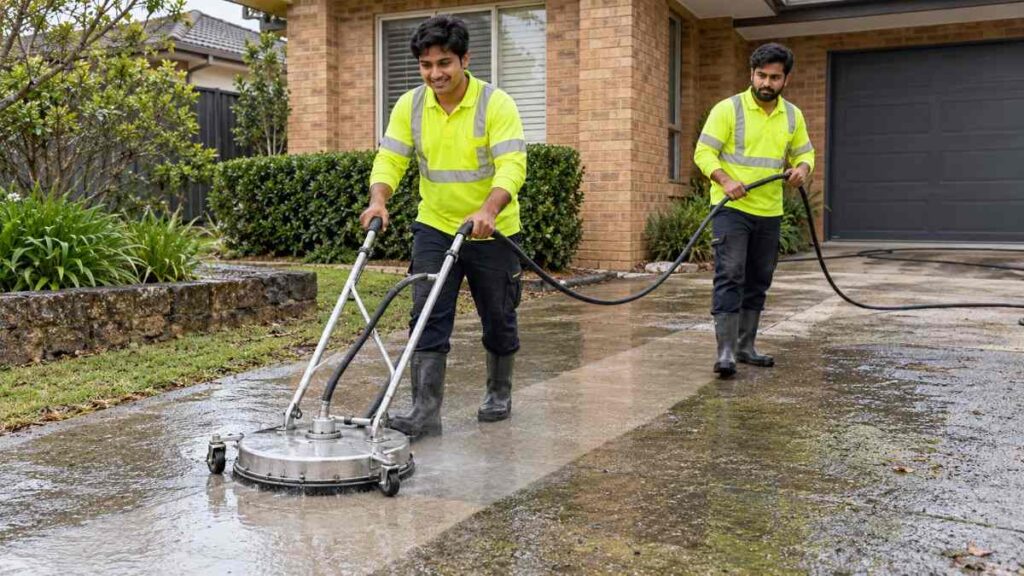
Pressure cleaning is a method of cleaning hard surfaces with water forced through a nozzle by a motorised pump, at far higher pressure than a garden hose. The force lifts dirt, mould, algae, oil, chewing gum and loose paint from surfaces such as concrete driveways, pavers, brick and car parks. “Pressure cleaning” is the term most Australians use; in the United States the same job is usually called pressure washing.
Professionals adjust three things to suit each surface: water pressure, water flow and water temperature. Hard concrete can take high pressure, while roofs, render and painted walls need low-pressure soft washing instead. This guide explains how each method works, which one suits each surface around a Sydney home or business, and what pressure cleaning can damage. If you would rather have it done for you, see our pressure cleaning services in Sydney.
Pressure Cleaning vs Pressure Washing vs Power Washing vs Soft Washing
Pressure cleaning and pressure washing are the same thing: Australians usually say pressure cleaning, and Americans say pressure washing. Power washing is pressure cleaning with heated water and is used for oil and grease. Soft washing is different; it uses low pressure and a cleaning solution to kill mould and algae on surfaces that high pressure would damage.
|
Method |
Water pressure |
Water temperature |
What does the cleaning |
Best for |
Avoid on |
|
Pressure cleaning (pressure washing) |
High: about 1,500–4,000 PSI (100–275 bar) |
Cold |
Force of the water |
Concrete, pavers, brick, car parks, bins |
Roofs, render, painted surfaces, timber at close range |
|
Power washing (hot-water pressure cleaning) |
High: about 2,000–4,000 PSI (140–275 bar) |
Hot, typically 60–90 °C |
Force plus heat that softens grease |
Oil-stained concrete, workshops, car parks, bin bays |
Delicate or heat-sensitive surfaces |
|
Soft washing |
Low: usually under 500 PSI (35 bar) |
Cold |
Cleaning solution and dwell time |
Roof tiles, Colorbond, render, painted walls, timber |
Heavy oil and grease |
Because the terms overlap, ask any contractor which method and pressure they plan to use on each surface before work starts.
How Does Pressure Cleaning Work?
A pressure cleaner draws water from a tap, pressurises it with a pump driven by an electric motor or petrol engine, and forces it out through a narrow nozzle. Its cleaning power comes from four settings working together: pressure, flow, temperature and nozzle angle.
Pressure (PSI and bar)
Pressure is the force of the water stream, measured in pounds per square inch (PSI) or bar. One bar equals about 14.5 PSI, and machines sold in Australia often list both.
- Under 500 PSI (35 bar): the soft washing range for roofs, render, painted surfaces and timber, where cleaning solutions do most of the work.
- About 1,500–2,500 PSI (100–170 bar): the typical range of household electric pressure cleaners. Suitable for outdoor furniture, bins, vehicles and light cleaning of pavers.
- About 3,000–4,000 PSI (200–275 bar): professional petrol and hot-water machines for concrete, exposed aggregate, brick and car parks.
- Above 4,000 PSI: industrial water jetting for equipment and surface preparation. It is not used on homes.
Flow rate (litres per minute)
Flow rate is the volume of water the machine delivers, measured in litres per minute (L/min). Pressure loosens dirt; flow carries it away. A machine with moderate pressure and high flow often cleans a driveway faster than one with higher pressure and low flow. Household machines typically deliver about 5–8 L/min, while professional units deliver about 11–21 L/min.
Water temperature
Cold water handles most dirt, mould and algae. Hot water, typically 60–90 °C from a machine with a diesel or electric burner, softens oil and grease so they lift without harsh degreasers. That is why hot water is standard for oil-stained driveways, car parks, workshops and bin bays.
Nozzles and attachments
The nozzle sets the spray angle. A narrower angle concentrates the force on a smaller area.
- 0° (red): a pinpoint jet. It can cut timber, etch concrete and injure skin, so professionals rarely use it.
- 15° (yellow): a narrow, forceful fan for stubborn grime and spot-cleaning concrete.
- 25° (green): the general-purpose fan for driveways, paths and patios.
- 40° (white): a wide, gentle fan for walls, vehicles and outdoor furniture.
- Soap nozzle (black, about 65°): low pressure for applying cleaning solutions.
- Rotary (turbo) nozzle: spins a narrow jet in a cone for heavy concrete cleaning. Effective, but too aggressive for soft surfaces.
- Flat surface cleaner: a spinning bar under a hood that cleans driveways and pavers evenly, without stripes and with less overspray.
The professional process, step by step
- Inspect the surface for cracks, loose mortar, drummy render or failing paint.
- Protect plants, doors, windows, electrical fittings and nearby stormwater drains.
- Pre-treat oil, rust or organic growth with a cleaning solution suited to the surface.
- Clean with the right pressure and nozzle. On flat areas, use a surface cleaner for an even finish.
- Rinse, collect or divert the wash water, and inspect the result.

Which Pressure Cleaning Method Suits Each Surface?
Hard, unpainted masonry can take high pressure. Anything coated, soft or brittle needs low pressure and the right cleaning solution. The table shows the approach for surfaces common around Sydney homes and businesses.
|
Surface |
Method |
Typical pressure |
Notes |
|
Plain concrete driveways and paths |
Pressure cleaning with a surface cleaner; hot water for oil |
3,000–4,000 PSI |
Pre-treat oil stains. Sealing afterwards slows re-staining. |
|
Exposed aggregate |
Pressure cleaning with a wide fan or surface cleaner |
2,000–3,000 PSI |
Too much pressure can loosen stones and strip the sealer. |
|
Concrete and clay pavers |
Surface cleaner, then re-sand joints |
2,000–3,000 PSI |
Joint sand washes out and must be replaced. |
|
Sandstone |
Low pressure with a suitable cleaner |
Low; test a hidden area first |
Sandstone is soft and erodes under high pressure. |
|
Brick walls and fences |
Pressure cleaning, wide fan, kept back from mortar |
1,500–2,500 PSI |
Repair damaged mortar rather than blasting it. |
|
Rendered and painted walls |
Soft wash |
Under 500 PSI |
High pressure can strip paint and force water behind render. |
|
Concrete and terracotta roof tiles |
Soft wash |
Under 500 PSI |
Blasting and walking on tiles can crack them and strip coatings. |
|
Colorbond and metal roofs, walls, garage doors |
Soft wash or low-pressure rinse |
Under 500 PSI |
Follow BlueScope’s maintenance guidance (see Roofs below). |
|
Timber decks |
Low pressure, wide fan, with the grain |
500–1,500 PSI |
High pressure raises and splinters the grain. Clean before re-oiling. |
|
Composite decking |
Low pressure with an approved cleaner |
As the manufacturer allows |
Check the warranty before any pressure cleaning. |
|
Car parks and loading docks |
Hot-water pressure cleaning with large surface cleaners |
3,000+ PSI |
Usually scheduled outside trading hours. |
|
Tiled and membrane balconies |
Low pressure and manual scrubbing |
Under 1,000 PSI |
Protect waterproofing membranes and drains. |
|
Commercial facades and high-rise |
Soft wash, water-fed pole or rope access |
Depends on the finish |
Rope access is available for safe high-rise building cleaning. |
Driveways, paths and concrete
Driveways collect tyre marks, oil drips, rust, moss and black mould, especially on shaded or south-facing concrete. Professionals pre-treat oil and rust, then clean with a rotary surface cleaner so the finish is even rather than striped. Hot water lifts oil so that cold water only spreads around. For garage and indoor slabs, see our guide on how to clean concrete floors.
House exteriors (house washing)
Exterior walls in Sydney collect dust, cobwebs, mould and, near the coast, salt. Most homes are rendered, painted, brick or clad, so a house wash is usually a soft wash: a cleaning solution is applied at low pressure, left to work, then rinsed off. Bricks can take moderate pressure if the mortar is sound. A house wash before repainting also helps new paint bond. Gutters, fascias and eaves are often cleaned in the same visit; see our gutter cleaning
Roofs
Tiled roofs grow moss, lichen and black streaks that hold moisture against the tiles. Soft washing kills this growth without blasting the tiles. For Colorbond and Zincalume steel, BlueScope recommends regular washing with clean fresh water: at least every six months for areas where rain does not wash, more often near the coast, and never with abrasive or solvent cleaners. Roof washwater runs down the downpipes into stormwater, so it has to be managed (see the water rules below).
What Can Pressure Cleaning Damage?
Pressure cleaning damages surfaces when the pressure, nozzle or distance is wrong for the material. The most common problems are:
- Etched or striped concrete from a narrow nozzle held too close
- Loose stones and stripped sealer on exposed aggregate driveways
- Washed-out mortar in brickwork and joint sand between pavers
- Cracked roof tiles and stripped tile coatings
- Water forced behind render, cladding, window frames and weep holes
- Stripped paint and raised, furry timber grain
- Voided warranties: some roofing, cladding and composite decking makers restrict how their products can be cleaned, so check before any pressure cleaning
Injury risk
A high-pressure jet can cut skin and inject water and dirt beneath it. These injection injuries can look minor at first but need urgent medical care. Never point the wand at people or pets, wear enclosed shoes and eye protection, and keep both hands on the gun.

Benefits of Pressure Cleaning
- Safer surfaces: removes slippery moss, algae and slime from paths, steps, decks and car parks.
- Longer surface life: organic growth holds moisture against concrete, timber and tiles; removing it slows deterioration.
- Better paint and sealer adhesion: a clean surface is the first step before repainting, staining or sealing.
- Presentation: clean entrances, facades and car parks matter for rental inspections, property sales and retail customers.
- Speed: large areas are cleaned in hours instead of days of scrubbing.
DIY Pressure Cleaning or Hire a Professional?
A household pressure cleaner from a hardware store is fine for outdoor furniture, bins, cars and small paved areas. Hire a professional when:
- the job involves a roof, a second storey or any work at height
- surfaces are rendered, painted, sandstone, exposed aggregate or under warranty
- there are oil, rust or grease stains that need hot water or pre-treatment
- the area is large, such as long driveways, car parks or strata common areas, where professional surface cleaners are much faster and leave no stripes
- wash water has to be kept out of stormwater drains
Professional machines deliver more flow and, where needed, hot water, and a professional operator carries public liability insurance for any damage to your property.
Cleaning Solutions, Safety and Licences
We choose the cleaning solution for each surface, not one product for every job. Most exterior cleaning uses a diluted biocide to kill mould, algae and lichen, a surfactant to help it cling, and a fresh-water rinse. Every product we carry has a safety data sheet on site.
What we use on each surface
| Surface or job | Cleaning solution | Why |
|---|---|---|
| Rendered, painted and brick walls | Diluted sodium hypochlorite with a surfactant | Kills mould and algae at low pressure; rinsed off after it has worked |
| Terracotta and concrete roof tiles | Diluted sodium hypochlorite biocide, mixed weaker for older or porous tiles | Kills moss, algae and black streaks without high-pressure blasting |
| Colorbond and metal roofs, walls, garage doors | Mild non-ionic detergent and a gentle biocide; no strong chlorine | Follows BlueScope’s guidance: fresh-water washing and no abrasive or solvent cleaners |
| Heavy lichen | Quaternary ammonium (benzalkonium chloride) treatment, left to work | Kills lichen slowly; dead growth washes away with rain over the following weeks |
| Oil and grease on concrete | Biodegradable degreaser with hot water | Heat and degreaser lift oil that cold water only spreads |
| Rust stains on concrete and pavers | Rust remover suited to the surface, tested on a hidden area first | Some rust removers can mark coloured or sealed surfaces |
Protecting plants, pets and waterways
“Biodegradable” does not mean harmless while a cleaning solution is still active, so we treat every job as if it drains somewhere that matters.
- Garden beds and lawns are watered before we start, sensitive plants are covered, and foliage is rinsed afterwards.
- Pets and children stay indoors until surfaces are rinsed and dry.
- Before roof treatments, downpipes that feed rainwater tanks are disconnected or blocked so treated water can’t reach your tank.
- Wash water and cleaning solutions are kept out of stormwater drains, as NSW law requires (see Pressure Cleaning and Water Rules in Sydney below).
Licences, training and insurance
- Technicians who work on construction sites hold a White Card (general construction induction).
- Roof and multi-storey work is done by technicians trained to work at heights, using harnesses and anchor points rated to AS/NZS 1891.
- Where a job needs a boom-type elevating work platform with a boom of 11 metres or more, the operator holds a SafeWork NSW WP high risk work licence.
- We carry $20 million public liability insurance. Certificates are available on request.
Pressure Cleaning and Water Rules in Sydney
Two sets of rules apply when pressure cleaning in Greater Sydney.
Sydney Water’s Water Wise Guidelines
Sydney Water’s Water Wise Guidelines apply year-round to all homes and businesses in Sydney, the Blue Mountains and the Illawarra. You may wash building structures such as walls, windows, gutters and roofs with drinking water at any time. Cleaning hard surfaces such as driveways, paths and paved areas with drinking water is only permitted for safety, health or emergency reasons, construction activity or surface contamination, and run-off or overspray onto hard surfaces is not allowed. Hoses must have a trigger nozzle unless they supply high-pressure cleaning equipment. The guidelines do not apply to rainwater, bore water or recycled water from a tank that is not topped up from the mains.
Keep wash water out of stormwater drains
Stormwater drains carry water straight to creeks, rivers and the harbour without treatment. Under the NSW Protection of the Environment Operations Act 1997 it is an offence to pollute waters, and councils such as the City of Ryde treat wash water, detergent and oil entering drains as pollution. Professionals block or bund nearby drains, divert wash water to lawns or garden beds where suitable, and use wet vacuums or water recovery on commercial sites.
Residential and Commercial Pressure Cleaning in Sydney
We pressure clean homes, strata complexes and commercial sites across Sydney, matching the method to each surface.
Homes
For homeowners, landlords and tenants, we offer house washing, roof soft washing, driveway and path cleaning, deck and paver cleaning, and washing before repainting. Many customers book a house wash and driveway clean in one visit. See real results in our before and after gallery.
Strata, commercial and industrial
- Strata and body corporate: car parks, driveways, common paths, bin rooms and facades on a maintenance schedule, alongside our strata cleaning.
- Retail, schools and councils: entrances, footpaths, car parks, playgrounds and gum removal, scheduled outside opening hours.
- Factories, warehouses and workshops: oil and grease on floors, loading docks and hardstand areas.
- Restaurants and food businesses: bin bays and back-of-house areas, often booked with commercial kitchen cleaning.
Pricing depends on area, surface, staining, access and height. For typical Sydney prices, see our pressure cleaning cost guide.
How Often Should You Pressure Clean?
Most Sydney homes need a house wash every 1–3 years, depending on how close they are to the coast and how much shade they get. High-traffic commercial areas need cleaning far more often.
| Area | How often | Why |
|---|---|---|
| Homes in coastal suburbs such as the Eastern Suburbs, Northern Beaches and Sutherland Shire | Every 12–18 months | Salt and humidity build up faster |
| Homes in inland and Western Sydney | Walls every 2–3 years | Less salt and moisture |
| Driveways and paths | When stains or slipperiness appear | Depends on traffic, trees and shade |
| Shaded paths, steps and south-facing walls | Check every year | Moss and algae make them slippery |
| Colorbond areas not washed by rain | At least every 6 months, more often near the coast | BlueScope’s maintenance guidance |
| Commercial car parks, entrances and bin areas | Monthly to quarterly | Heavy foot and vehicle traffic |
Don’t wait for the schedule if you see green or black growth, slippery surfaces or fresh oil stains. These are easier to remove early.
Conclusion Getting Pressure Cleaning Done Right
Pressure cleaning works when the method matches the surface. Hard concrete and oil stains need high pressure and hot water. Roofs, render, paint and timber need low-pressure soft washing. Using the wrong method causes etched driveways, cracked tiles and stripped paint.
Westlink Cleaning Services has cleaned homes and commercial sites across Sydney since 2014. Our technicians match the pressure, nozzle and cleaning solution to each surface and keep wash water out of stormwater drains. Get a free quote for your property.
Frequently Asked Questions
Can pressure cleaning remove oil stains from concrete?
Usually, yes. Fresh oil lifts well with a degreaser and hot water. Old stains that have soaked deep into the concrete may fade rather than disappear, so we tell you what to expect before we start.
Is pressure cleaning safe for roof tiles?
High pressure can crack tiles and strip their coating. Low-pressure soft washing is the safer method for both tiled and Colorbond roofs.
Will soft washing remove black streaks on my roof?
Yes. Black streaks are usually mould, algae or lichen, and soft washing kills them. Some dead lichen washes away with rain over the following weeks rather than on the day.
Can you pressure clean a two-storey house?
Yes. Two-storey homes are usually soft washed from the ground using extension wands, so walls are cleaned at low pressure without anyone climbing onto the roof.
Do I need to be home during pressure cleaning?
No. We need access to the area, an outdoor tap, and windows and doors closed.
Are your cleaning solutions safe for pets and plants?
We pre-wet and cover garden beds, rinse plants afterwards, and ask that pets stay inside until surfaces are rinsed and dry.
Can pressure cleaning damage pavers?
Only if the pressure or nozzle is wrong. Even with the right settings, cleaning washes some joint sand out, so the joints should be re-sanded afterwards.


