

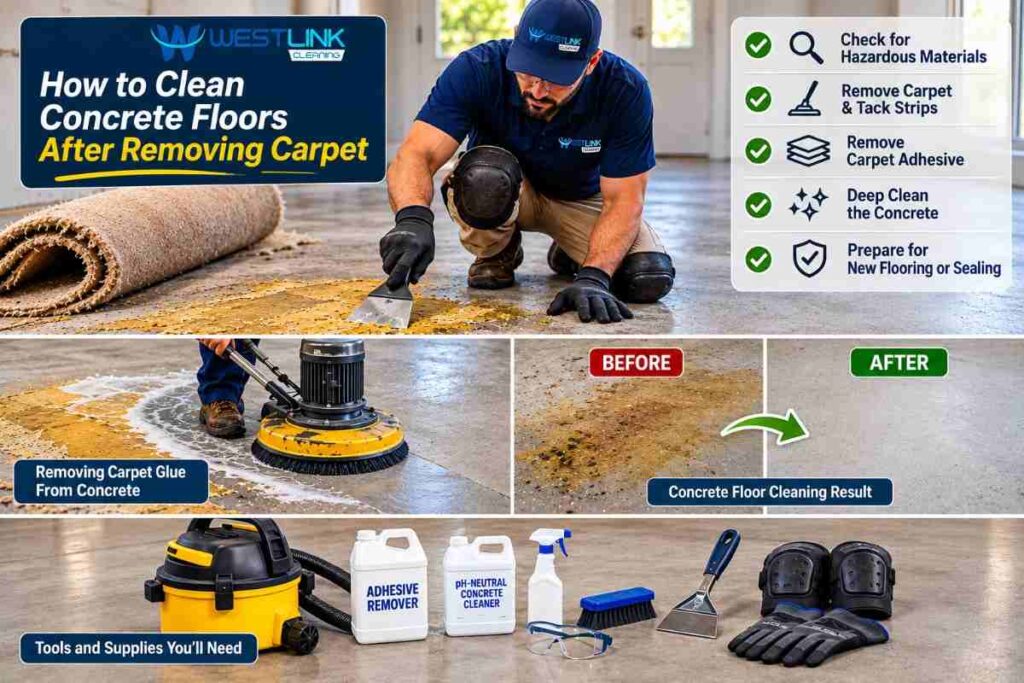
How to Clean Concrete Floors After Removing Carpet
To clean concrete floors after removing carpet, first check whether the old underlay or adhesive may contain asbestos, especially in older Australian properties. Once the materials are confirmed safe to disturb, remove the remaining carpet, underlay, tack strips and loose debris. Identify any leftover carpet glue, choose a compatible removal method, clean the concrete and inspect the slab for moisture, stains and damage before installing new flooring or applying a finish.
Carpet removal often reveals more than a dusty concrete surface. You may find hardened adhesive, deteriorated underlay, tack-strip holes, pet urine stains, uneven patches or moisture-related discolouration. These conditions affect the cleaning method and whether the slab needs additional preparation.
This guide explains how to clean exposed concrete after carpet removal, manage adhesive residue, assess common subfloor problems and prepare the surface for painting, sealing or replacement flooring. It also covers professional cleaning costs and when specialist assistance is necessary.
How to Clean Concrete After Carpet Removal: Quick Answer
The best way to clean concrete after carpet removal is to inspect the exposed materials for hazards, remove loose debris, treat adhesive with a suitable method and clean the slab according to its condition and intended use.
Follow this general sequence:
-
Check for hazardous materials. Determine whether older carpet underlay, flooring or adhesive needs an asbestos assessment before disturbance.
-
Remove remaining carpet materials. Once confirmed safe, take out loose carpet, underlay, tack strips and other fixings.
-
Clear loose dirt and dust. Use an appropriate cleaning and vacuuming method for the material and identified hazards.
-
Identify carpet adhesive. Determine whether the residue is a compatible water-based adhesive, hardened mastic or another bonding material.
-
Remove suitable adhesive residue. Use a removal product or method approved for the adhesive, concrete and intended next floor finish.
-
Clean and extract residue. Follow the cleaner’s instructions for agitation, residue removal and rinsing.
-
Inspect the exposed concrete. Check for stains, cracks, dampness, uneven sections and remaining contaminants.
-
Confirm readiness for the next finish. Follow the new flooring or coating manufacturer’s surface preparation and moisture-testing requirements.
A clean-looking slab is not automatically suitable for painting or installing new flooring. Adhesive residue, moisture and surface irregularities may remain even after visible dirt has been removed.
If the concrete will remain exposed, the main objective may be a clean, maintainable surface. If it will receive vinyl, tile, carpet or an epoxy coating, additional preparation may be necessary to meet the new flooring system’s requirements.
What to Check Before Cleaning an Exposed Concrete Subfloor

Before selecting cleaning tools or adhesive removers, examine the condition and history of the floor.
The most important questions are whether the existing materials can be safely disturbed, what type of adhesive remains, whether the concrete is sound and whether the slab shows signs of moisture.
Asbestos and Older Flooring Adhesives
Older carpet underlay, flooring backing and some adhesives may contain asbestos, so potentially hazardous materials should be identified before scraping, sanding or grinding.
Asbestos-containing materials were used in certain Australian flooring products and adhesives. Some historical bituminous adhesives contained asbestos fibres, and asbestos may not be identifiable by appearance alone.
Black adhesive is not necessarily asbestos-containing, but its colour does not establish that it is safe.
Before disturbing suspect materials:
-
Check the property’s age and available renovation records.
-
Identify whether older vinyl flooring, felt-backed flooring or underlay may have existed beneath the carpet.
-
Inspect adhesive and underlay without breaking, sanding or scraping suspect material.
-
Seek advice from an appropriately qualified asbestos professional where the material is uncertain.
-
Arrange appropriate sampling, testing and any necessary professional removal before continuing.
Do not scrape, sand, dry-brush, grind or use an ordinary vacuum on suspected asbestos-containing materials.
Australian asbestos guidance identifies some historical carpet underlays, resilient flooring backings and bituminous adhesives as potential asbestos sources.
If potentially asbestos-containing material is discovered, stop disturbing the area and follow the applicable state or territory requirements.
The cleaning process described below should only begin once the relevant materials have been assessed and it is safe to proceed.
Inspecting Concrete for Moisture, Cracks and Damage
After confirming that the exposed floor is safe to inspect, check the slab for moisture, cracks, adhesive residue and surface deterioration.
Carpet can hide problems that only become visible once the floor covering is lifted.
| Concrete condition | What it may indicate | Recommended response |
|---|---|---|
| Sticky or hardened adhesive | Remaining carpet bonding material | Identify the adhesive before removal |
| Small tack-strip holes | Fixings removed from the perimeter | Assess whether patching is necessary |
| Cracks or damaged patches | Shrinkage, movement or surface deterioration | Determine whether repairs are required |
| White powdery deposits | Possible efflorescence or moisture movement | Investigate the moisture source |
| Dark or damp patches | Possible moisture or staining | Assess before coating or installation |
| Loose or powdery concrete | Weak or deteriorating surface material | Seek suitable substrate assessment |
| Uneven sections | Irregular slab profile | Check the new flooring’s flatness requirements |
Moisture is particularly important.
A slab may look dry while still containing moisture above the limits permitted by an adhesive, coating or flooring system.
Look for visible dampness, discolouration, recurring white deposits and evidence of water entering around walls or joints.
However, visual inspection cannot establish whether the concrete passes the moisture requirements for a new floor covering. Testing must follow the applicable standard and product instructions.
Cracks and uneven surfaces
Small surface defects may be repairable with a compatible concrete repair material. Wider, moving or structurally significant cracks may require further assessment.
Likewise, an uneven slab may need patching or levelling before installing resilient flooring or applying certain coatings.
Do not assume that cleaning will correct concrete defects. Surface preparation and repairs may be separate tasks.
Tools and Supplies Needed to Clean Concrete After Carpet Removal
The necessary tools depend on the age of the flooring, type of adhesive, concrete condition and intended final surface. Not every project requires chemical removers, mechanical equipment or extensive washing.
Once the existing materials have been confirmed safe to handle, the following items may be useful.
| Tool or material | Purpose |
|---|---|
| Protective gloves | Protects hands from sharp fixings and compatible cleaning products |
| Safety glasses | Reduces exposure to flying debris and splashes |
| Knee pads | Improves comfort during floor-level work |
| Suitable pry bar or removal tool | Removes tack strips and accessible fixings |
| Plastic or approved floor scraper | Lifts compatible loose residues without unnecessary damage |
| Appropriate industrial vacuum | Removes identified, non-hazardous debris |
| Soft or medium-bristle brush | Helps remove loose dirt and compatible residue |
| Approved adhesive remover | Treats suitable remaining carpet glue |
| Concrete-compatible cleaning detergent | Removes applicable surface soil |
| Microfibre mop or cloths | Supports controlled surface cleaning |
| Wet-dry extraction equipment | Removes liquid when wet cleaning is appropriate |
| Fans or dehumidification equipment | Supports drying under suitable conditions |
| Floor inspection and moisture-testing equipment | Helps assess condition and preparation requirements |
Use cleaning products that are suitable for both the concrete and the next floor finish.
Some adhesive removers can leave residues that interfere with later bonding, even when they successfully soften the old glue.
A remover suitable for an exposed garage floor may not be compatible with a slab that will receive vinyl planks, epoxy or another adhered flooring system.
Do you need a concrete grinder?
Not for every job.
Mechanical grinding may be needed when a flooring system requires a particular surface profile or when compatible adhesive cannot be removed by less intrusive means. However, grinding concrete can release hazardous respirable crystalline silica.
Specialist grinding should be carried out with suitable dust-exposure controls, equipment and competent operators. Suspected asbestos-containing material must not be ground.
For many straightforward residential jobs, the appropriate starting equipment is limited to safe debris removal, compatible manual tools and controlled cleaning.
How to Clean Concrete Floors After Removing Carpet Step by Step

Cleaning concrete after carpet removal involves removing safe-to-handle flooring residue, selecting a compatible adhesive treatment, cleaning the slab and checking its condition after drying.
Follow these six steps once potential asbestos and other hazards have been addressed.
Step 1: Remove Remaining Carpet and Underlay Safely
Remove remaining carpet and underlay only after confirming that the materials can be safely disturbed.
If the carpeting has already been taken up, inspect the room for leftover strips, loose padding, old underlay and materials caught along the perimeter.
Modern carpet may have been secured with perimeter tack strips, adhesive or a combination of fixing methods. Padding may also have been glued directly to the concrete.
For materials confirmed safe to handle:
-
Clear furniture and other movable objects from the area.
-
Collect loose carpet pieces and uncontaminated padding.
-
Separate sharp fixings and unsuitable waste from ordinary debris.
-
Follow local disposal requirements for the removed materials.
-
Avoid dragging sharp objects across finished or exposed surfaces that are to be preserved.
Why this matters: Removing loose materials makes the concrete accessible for inspection and helps identify where adhesive, moisture or damaged surfaces remain.
If you uncover another unexpected flooring layer, stop and assess it before continuing. Earlier vinyl flooring or felt underlay may have been covered by subsequent installations.
Step 2: Remove Tack Strips and Loose Debris
Once the materials are confirmed safe, remove accessible tack strips and loose fixings before cleaning the exposed slab.
Carpet tack strips are commonly installed around room edges. They contain sharp pins and may be fastened to concrete with nails or adhesive.
Wear suitable gloves and eye protection.
Use an appropriate removal tool to carefully release the strip without unnecessarily chipping the slab. Collect loose nails and sharp fragments promptly.
Do not force fixings that are embedded deeply in the concrete. Excessive force may leave larger holes or damaged edges.
After removing the strips, inspect the perimeter for nail holes, broken concrete and remaining adhesive.
Next, remove identified, non-hazardous loose debris using an appropriate industrial vacuum or other suitable dust-control method.
Important: An ordinary household vacuum should not be used for suspected asbestos debris or hazardous concrete grinding dust.
If concrete dust requires specialist controls, use equipment and procedures appropriate to the assessed hazard.
Why this matters: A properly cleared surface allows more accurate inspection of the adhesive and concrete. It also reduces the risk of carrying sharp fragments into later cleaning stages.
Step 3: Identify and Remove Carpet Adhesive
Identify the adhesive before choosing how to remove it from the concrete floor.
Carpet glue varies by age, formulation and installation method. Some residues are relatively soft, while others form hardened or tightly bonded layers.
| Adhesive condition | What to consider |
|---|---|
| Thin, compatible water-based residue | May respond to a manufacturer-approved removal method |
| Thick carpet glue | May need controlled scraping or specialist treatment |
| Old bituminous or black mastic | Requires asbestos risk assessment before disturbance |
| Unknown hardened coating | Should be identified before treatment |
| Adhesive beneath damaged concrete | May require substrate repair as well as residue removal |
For adhesive confirmed safe to remove:
-
Inspect the type, thickness and extent of the residue.
-
Choose a removal method permitted for that adhesive and concrete surface.
-
Test the method in a small area where required.
-
Follow the product’s application, contact-time and removal instructions.
-
Collect loosened material without spreading it across the slab.
-
Inspect for remaining residue and possible surface damage.
Do not automatically pour boiling water, apply concentrated solvents or grind the floor.
The correct treatment depends on the adhesive chemistry, the condition of the slab and whether the concrete will receive another floor covering.
When additional adhesive removal guidance is needed
Removing loose carpet glue from a small patch is different from treating an entire concrete room with thick, hardened adhesive. Product selection and cleaning residue become particularly important if the slab will later receive tiles, vinyl or a coating.
For a more detailed discussion of these methods, see Westlink’s guide to cleaning adhesive off concrete floors. Check the relevant product and safety instructions before applying any technique to older or unidentified adhesive.
Step 4: Clean Remaining Residue
After compatible adhesive has been removed, clean the remaining surface soil and residue using a concrete-appropriate product.
Start by identifying what remains on the floor.
Fine dust, greasy marks, adhesive-remover residue and ordinary dirt may require different cleaning methods.
Apply a suitable cleaning product according to its instructions. Use only the recommended concentration and cleaning equipment.
Where agitation is permitted, use a suitable brush, pad or machine setting that will not damage the slab or create unnecessary dust.
Work in manageable areas so that loosened soil or cleaning chemicals do not dry back onto the surface.
Does pH-neutral detergent neutralise adhesive remover?
Not necessarily.
A pH-neutral detergent may help remove compatible surface soil, but it does not automatically neutralise chemical residues.
If the adhesive-remover manufacturer specifies a neutralising step, use its prescribed method. Do not improvise with vinegar, baking soda, acids or alkaline products.
Why this matters: Residual chemicals, oil and loose material can affect subsequent coatings or adhesives, even when the concrete appears visually clean.
Step 5: Rinse or Extract as Required
Rinse the concrete only when the cleaning or adhesive-removal product requires it, then remove the liquid using an appropriate extraction method.
Not every concrete floor or cleaning process needs repeated washing.
Some products require water rinsing, while others prescribe mechanical residue removal or another specific cleanup procedure.
For wet-cleaning processes that permit rinsing:
-
Apply the amount of clean water specified by the product instructions.
-
Avoid flooding internal rooms or adjoining floor finishes.
-
Prevent dirty water from spreading into wall joints or adjacent spaces.
-
Use suitable wet extraction equipment where appropriate.
-
Collect and dispose of contaminated liquid according to the relevant product and local requirements.
Do not use an ordinary household vacuum for wet extraction.
Should you pressure wash indoor concrete?
Pressure washing is generally unsuitable as a routine indoor cleaning method unless the site has been specifically assessed and appropriate water containment, drainage and extraction arrangements are in place.
Excess water may spread contaminants, affect adjacent building materials and complicate moisture management before new flooring installation.
Why this matters: Cleaning residue and wastewater should be removed rather than redistributed across the concrete.
Step 6: Dry and Inspect the Concrete
After cleaning, allow the slab to dry and inspect it before deciding whether further preparation is needed.
Drying time varies according to floor porosity, moisture exposure, room ventilation, temperature and the cleaning method used.
Fans and appropriate dehumidification may support drying, but they do not establish that the slab meets a new flooring manufacturer’s moisture limits.
Inspect the concrete for:
-
Remaining adhesive or cleaning residue.
-
Cracks, holes and damaged patches.
-
Uneven or weak surface areas.
-
Dampness or recurring discolouration.
-
Efflorescence or other signs of moisture movement.
-
Oil, grease or persistent odour.
-
Coatings or sealers that may interfere with the next treatment.
If the floor will receive a new covering or coating, arrange the required substrate assessments, including moisture and surface preparation checks.
Do not assume that waiting 48–72 hours makes the slab installation-ready.
The concrete must satisfy the conditions specified by the intended flooring or coating system.
How to Remove Carpet Glue From Concrete

Carpet glue can be removed from concrete using compatible manual, chemical or professional mechanical methods, but the safest option depends on the adhesive type and whether hazardous legacy material is present.
There is no single adhesive remover that works for every installation.
Manual removal
Manual scraping may be appropriate for small amounts of safe-to-disturb adhesive that can be lifted without damaging the slab.
Use an approved scraper and controlled pressure. Stop if the concrete begins to chip, the adhesive cannot be identified or the removal process creates unexpected dust.
Manual scraping is less suitable for extensive, strongly bonded residue or potentially asbestos-containing mastic.
Chemical adhesive removal
Some carpet adhesives can be softened with a commercial remover.
Select the product based on the adhesive type and the intended next flooring system.
Check the product’s safety data, ventilation requirements, surface compatibility and residue-removal instructions.
Low-VOC or bio-based marketing claims do not automatically establish that a product is suitable for every indoor project.
If a remover leaves oily or incompatible residues, additional preparation may be necessary before applying new flooring adhesive or paint.
Professional mechanical preparation
Specialised machines may be used when hardened adhesive must be removed and the concrete requires a defined surface profile.
However, concrete grinding creates silica exposure risks, and old adhesives must be assessed for asbestos before work begins.
Qualified contractors should select the equipment, extraction and other exposure controls based on the job and applicable safety requirements.
Which method is best?
| Situation | Appropriate direction |
|---|---|
| Small amount of identified, loose adhesive | Controlled manual removal |
| Compatible residual carpet glue | Manufacturer-approved adhesive remover |
| Extensive hardened residue | Professional assessment |
| Suspected asbestos-containing mastic | Stop disturbance and arrange specialist advice |
| Floor intended for epoxy or new bonded covering | Follow the intended system’s substrate preparation requirements |
The objective is not necessarily to remove every microscopic trace with the most aggressive method. It is to achieve a safe, sound and compatible substrate for the intended next use.
How to Clean Concrete Stains and Odours After Carpet Removal
After carpet removal, concrete may have stains and odours from pets, moisture, spills, rust or years of trapped dirt. Each type of contamination requires a different assessment.
Pet urine stains and odours
Pet urine may penetrate porous concrete, especially when the slab was previously covered with carpet and underlay.
After confirming that the area is safe to clean, select an enzymatic pet urine product specifically approved for the concrete surface.
Follow the product’s application, contact-time, extraction and drying instructions.
Older contamination may require further assessment if odours continue after the floor has dried.
Do not assume that surface washing or applying a sealer will remove absorbed urine odours.
Mould or suspected microbial contamination
Damp underlay or carpet may conceal mould growth or moisture damage.
If mould is suspected, first determine whether an ongoing moisture problem exists.
Extensive contamination, unexplained water intrusion or signs of mould affecting building materials may require professional remediation.
Do not rely on a universal bleach mixture as the treatment for every mould-contaminated concrete floor.
Rust stains
Rust-coloured marks may be associated with metal fixings, stored objects or moisture exposure.
Before using a chemical rust remover, check compatibility with the concrete and any intended finish.
Some acidic cleaners can alter cementitious surfaces, so they should not be applied indiscriminately.
Efflorescence
White, powdery deposits may indicate salts carried to the surface by moisture movement.
Removing the visible residue does not necessarily solve the underlying moisture source.
If deposits return, investigate the moisture conditions before painting, sealing or installing moisture-sensitive flooring.
Paint and other surface stains
Old paint spots and residual coatings should be identified before removal.
A product designed for paint removal may not be suitable for an unknown adhesive or for concrete that will later receive a specific coating.
Avoid mixing chemicals or using aggressive grinding without a suitable risk assessment.
The main principle: Identify the stain or contaminant first, then choose a compatible treatment. Cleaning the visible mark is not always the same as correcting its source.
How to Prepare Concrete for New Flooring, Painting or Sealing
Preparing concrete after carpet removal depends on the floor finish you plan to install. A surface suitable for leaving exposed may not meet the preparation requirements for vinyl, carpet, ceramic tiles, epoxy or concrete paint.
After removing unwanted adhesive and cleaning the slab, confirm its surface condition and the requirements of the new flooring system.
| Intended floor finish | Main preparation requirements |
|---|---|
| New carpet | Sound, reasonably even and suitably dry subfloor |
| Vinyl planks or sheet vinyl | Manufacturer-specified smoothness, moisture and adhesive compatibility |
| Ceramic or porcelain tiles | Sound substrate, appropriate flatness, moisture and bonding conditions |
| Concrete paint | Clean, sound and appropriately prepared surface with acceptable moisture |
| Epoxy coating | Specified surface profile, cleanliness and coating-compatible moisture conditions |
| Exposed concrete | Suitable cleaning, surface repairs and optional finishing |
Preparing concrete for new carpet
New carpet and underlay may conceal minor visual imperfections, but the slab still needs to be sound, suitable for the fixing method and free of unacceptable moisture or contamination.
Remove loose adhesive that may interfere with installation, and repair defects as required by the chosen carpet system.
Preparing concrete for vinyl flooring
Vinyl flooring, particularly thin or glued products, can reveal irregularities in the subfloor.
The concrete may need additional levelling, smoothing and moisture testing before installation. Follow the manufacturer’s instructions and relevant Australian flooring standards.
Preparing concrete for tiles
Ceramic and porcelain tiles require an appropriate substrate for bonding.
Check for contamination, weak concrete, cracks, flatness and any movement or moisture issues that could affect the tiling system.
Preparing concrete for painting
Concrete paint needs a suitably clean, dry and sound surface.
Residual carpet adhesive, oily chemicals, weak concrete or inappropriate surface preparation can affect coating adhesion.
Preparation may involve removal of incompatible materials, repairs, surface profiling and moisture testing, depending on the coating.
If painting is your next step, Westlink’s guide to cleaning a concrete floor before painting explains the specific preparation considerations for concrete coatings.
Preparing concrete for sealing or epoxy
Concrete sealers and epoxy coatings have their own substrate preparation requirements.
Some systems require mechanical profiling, specific moisture limits or treatment of existing cracks.
Do not apply a coating simply because the concrete appears clean and dry.
Where grinding is required, arrange competent operators and suitable silica exposure controls. Suspected asbestos-containing adhesive must be assessed before the slab is mechanically disturbed.
Is moisture testing always necessary?
Testing requirements depend on the flooring material, slab condition, applicable standards and manufacturer’s specifications.
For moisture-sensitive flooring and coatings, a suitable test may be essential even when no dampness is visible.
A handheld meter or visual inspection alone may not establish compliance with the required limits.
Common Mistakes to Avoid
The biggest mistake when cleaning concrete after carpet removal is assuming that every exposed slab can be scraped, washed and immediately covered with new flooring.
The existing materials, concrete condition and next flooring type must be considered.
| Common mistake | Why it causes problems | Better approach |
|---|---|---|
| Scraping unidentified old black adhesive | May disturb asbestos-containing material | Complete a suitable risk assessment first |
| Grinding concrete without adequate controls | Can generate hazardous silica dust | Use competent operators and required exposure controls |
| Pouring boiling water onto adhesive | Can cause burns and introduce unnecessary moisture | Use an approved removal method |
| Mixing adhesive-removal chemicals | May cause hazardous reactions | Follow one compatible product system |
| Assuming all removers leave no residue | Residue can interfere with new flooring | Follow the manufacturer’s cleanup instructions |
| Using household equipment on hazardous dust | May spread contamination | Select hazard-appropriate equipment |
| Flooding an indoor concrete floor | Can introduce moisture into nearby materials | Control and extract water |
| Painting over incompatible adhesive | May cause poor coating adhesion | Follow the coating system’s preparation requirements |
| Ignoring recurring moisture | Can contribute to later flooring problems | Investigate the source and test as required |
| Using a fixed 48-hour drying rule | Does not prove slab readiness | Verify against the next flooring system’s limits |
| Sealing over unresolved stains or odours | May conceal rather than solve contamination | Address the cause before finishing |
How can you tell whether the concrete is ready?
A clean appearance is only one part of the assessment.
The slab should meet the intended flooring manufacturer’s requirements for surface soundness, flatness, cleanliness, moisture and compatibility.
If those requirements have not been checked, the surface should not be assumed ready for installation.
When to Hire a Professional Concrete Floor Cleaner
Professional assistance is recommended when concrete cleaning involves uncertain adhesive, extensive staining, difficult residue, moisture problems, specialised equipment or preparation for a bonded flooring system.
Small, straightforward cleaning jobs may be manageable after hazards have been ruled out. However, larger or more complicated projects require additional knowledge and equipment.
Consider professional assistance when:
-
Carpet adhesive covers a large area or cannot be identified.
-
You suspect asbestos-containing underlay or old flooring materials.
-
The floor has thick, hardened mastic requiring specialist removal.
-
Mechanical surface grinding or profiling is necessary.
-
The concrete is cracked, uneven or deteriorating.
-
Moisture or efflorescence keeps returning.
-
Pet urine odours remain after compatible cleaning.
-
A new flooring system has strict substrate preparation requirements.
-
The project involves a commercial or heavily used floor.
How much does concrete cleaning after carpet removal cost in Australia?
Professional costs depend on the difference between basic cleaning, carpet removal, adhesive stripping and mechanical preparation.
Indicative 2026 Australian pricing includes:
| Service | Indicative cost |
|---|---|
| Carpet and underlay removal | $5–$10/m² |
| Floor levelling and subfloor preparation | $10–$30/m² |
| Standard concrete grinding | Around $22/m² |
| Carpet glue or mastic removal grinding | Around $40/m² |
| Grind-and-seal concrete finishing | $55–$90/m² |
These figures are published benchmarks for different jobs, not guaranteed national averages or Westlink quotations.
For example, removal of carpet from a 40 m² room at $5–$10 per square metre gives an indicative removal cost of $200–$400 before any separately charged preparation work.
If the slab requires extensive adhesive removal, levelling, repairs or specialised hazard management, the total price can be substantially higher.
What should a professional quote include?
A written quote should identify the floor area, condition, proposed cleaning or preparation method, waste disposal, any specialist testing, additional repairs, GST treatment and whether the price includes preparing the slab for its next floor finish.
For Sydney homeowners dealing with dirty or contaminated exposed flooring, Westlink’s professional floor cleaning services in Sydney explain how cleaning methods can be selected according to the surface and its existing condition.
Before booking, confirm whether the provider offers the specific work required, such as carpet adhesive removal, mechanical grinding, asbestos assessment or moisture testing. General floor cleaning does not automatically include these specialist services.
Frequently Asked Questions
1. How do you clean concrete floors after removing carpet?
First check for potentially hazardous underlay or adhesives. Once safe, remove carpet remnants, tack strips and loose debris. Identify remaining glue, use a suitable removal method and clean the concrete according to product instructions. Inspect for stains, cracks and moisture before applying a coating or installing new flooring.
2. What is the best way to remove carpet glue from concrete?
The best method depends on the adhesive type, age and surface condition. Compatible loose residue may be removable manually, while other adhesives require approved chemical treatment or professional mechanical preparation. Suspected asbestos-containing adhesives must be assessed before disturbance.
3. Can you clean concrete after removing carpet with vinegar?
Vinegar is not a universal concrete or carpet-glue cleaner. Its acidity may affect cementitious surfaces, and it may not effectively remove hardened adhesive. Use a product suited to the identified contamination and intended floor finish.
4. Can you paint over old carpet adhesive?
Only if the coating manufacturer expressly allows the specific remaining material and preparation system. Many adhesives interfere with bonding or are otherwise incompatible. The safest approach is to follow the coating manufacturer’s surface preparation requirements.
5. How long does concrete take to dry after carpet removal and cleaning?
Drying time varies with moisture exposure, slab condition, humidity, temperature and ventilation. There is no universal 48–72-hour rule that establishes readiness for new flooring. Moisture-sensitive systems require testing against their specified limits.
6. Is black carpet glue dangerous?
Black carpet glue is not necessarily hazardous, but some older black bituminous adhesives contained asbestos. Colour alone cannot establish whether asbestos is present. If the adhesive is unidentified and potentially hazardous, stop work and arrange professional assessment.
7. Can you use a pressure washer on an indoor concrete floor?
Pressure washing is generally unsuitable for routine indoor cleaning without suitable water containment, drainage and extraction arrangements. Excess water can spread contamination and create moisture problems. Controlled cleaning methods are usually more appropriate.
8. How do you remove pet urine smell from concrete after carpet removal?
Use a pet urine cleaning product specifically approved for the concrete surface and follow its instructions. Older contamination may have penetrated the slab, so repeat treatment or professional assessment may be required. Sealing alone does not guarantee odour removal.
9. Does concrete need to be sealed after removing carpet?
Not always. If the concrete will remain exposed, a suitable sealer may help with maintenance and stain resistance. If new flooring will be installed, the substrate must be prepared according to the flooring system’s requirements. An additional sealer may be unnecessary or incompatible.
10. Can you install new flooring directly over cleaned concrete?
Only when the slab meets the flooring system’s requirements for cleanliness, surface soundness, flatness, moisture and adhesive compatibility. Some floors require additional repairs, levelling or preparation after cleaning.
11. What is the fastest way to remove stubborn carpet glue?
Professional mechanical removal can be efficient for some hardened adhesive, but it is not automatically the safest or best method. The adhesive must be identified first, and any grinding must account for silica exposure and the possible presence of asbestos.
12. How much does it cost to prepare concrete after carpet removal?
Costs vary by the required work. Carpet removal may cost around $5–$10/m², while floor levelling and preparation may cost $10–$30/m². Specialist adhesive removal, grinding, repairs and finishing can increase the total. Obtain a quote based on the actual slab condition.
Conclusion
Cleaning concrete floors after removing carpet requires more than sweeping away dust and scraping off glue. The first step is to establish that the existing flooring materials can be safely disturbed, particularly in older Australian properties.
Once safe, remove remaining carpet materials, identify the adhesive, select a compatible cleaning method and inspect the slab for stains, cracks, moisture and surface damage.
If you intend to install new carpet, vinyl, tiles or an epoxy coating, the concrete must also satisfy the preparation requirements of that flooring system. A clean-looking slab does not necessarily mean it is suitable for immediate installation.
For extensive contamination or commercial cleaning requirements, Westlink’s professional floor cleaning services provide a starting point for discussing concrete floor condition and appropriate surface-cleaning methods. Confirm the availability of any specialist preparation or remediation work separately.
The objective is a clean, sound and suitable concrete surface that can support the next stage of your flooring project without avoidable damage or compatibility problems.


