

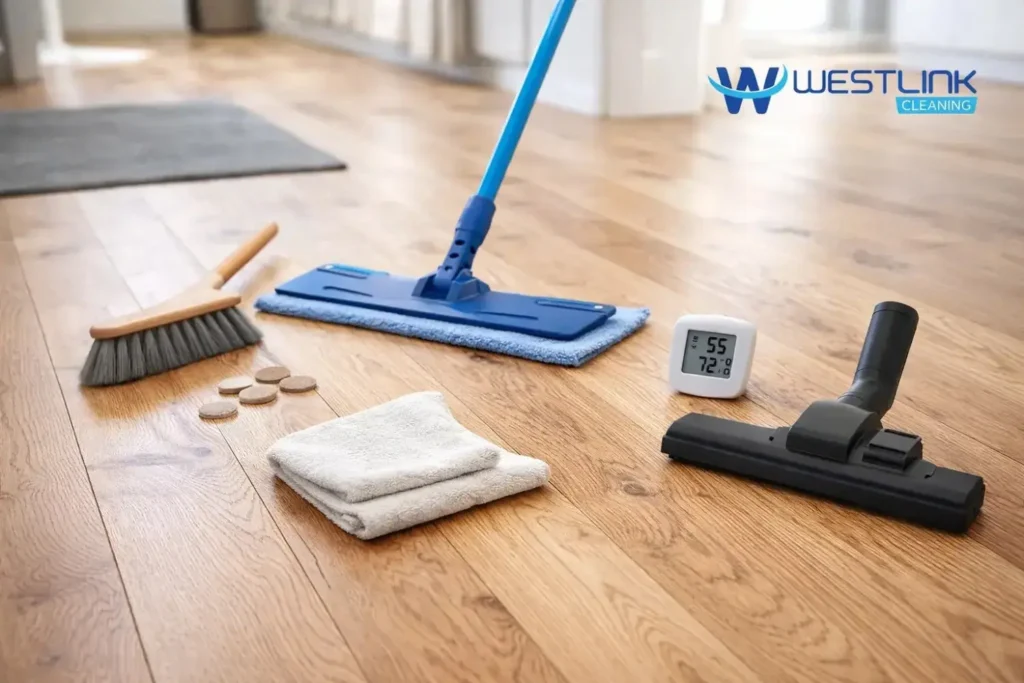
Professional care for wood and timber floors means removing grit regularly, cleaning with minimal moisture, using a finish-compatible pH-neutral cleaner, maintaining stable indoor humidity, protecting the surface from scratches and sunlight, and restoring the finish before wear exposes bare wood. The right care method depends on the floor’s construction, finish type, traffic level, and moisture exposure because wood responds to wear and environmental change differently from other hard flooring materials.
Wood and timber floors stay in better condition when routine care is matched to the material and the finish. The main priorities are simple: keep abrasive dirt off the surface, avoid excess water, use compatible cleaning products, and address early signs of wear before they become deeper damage. Routine maintenance is usually enough while the protective coating remains intact, but corrective treatment may be needed when the finish breaks down, moisture-related movement appears, or stains, scratches, and dull areas no longer improve with normal cleaning.
What are professional care essentials for wood and timber floors?
Professional care essentials are the set of cleaning, protection, moisture-control, and restoration decisions that match the floor’s material and finish. They are not one product or one task. They are a system that reduces abrasion, limits water exposure, preserves the protective coating, and identifies the restoration threshold before damage becomes structural.
The main essentials are:
- dry dust removal with a microfiber mop, soft broom, or vacuum on a hard-floor setting
- damp cleaning only with a well-wrung mop and a compatible cleaner
- fast spill response so moisture does not enter joints, grain, or edges
- abrasion control through walk-off mats, felt pads, and traffic management
- finish maintenance through refreshing, oiling, recoating, or refinishing at the right time
- environmental control through stable temperature, relative humidity, and a dry subfloor where required
Why do wood and timber floors need specialized care?

Wood and timber floors need specialized care because wood reacts to moisture, temperature, dirt, and finish chemistry more than most hard floor surfaces do. A tile or vinyl cleaning habit can shorten the life of a wood floor if it adds too much water, uses the wrong cleaner, or leaves residue on the coating.
Grit is another reason care must be specific. Small particles act like an abrasive under foot traffic, dulling a protective coating long before the wood itself wears out. That is why repeated dry cleaning, entry mats, and felt pads matter so much on both residential and commercial floors.
A third reason is finish sensitivity. Lacquered or polyurethane-coated floors, oiled floors, and waxed floors do not accept the same cleaners or the same corrective work. The wrong product can leave haze, soften the finish, reduce adhesion for a future recoat, or create unnecessary buildup.
Which wood and timber floor types need different care?
Different wood floor types need different care because construction changes movement, sanding potential, moisture sensitivity, and restoration options. Floor type affects how much the boards move, how thick the wear layer is, and how much corrective work is still possible later.

1. Solid hardwood flooring
Solid hardwood flooring is made from one piece of wood, so it is durable but more responsive to seasonal humidity changes than engineered wood. That movement makes climate control especially important. Solid boards usually offer the most future sanding allowance, but they also need stricter control of moisture and expansion gaps.
For care, solid hardwood responds best to low-moisture cleaning, frequent grit removal, and early action when the finish starts to wear. In high-risk areas, such as kitchens or entrances, the goal is to protect the coating before repeated wet traffic reaches bare wood.
2. Engineered wood flooring
Engineered wood flooring has a real-wood top layer over stabilizing layers, so it is usually more dimensionally stable than solid hardwood. The top wear layer defines how much future sanding is possible, while the layered core improves resistance to gapping and makes engineered wood the easier option for many underfloor-heated installations.
Care still has to respect the finish and the wear layer. Some engineered floors can be refinished several times, some only once, and thin veneer products may not be sandable at all. That is why product-specific guidance matters more on engineered floors than many owners realize.
3. Parquet flooring
Parquet flooring is real wood flooring arranged in patterns, so it needs the same wood-safe care as plank floors plus extra attention to joints, edges, and appearance consistency. Whether the pattern is herringbone, chevron, or another layout, moisture control and low-residue cleaning are important because patterned floors show uneven color change, residue, and localized wear quickly.
Parquet also benefits from careful sunlight management. Patterned floors can show contrast more clearly when rugs, furniture, or strong daylight expose one area and shield another.
4. Prefinished vs site-finished floors
Prefinished floors receive color and finish at the factory, while site-finished floors are sanded and finished in the room after installation. Prefinished floors are ready to walk on immediately after installation, while site-finished floors offer more customization but require drying and curing time.
This difference matters for maintenance. Factory-finished surfaces can be very tough, but they may need more careful preparation for recoating, while site-finished floors may be easier to customize during later restoration. In both cases, the best time to recoat is before the finish wears through.
Which finish types change the maintenance method?
The finish type changes the maintenance method because the finish, not just the wood species, is what your cleaner and foot traffic touch every day. The protective coating controls water resistance, stain response, gloss retention, repair options, and product compatibility.

1. Polyurethane finishes
Polyurethane finishes are usually the easiest wood-floor finishes to clean and maintain. Junckers describes its factory-applied lacquer as a hard-wearing polyurethane system, while lacquered floors are widely considered the most common residential option because they are easy to clean and maintain.
These floors generally do best with dry cleaning, occasional damp cleaning, and timely recoating when wear patterns appear. Waiting until the finish wears through to bare wood raises the chance that full sanding will be needed instead of a lighter maintenance treatment.
2. Oil finishes
Oil finishes highlight the grain and natural texture of wood, but they need regular care with compatible oil-maintenance products. Oil-treated floors can perform very well even in public spaces when they are cleaned routinely and maintained with oil, while maintenance oil can also revive dull surfaces unless the finish has already worn through to bare wood.
That means oiled floors are often easier to spot-repair than coated floors, but only when maintenance is done at the right time. Once the oil protection has worn away, the floor may need sanding and re-oiling instead of a simple refresh.
3. Wax finishes
Wax finishes provide a traditional soft sheen, but they are higher-maintenance and depend heavily on compatible cleaning and refresh products. Osmo states that its wash-and-care and maintenance-oil products are designed for oiled and waxed wooden flooring, while floor wax is widely used as a protective and maintainable traditional finish.
Waxed floors therefore need low-residue care and periodic refreshing rather than generic cleaners. They also require more caution before any later coating work, because compatibility varies by system.
4. Finish-specific risks
The main finish-specific risks are wear-through on polyurethane, dryness or dullness on oil, and buildup or compatibility problems on wax. Across all finish types, excess water, aggressive detergents, steam, and residue-forming products increase risk faster than normal traffic does.
What routine care tasks matter most?
The most important routine tasks are frequent dry cleaning, controlled damp cleaning, environmental control, and early finish maintenance. The exact frequency depends on traffic level, pets, shoes, wheeled furniture, sunlight, and whether the floor is in residential or commercial use.
1. Daily care
Daily care is mainly about removing loose grit before it causes abrasion. In busy homes and commercial areas, that usually means dry mopping, sweeping, or vacuuming on a hard-floor setting, plus spot-cleaning spills and visible marks.
2. Weekly care
Weekly care usually means a deeper clean with minimal moisture. Many manufacturer guides recommend a barely damp or well-wrung microfiber mop with a wood-safe cleaner, followed by quick drying rather than a wet wash.
3. Monthly care
Monthly care should check the floor’s condition, not just its cleanliness. This is the right time to inspect felt pads, entry mats, scratch-prone chair areas, dull traffic lanes, and any places where water is repeatedly tracked in. On oiled or waxed floors, this is also when refresher products may become relevant.
4. Seasonal and annual care
Seasonal and annual care focus on environmental stability and finish preservation. Many wood-floor manufacturers specify roughly 30% to 60% relative humidity around the floor, while EPA moisture guidance recommends keeping indoor humidity below 60%, ideally 30% to 50% when possible. Seasonal checks should therefore include humidity, temperature, sunlight exposure, and any movement symptoms such as gaps, noise, or cupping.
Which cleaning methods are safe, and which methods increase damage risk?

1. Dry cleaning methods
Dry cleaning is the safest default method for wood floors. Manufacturer guidance commonly recommends microfiber dust mops, soft brooms, or vacuums with hard-floor settings and no rotating brush or beater bar, while dry cleaning is often considered better than wet cleaning for commercial wood floors.
Dry cleaning matters because it removes grit without adding moisture. It also helps preserve the protective coating, especially on prefinished and low-sheen floors where abrasion often appears first as dullness rather than obvious scratches.
2. Damp cleaning methods
Damp cleaning is safe only when the mop is thoroughly wrung out, the cleaner is compatible with the floor finish, and the surface does not stay wet. Low-moisture mopping with a suitable cleaner is widely accepted as safe for timber floors when it is done correctly.
A simple rule helps: the floor should dry quickly after cleaning. If water sits on the surface, seeps into joints, or leaves a haze, the method is too wet or the cleaner is not suitable.
3. Unsafe methods
Unsafe methods are any methods that add excess water, heat, strong alkalinity or acidity, abrasive friction, or incompatible residues. The main examples are wet mopping, steam mops, ammonia, bleach, vinegar, abrasive scrubbers, all-purpose cleaners, oil soaps, wax on incompatible finishes, and vacuums with a beater bar or rotating brush.
Which cleaning products are suitable, and which products should be avoided?

1. Suitable product characteristics
Suitable products are low-residue, finish-compatible, and usually pH-neutral. Routine damp cleaning is generally safest with a pH-neutral cleaner made for wood floors or engineered wood surfaces.
The safest buying rule is to match the product to both the floor and the finish. A cleaner that works on sealed polyurethane may not be suitable for oiled or waxed wood. In the same way, a refresher made for lacquer may be incompatible with a wax-based system.
2. Products and ingredients to avoid
Products to avoid include ammonia, bleach, vinegar, harsh detergents, citrus oils, oil soaps, generic polish, and any product the finish manufacturer does not approve. These can strip, dull, haze, soften, or contaminate the coating, and some also interfere with future recoating.
How do moisture, humidity, and temperature affect wood and timber floors?

1. Expansion and contraction
Wood expands when it gains moisture and contracts when it loses moisture. That is a direct result of wood’s hygroscopic nature. Relative humidity and temperature change the wood’s moisture content, and moisture content changes its dimensions and performance.
This is why environmental stability matters as much as cleaning. A perfectly cleaned floor can still fail early if the room is too dry in winter, too humid in summer, or repeatedly exposed to moisture from the subfloor below.
2. Cupping, crowning, and gaps
Cupping, crowning, and gaps are signs of moisture-related movement, not just cosmetic flaws. Low or unstable humidity can lead to cracks, gaps, noise, and cupping, while moisture imbalance through the board thickness is a well-known cause of cupping and crowning.
Because these symptoms can come from different moisture problems, proper diagnosis matters before sanding. Sanding a floor that is still moving or still damp can lock in the problem or make the shape change harder to correct later.
3. Indoor environmental control
Indoor environmental control means maintaining stable relative humidity, moderate temperature, and a dry, suitable subfloor. Wood floors generally perform best when indoor humidity stays stable, room temperatures remain moderate, and the subfloor is protected from excess moisture. Keeping indoor relative humidity below 60%, and ideally around 30% to 50% where possible, also helps reduce moisture-related problems.
Where underfloor heating is involved, control becomes even more important. Floor surface temperature should generally not exceed 27°C, and mineral-based subfloors may need a vapour barrier to help protect the wood from moisture migration.
Which signs show that a floor needs more than routine care?
1. Surface wear
Surface wear becomes a corrective issue when dull traffic lanes, scratches, and micro-abrasion no longer respond to normal cleaning or finish refreshers. Light wear may be a maintenance issue. Wear that reaches the wood is a restoration issue.
2. Coating failure
Coating failure is the clearest sign that routine cleaning is no longer enough. A developing wear pattern, exposed bare wood, repeated staining, or gray/black discoloration means the protective coating is no longer doing its job. At that point, recoating may still be possible if the finish is not worn through, but sanding may be required once the wood itself is affected.
3. Moisture-related symptoms
Moisture-related symptoms include swelling, cupping, crowning, persistent gaps, lifting, noise, and local staining. These symptoms point to a moisture imbalance, subfloor issue, leak, wet cleaning problem, or climate-control problem, and they should be assessed before any cosmetic treatment is chosen.
4. Symptoms that require assessment
Professional assessment is appropriate when the cause is uncertain, the damage is structural, or the finish system is unknown. This includes repeated cupping, boards that lift, finish adhesion problems, deep dents, large black stains, major scratches through the wear layer, and engineered floors whose sanding limit is unclear.
What mistakes shorten the service life of wood and timber floors?
The biggest life-shortening mistakes are too much water, the wrong cleaner, poor humidity control, unmanaged grit, and delayed finish maintenance. Owners also shorten floor life by dragging furniture, using beater-bar vacuums, ignoring sunlight imbalance, covering wet entrances without drying them, and waiting until finish wear reaches bare wood.
Step-by-step maintenance checklist for wood and timber floors
A simple maintenance checklist works best when it protects the finish before damage reaches the wood. Use this sequence and adjust the frequency to traffic, pets, moisture exposure, and finish type.
- Remove loose dust and grit with a microfiber mop, soft broom, or hard-floor vacuum.
- Wipe spills immediately with a soft cloth.
- Damp-clean only when needed, using a well-wrung microfiber mop and a compatible cleaner.
- Keep walk-off mats clean and keep felt pads in good condition.
- Check high-traffic lanes, chair areas, sink zones, and sunny areas for early wear.
- Monitor room humidity and temperature through seasonal changes.
- Refresh oil, wax, or lacquer systems before wear reaches bare wood.
- Get a professional assessment when moisture symptoms, deep damage, or finish uncertainty appears.
Conclusion
Professional care for wood and timber floors is not about cleaning more often. It is about cleaning correctly, controlling moisture, protecting the finish, and choosing the least aggressive corrective treatment that solves the actual problem. The best long-term results come from matching care to floor type, finish type, traffic level, and indoor climate. When that match is correct, routine care extends service life, protects appearance, and reduces the need for major restoration.
Frequently Asked Questions
1. How often should wood floors be mopped?
Ans. Wood floors should be damp-mopped only as needed, not on a fixed wet-cleaning schedule. High-traffic spaces may need weekly low-moisture cleaning, while quieter rooms may need it less often. The mop should be well wrung, and the floor should dry quickly.
2. Can vinegar be used on timber floors?
Ans. Vinegar is usually a poor choice for modern timber floors because many manufacturers warn that it can damage or dull protective finishes. Use a compatible pH-neutral cleaner instead.
3. Are steam mops safe for engineered wood floors?
Ans. Steam mops are generally not recommended for engineered wood floors. Heat and moisture can push water into joints, wear layers, and adhesives, especially over time.
4. What humidity is best for wood flooring?
Ans. A practical target for most wood-floor systems is about 30% to 60% relative humidity, with indoor moisture control ideally staying below 60%. Many manufacturers use the 30% to 60% range, and EPA guidance prefers 30% to 50% when possible.
5. Why do wood floor gaps often appear in winter?
Ans. Gaps often appear in winter because indoor air becomes drier and the wood contracts. Small seasonal movement can be normal, but large or persistent gaps point to humidity imbalance or installation issues.
6. Can scratched engineered wood floors be sanded?
Ans. Sometimes, but not always. Sanding depends on the wear layer thickness and product construction; some engineered floors can be refinished, while thin veneer products may not be sandable at all.
7. What is the difference between recoating and refinishing?
Ans. Recoating adds a new compatible finish layer over an intact existing finish, while refinishing removes the old finish and often some wood before a new system is applied. Recoating is lighter maintenance. Refinishing is a deeper restoration.
8. When should I call a professional for cupping or crowning?
Ans. Call a professional when cupping, crowning, swelling, or lifting does not stop after the moisture source is corrected, or when you do not know the cause. Moisture-related movement should be diagnosed before sanding or recoating.
9. Are oiled floors harder to maintain than polyurethane floors?
Ans. They are usually more maintenance-sensitive, but not necessarily harder to live with. Oiled floors often need regular oil maintenance, while polyurethane floors are usually easier for routine cleaning. The advantage of oil is that it can be easier to refresh locally when maintained on time.
10. Can sunlight permanently change timber floor color?
Ans. Yes. Wood naturally changes color with light exposure and age, and uneven exposure can leave visible contrast under rugs or furniture.


