

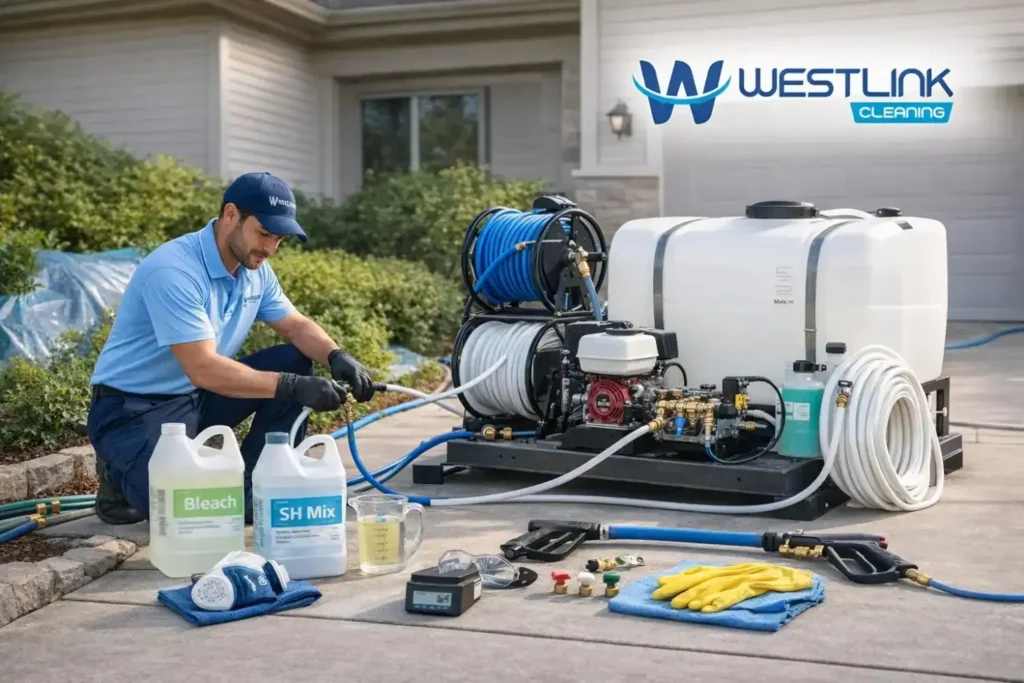
How to set up a soft wash system on site starts with preparing a low-pressure cleaning system by checking the pump, tank, hoses, nozzles, chemical mix, safety gear, and surface conditions before spraying. This helps apply the solution at the correct strength, clean the surface evenly, and protect plants, drains, and nearby areas during rinsing.
A correct setup involves understanding the equipment needed, system types, pre-site inspection, chemical handling, dilution, test patching, spray control, dwell time, rinsing, runoff management, troubleshooting, and post-job flushing so the work stays safe, efficient, and repeatable.
What does a proper on-site soft wash setup include?
A proper on-site soft wash setup includes preparing the equipment, chemical mix, spray pattern, and safety controls before cleaning begins so the surface can be treated evenly and safely. It requires checking the pump, tank, hoses, nozzles, valves, and mix strength, then confirming that the surface, nearby plants, drainage path, and working conditions are suitable for the job.
It also includes testing before full application. The operator should confirm that the system is drawing correctly, the solution is reaching the surface at the right strength, and the rinse plan will not create overspray, runoff, or surface damage. Without that preparation, even a strong system can produce weak, uneven, or unsafe results.
Why does setup quality affect cleaning quality, safety, and efficiency?
Setup quality affects cleaning quality, safety, and efficiency because soft washing depends on controlled chemical delivery rather than high force. If the system is not set correctly, the surface may receive too little solution, too much solution, uneven coverage, poor dwell time, or unnecessary runoff, all of which can reduce cleaning performance and increase risk.
A poor setup also wastes time and materials. Leaks, wrong nozzles, weak draw, bad dilution, and missed site checks can lead to rework, plant damage, streaking, or equipment corrosion. A correct setup reduces these problems and makes the job more consistent from start to finish.
When is soft washing the right method, and when is pressure washing the wrong one?

Soft washing is the right method when the surface is delicate, coated, painted, weathered, porous, or affected by mold, algae, mildew, or other biological growth that needs chemical treatment. It is commonly used on roofs, render, painted siding, timber, and other materials that can be damaged by aggressive pressure.
Pressure washing is the wrong method when force can strip coatings, etch render, roughen timber, force water behind cladding, or damage roofing materials. It may still suit harder surfaces such as some concrete and pavers, but it should not be the default choice for every exterior surface. The right method should always be chosen based on surface condition, contamination type, and damage risk.
| Factor | Soft Washing | Pressure Washing | Practical Implication |
| Pressure | Low pressure, often under 500 PSI | Much higher pressure | Lower risk on fragile finishes |
| Cleaning action | Chemistry + dwell + rinse | Force + rinse | Soft washing relies on correct mix and contact time |
| Best fit | Roofs, render, painted siding, timber | Concrete, dense masonry | Choose by substrate |
| Biological growth | Treats mould, algae, mildew | May remove surface grime faster | Soft washing often controls growth better |
| Risk profile | Less impact force, more chemistry responsibility | More force, less chemical dependence | Both need setup discipline |
What equipment is needed in a working soft wash setup?

A working soft wash setup needs a compatible pump, tank, hoses, spray gun, nozzles, valves, fittings, and a chemical metering method such as batch mixing, downstreaming, or a proportioner. It also needs basic safety gear because soft washing uses chemicals that can affect skin, eyes, breathing, nearby plants, and surrounding surfaces if handled carelessly.
Each part of the system affects performance. The pump controls flow and reach, the tank holds the solution, the hoses and fittings carry it through the system, and the nozzles shape the spray pattern and back pressure. If one part is set up badly, the whole system can suffer from weak draw, uneven coverage, poor rinsing, or chemical loss.
What system types can you use on site?
The main system types used on site are batch mix, proportioner, downstream, 12V, air diaphragm, and gas-powered setups. Each one is designed for a different level of control, output, flexibility, and job size, so the right choice depends on the type of surfaces being cleaned and how often the operator needs to change chemical strength during the job.
Batch mix systems are simple because the solution is mixed in the tank before spraying. Proportioners allow faster on-site adjustment by metering water, chemical, and surfactant into the stream. Downstream setups are often used with pressure washers for lighter application, while 12V, air diaphragm, and gas-powered systems vary more in output, reach, runtime, and job demand.
What should you inspect before you unload and mix?

Before unloading and mixing, you should inspect the surface, contamination type, nearby plants, drainage path, weather, access points, and overspray risk. This step helps prevent the wrong method, the wrong mix, or runoff and exposure problems that could have been avoided before spraying.
The inspection should begin with the surface itself. You need to know whether it is painted, porous, aged, delicate, or dense, then identify whether the staining is biological, mineral, greasy, oxidised, or mixed. After that, check surrounding risks such as storm drains, planting beds, foot traffic, wind direction, and how quickly the area may dry, because these factors affect dwell time, rinse control, and chemical safety.
How should chemicals be handled safely on site?
Chemicals should be handled safely on site by checking the product label and SDS before mixing, storing incompatible products separately,wearing suitable PPE, and preparing the mix at the correct strength for the surface and contamination type. Safe handling matters because soft washing often uses sodium hypochlorite and surfactants, which can cause exposure problems, equipment damage, or surface issues if used carelessly.
Chemical safety also depends on storage and compatibility. Bleach should never be mixed with acids, ammonia, or unknown cleaners, and old or poorly stored chemicals may not perform at its expected strength. Safe handling includes keeping products shaded, sealed, clearly identified, and away from areas where spills, runoff, or accidental contact can create risk during setup or spraying.
What is the correct step-by-step setup process on site?
The correct setup sequence is inspect, protect, assemble, verify, mix, prime, test, spray, rinse, flush, and pack down.
- Walk the site and inspect surface, stains, plants, drains, weather, and access.
- Review product labels and SDS.
- Move or protect nearby items.
- Pre-wet vegetation and prepare runoff control if needed.
- Assemble hoses, gun, nozzles, valves, and injector or proportioner.
- Check for leaks, blockages, loose tubing, and wrong flow direction.
- Mix or meter the solution to the required strength.
- Prime the system and confirm stable flow.
- Perform a test patch.
- Adjust nozzle, section size, and dwell time.
- Complete the main application and rinse fully.
- Flush the system with clean water before storage.
How do dilution and proportioning work?
Dilution works by reducing the source chemical to the correct final strength at the surface, while proportioning controls how water, sodium hypochlorite, and surfactant combine during application. Both matter because cleaning results depend on delivering the correct strength, not just on adding more product to the tank or increasing flow.
In a batch-mix system, the solution is measured and mixed in advance using the source strength and the target strength needed for the job. In a proportioner system, the operator adjusts valves or metering controls so the chemical and water combine at the required ratio while spraying. In both cases, the goal is the same: even delivery, stable performance, and enough chemical action to clean the surface without over-applying product or increasing risk.
How do you test patch and calibrate before full application?

A test patch and calibration check confirm that the chemistry, spray pattern, dwell time, and rinse plan match the actual surface before full application begins. This step reduces guesswork and helps the operator see whether the system is delivering the right strength, covering evenly, and reacting properly on the material being cleaned.
The test patch should be done on a small but representative area that shows the real condition of the surface. After that, the operator should check whether the spray is even, whether the solution stays on the surface long enough to work, and whether rinsing removes residue cleanly without streaking or damage. If the result is weak or uneven, the nozzle, section size, flow, or mix strength should be adjusted before continuing.
How should spray pattern, dwell time, and rinse be managed?
Spray pattern, dwell time, and rinse should be managed according to the surface type, contamination level, weather, and working conditions, because soft washing depends on controlled chemical action rather than force. The goal is to apply the solution evenly, keep it active for the right amount of time, and rinse it off without leaving residue or creating unnecessary runoff.
A correct spray pattern should wet the surface consistently without causing excessive drift or back pressure. Dwell time should be long enough for the chemistry to work but not so long that the solution dries on the surface. Rinsing should remove residues thoroughly while staying gentle enough to protect the finish. If any of these three parts are wrong, the cleaning result can become patchy, weak, or unsafe.
How should the setup change by surface type?
Surface type changes safe pressure, mix strength, dwell strategy, and risk control.
| Surface Type | Contamination Type | Setup Adjustment | Caution |
| Painted siding / weatherboard | Algae, mildew, light grime | Low pressure, even fan, moderate dwell | Avoid lifting paint or forcing water behind laps |
| Render / stucco | Algae, grime, black spots | Low pressure, controlled rinse | Avoid etching and streaking |
| Roof tile / shingles | Heavy growth, lichen, dark staining | Chemistry-led treatment, runoff planning | Avoid unnecessary force |
| Timber / cedar | Mildew, dirt, weathering film | Mild approach, careful test patch | High pressure can roughen fibres |
| Windows / trim / gutters | Light soil, residue | Controlled sectioning and light rinse | Avoid residue drying on glass |
| Concrete / pavers | Heavier grime and algae | May combine chemistry with stronger rinse if surface allows | Check drains and plant exposure first |
How do you protect plants, control runoff, and prevent stormwater problems?

Plants, runoff, and stormwater should be managed before spraying begins, because soft washing can affect surrounding areas if the solution is allowed to drift, pool, or enter drains. The operator should identify planting beds, downpipes, slope direction, and nearby stormwater entry points so the work can be planned around those risks instead of reacting after the spray has already been applied.
Plant protection usually starts with pre-wetting sensitive vegetation and rinsing it again after treatment. Runoff control means watching where wash water will travel and adjusting section size, rinse direction, and work sequence to reduce flow into drains or landscaped areas. Overspray control also matters, especially in wind, tight access areas, and spaces where vapors or drift can affect people, plants, or nearby surfaces.
What common setup mistakes cause poor results?
Most poor soft wash results come from preventable setup mistakes such as wrong mix strength, poor nozzle choice, skipped test patches, leaking fittings, weak chemical draw, or no runoff planning. These mistakes can lead to uneven cleaning, plant damage, streaking, wasted product, poor dwell performance, or extra time spent fixing problems that could have been avoided before the main application began.
Many operators also make mistakes by using old chemicals, assuming every surface needs the same setup, or starting large sections before checking how quickly the surface dries. The most reliable way to avoid poor results is to follow the same setup order on every job, verify the system before spraying, and treat surface type, stain type, and surrounding conditions as separate decisions instead of one general cleaning task.
How do you troubleshoot weak draw, leaks, poor pattern, low dwell, and poor cleaning?
Troubleshooting should start with the flow path first and the chemistry second, because many soft wash problems are caused by hardware setup issues rather than by the mix itself. If the system is not drawing properly, spraying evenly, or holding a stable pattern, the operator should first check for leaks, disconnected tubing, blockages, wrong injector direction, poor nozzle choice, or too much back pressure.
If the flow path is working correctly, the next step is to check dwell performance, source chemical strength, surface drying speed, and whether the stain type matches the chemistry being used. Weak draw, poor spray pattern, low dwell performance, and poor cleaning often look similar during the job, but they come from different causes, so each one should be checked in a logical order before changing the mix or increasing application strength.
How should a soft wash system be flushed, checked, and stored after the job?
After the job, the system should be flushed with clean water, checked for residue or damage, and packed down in a way that reduces corrosion, clogs, and future setup problems. This matters because sodium hypochlorite and related residues can remain inside hoses, nozzles, valves, and fittings after spraying, and that leftover material can shorten equipment life and affect the next job.
Post-job maintenance should include flushing the pump, lines, injector or proportioner, and spray gun, then checking for leaks, wear, dried residue, and damaged parts. The operator should also store remaining chemicals safely, keep equipment away from unnecessary heat and sunlight, and note any issue that needs repair before the next use so the same problem is not repeated later.
Should a beginner do this alone, or should a professional handle it?
A beginner can learn the basic process, but a professional is usually the safer choice when the job includes height, delicate finishes, strong chemical use, difficult drainage, or public exposure risk. Soft washing is simple in principle, but real job sites add variables such as aging paint, hidden water paths, sensitive landscaping, wind, and unknown surface conditions that can quickly increase the chance of damage or poor results.
A beginner should start with small, low-risk, easy-to-observe surfaces where setup, test patching, and rinsing can be practiced safely. Larger roofs, fragile materials, drainage-sensitive sites, and jobs near pedestrians or public areas usually require more experience, better hazard control, and a more reliable system than a beginner setup can usually provide.
What do risk, cost, and efficiency look like in practice?
Risk, cost, and efficiency in soft washing depend more on correct setup and repeatable process than on buying the cheapest equipment or finishing the fastest. A poor system or rushed setup often creates hidden costs through chemical waste, rework, damaged plants, weak results, failed fittings, corrosion, and extra time spent solving issues during or after the job.
Efficiency comes from standardizing the work: inspecting in the same order, mixing accurately, documenting settings, checking flow before spraying, and flushing the rig after every job. A setup that looks cheaper at the start can become more expensive if it creates breakdowns, uneven results, or short equipment life, while a better-planned system usually saves time by reducing mistakes and making each stage easier to repeat.
Conclusion
Setting up a soft wash system on site means getting the equipment, chemistry, surface checks, and environmental controls right before the main spray begins. When the operator inspects the site, chooses the correct method, verifies the mix, tests the output, manages runoff, and flushes the system after the job, the cleaning process becomes safer, more consistent, and easier to repeat.
Frequently Asked Questions
1. What PSI is considered soft washing?
Ans. Soft washing usually uses low pressure, often under 500 PSI, because chemistry does most of the cleaning work.
2. Can you use a pressure washer for soft washing?
Ans. Yes, sometimes, usually through a downstream injector and low-pressure setup, but it is not the same as a dedicated soft wash rig.
3. What chemicals are used in soft washing?
Ans. Most soft wash systems use water, sodium hypochlorite, and a surfactant, with other additives only when they are safe and compatible.
4. How do you mix a soft wash solution?
Ans. You mix it by calculating the target strength from the actual source concentration, then measuring carefully instead of guessing.
5. Is soft washing safe for plants and pets?
Ans. It can be safe when the chemistry is controlled, plants are pre-wet and rinsed, and pets are kept away until surfaces are fully rinsed.
6. Can you soft wash in the rain?
Ans. Sometimes, but rain changes dwell, runoff, footing, and dilution, so the conditions must be assessed carefully.
7. What surfaces should be soft washed?
Ans. Soft washing is commonly used on roofs, render, painted siding, timber, and other delicate exterior finishes.
8. What is a softwash proportioner?
Ans. A softwash proportioner is a device that meters water, chlorine, and surfactant into the stream at adjustable ratios.
9. Why is my downstream injector not pulling chemicals?
Ans. The most common causes are leaks, wrong injector direction, blocked parts, or too much back pressure from the nozzle setup.
10. How long does soft washing last?
Ans. It depends on the surface, moisture, shade, and how completely the biological growth was treated, but results can last much longer than a basic rinse-only clean.


