
NDIS-funded support can cover household cleaning, while help with routine mobility-equipment cleaning may also be possible when the task relates to your disability, fits your plan and stays within the worker’s agreed scope. Technical servicing, adjustments and repairs are different and should be handled as assistive-technology work.
The important distinction is not simply whether the cleaner is touching a floor or a wheelchair. The real questions are what task needs to be done, why you need help with it and who is suitable to perform it.
Current NDIS guidance says plan funding can only be used for NDIS supports that relate to your disability and are in line with your plan. The guidance clearly recognises help with everyday cleaning. It also tells participants to regularly clean assistive technology according to manufacturer instructions. However, it does not specifically say that every professional wheelchair or mobility-aid cleaning task automatically falls under household cleaning.
What Household Cleaning Can NDIS Support Cover?

Core Supports can help with everyday household cleaning when you need assistance with daily-life tasks because of your disability.
NDIS guidance says Assistance with Daily Life can be used to hire support workers for everyday activities such as cleaning, cooking, yard maintenance and personal care when the support fits the participant’s plan.
For household cleaning, that can include tasks such as vacuuming carpet, mopping hard floors and cleaning essential household surfaces.
The reason assistance is required matters.
For example, a participant may be unable to mop safely because the task requires repeated bending, reaching, gripping or standing. Those same functional limitations can also make it difficult to reach the lower frame of a wheelchair or safely clean a walker.
That does not make every equipment-cleaning service automatically fundable. It explains why the disability-related need for assistance is central to the question.
Can NDIS-Funded Support Help Clean Mobility Equipment?

Routine assistance with suitable mobility-equipment surfaces may be possible, but it should be checked against your plan, provider scope and the equipment manufacturer’s instructions.
Mobility equipment can include manual wheelchairs, powered wheelchairs, mobility scooters, walkers, rollators, shower chairs and transfer equipment.
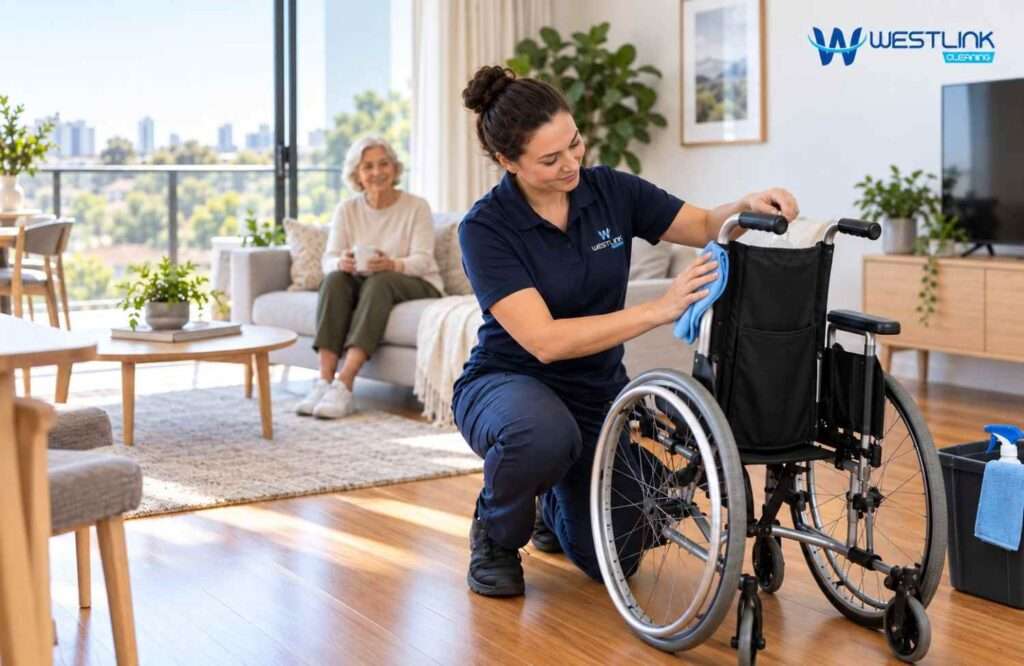
A routine task might involve wiping an accessible wheelchair frame, push handles or walker handles.
That is different from asking someone to repair a brake, inspect a motor or dismantle a powered component.
The NDIS advises participants to regularly clean assistive technology according to the manufacturer’s instructions. It also recommends specialist providers for regular servicing and technical maintenance.
This creates an important boundary:
Routine surface cleaning is not the same as servicing or repair.
Cleaning, Maintenance or Repair: What Is the Difference?

The exact action determines the type of service more clearly than the equipment name does.
| Task | What it is | Who would normally handle it |
| Vacuum carpet | Household cleaning | Cleaner or suitable support worker |
| Mop hard flooring | Household cleaning | Cleaner or suitable support worker |
| Wipe wheelchair push handles | Routine equipment cleaning | Worker/provider if within scope and safe |
| Wipe an accessible wheelchair frame | Routine equipment cleaning | Worker/provider if within scope and safe |
| Wipe walker handles | Routine equipment cleaning | Worker/provider if within scope and safe |
| Adjust wheelchair brakes | AT maintenance | Suitable AT provider |
| Service a mobility scooter motor | AT maintenance | Suitable AT provider |
| Repair a powered wheelchair joystick | AT repair | Suitable repair provider |
| Replace a damaged component | Repair/replacement | Suitable AT provider |
Cleaning deals with suitable surfaces and contamination.
Maintenance helps keep equipment working correctly through activities such as inspection, adjustment or scheduled servicing.
Repair deals with equipment that is damaged, faulty or no longer operating correctly.
Current NDIS guidance says participants should arrange regular servicing with providers who specialise in their equipment. Separate NDIS funding arrangements also exist for AT repairs and maintenance, including major repairs and regular servicing.
So a domestic cleaner should not be expected to adjust brakes, service batteries, open electrical systems or repair powered controls simply because the equipment is being cleaned during the same visit.
Which NDIS Funding May Apply?
Household cleaning commonly relates to Assistance with Daily Life, while technical AT maintenance and repairs have separate assistive-technology funding arrangements.
Core Supports can fund help with everyday cleaning when that support is included and appropriate for the participant.
For assistive technology, NDIS guidance separately covers maintenance and repairs. It states that funding for repairs and maintenance is generally included when mid-cost or high-cost AT is approved, while major repairs and regular servicing can sit within Capital Supports under assistive technology repairs and maintenance.
Routine mobility-equipment wiping sits between those clearer categories.
That is why it is safer not to assume:
“wheelchair = Capital Supports”
or:
“cleaning = automatically Household Tasks.”
Instead, define the actual work first.
“Wipe the external wheelchair frame and handles” describes a very different service from “service the wheelchair brakes.”
Can My Existing Cleaner or Support Worker Do It?
Possibly, but funding approval and provider scope are two different questions.
Use three checks.
First, confirm that the assistance is consistent with your NDIS plan and disability-related support needs.
Second, ask whether your cleaner or support worker actually offers the task. A provider may offer household cleaning but exclude mobility equipment, while another may agree to appropriate routine surface cleaning.
Third, check whether the task can be completed safely without moving into technical equipment work.
Powered wheelchairs and mobility scooters need particular care because they can include electrical controls, batteries, motors and specialised seating. The NDIS advises following the manufacturer’s cleaning instructions rather than applying one generic cleaning method to every type of AT.
A support worker helping with ordinary cleaning does not automatically become an AT technician.
What Should You Confirm Before the Cleaning Visit?

Define the exact task before asking whether it can be added to your NDIS cleaning support.
A practical sequence is:
- Identify the equipment, such as a wheelchair, walker, scooter or shower chair.
- Describe the exact task, such as wiping the external frame or handles.
- Check the manufacturer’s cleaning instructions.
- Confirm that you need assistance because of your disability and that the support fits your plan.
- Ask the provider whether the task is within their service scope and booked time.
- Use an AT provider instead if the work involves servicing, adjustment, electrical components or repair.
Specific wording helps.
“Can you clean my wheelchair?” leaves several questions unanswered.
“Can routine wiping of the external frame and push handles be included in my cleaning scope, following the manufacturer’s instructions?” makes the request much clearer.
A service agreement can also clarify what support the provider will deliver, its cost and how the arrangement can be changed. The NDIS recommends service agreements as a way to make those expectations clear.
Who Should I Ask If I Am Unsure?
Ask the person responsible for the part of the decision that is unclear.
Your cleaner or provider can confirm whether they perform the task.
Your plan manager, support coordinator or my NDIS contact can help clarify how the requested support relates to your plan where needed.
The equipment manufacturer or supplier can tell you which cleaning methods and products are suitable.
A qualified AT provider should handle servicing, adjustments, faults and repairs.
This separation matters because a cleaning provider can explain its service scope, but it cannot guarantee that every requested task can be claimed from an individual NDIS plan.
Conclusion
You can ask your provider to add suitable routine equipment cleaning, but confirm the exact task, available cleaning time, manufacturer requirements and funding arrangement first.
For example, a participant who already receives help with floors and bathrooms could ask whether wiping suitable external wheelchair or walker surfaces can be included within the agreed visit.
The provider should explain what it can safely clean and what requires an AT specialist.
Westlink Cleaning Services can clarify whether an appropriate routine equipment-cleaning task falls within its cleaning scope. Funding eligibility should still be checked against the participant’s individual NDIS plan and management arrangement.
The key question is therefore not simply whether NDIS cleaning stops at the floor. The correct boundary depends on the exact task: household cleaning, routine mobility-equipment assistance, or specialist assistive-technology maintenance and repair.
Frequently Asked Questions
Can an NDIS cleaner clean my wheelchair?
Routine surface cleaning may be possible when the assistance relates to your disability, fits your plan and is within the provider’s agreed scope. Technical servicing and repairs should be handled separately.
Can a support worker wipe down a walker or mobility aid?
A support worker may be able to assist with appropriate routine cleaning within their support role. The exact task should be agreed beforehand and completed according to the equipment manufacturer’s instructions.
Is wheelchair cleaning the same as wheelchair maintenance?
No. Cleaning suitable external surfaces is different from servicing brakes, adjusting components, inspecting mechanical systems or repairing faults. The latter tasks belong with an appropriate AT provider.
Can a cleaner clean a powered wheelchair or mobility scooter?
Suitable external surfaces may be cleaned where manufacturer guidance allows it, but electrical controls, batteries, motors and other technical components require additional care and may need a specialist.
Does my plan-management type matter?
It affects which providers you can use, but it does not make an otherwise unsupported task eligible. NDIA-managed funding requires registered providers, while plan-managed and self-managed participants can usually choose registered or unregistered providers, subject to specific exceptions.


