
Keeping a clean and safe home can become difficult when a disability affects your ability to complete everyday household tasks. For eligible NDIS participants, home cleaning and domestic assistance may be funded when the support is directly related to their disability needs and meets the NDIS reasonable and necessary criteria.
NDIS funding for cleaning is not designed to cover general household chores that everyone is responsible for. Instead, it helps participants access support for essential domestic tasks they cannot complete safely or independently because of their functional limitations.
To request cleaning support, participants usually need to explain how their disability affects their ability to manage household tasks, provide relevant supporting evidence, and ensure the requested support aligns with their NDIS plan goals. This guide explains how NDIS funding for home cleaning works, who may qualify, what evidence can help, and how to choose an appropriate cleaning provider in Sydney.
NDIS funding for home cleaning refers to support that helps participants maintain a safe and hygienic living environment when their disability prevents them from completing essential domestic tasks independently.
Cleaning assistance is generally considered a form of household support. The purpose is not simply to provide convenience but to reduce disability-related barriers that affect a person’s ability to live safely and maintain independence.
The NDIS does not generally fund cleaning because someone does not have enough time, prefers professional cleaning, or wants help with ordinary household responsibilities.
Cleaning support may be considered when a participant’s disability creates specific barriers, such as:
The focus is on the connection between the person’s disability and their need for support.
A clean and safe home environment can support independence, health, and daily functioning. For some participants, assistance with household tasks may help reduce safety risks, conserve energy for important activities, and support participation in community, work, education, or personal goals.
Yes, NDIS may fund cleaning support when it meets the required funding criteria. Each participant’s situation is assessed individually, and approval depends on whether the support relates to their disability needs.
The NDIA considers factors such as whether the support helps achieve personal goals, provides value for money, is effective and beneficial, and whether informal supports can reasonably provide the assistance.
Depending on individual circumstances and approved funding, NDIS cleaning support may include essential household tasks such as vacuuming, mopping, bathroom cleaning, kitchen cleaning, dusting, and maintaining hygiene areas. The type and amount of support provided depends on the participant’s plan and individual needs.
NDIS cleaning support is generally not intended for general household cleaning unrelated to disability, end-of-lease cleaning, major repairs, maintenance work, trade services, or ordinary household expenses. Support must be directly connected to the participant’s disability-related needs.
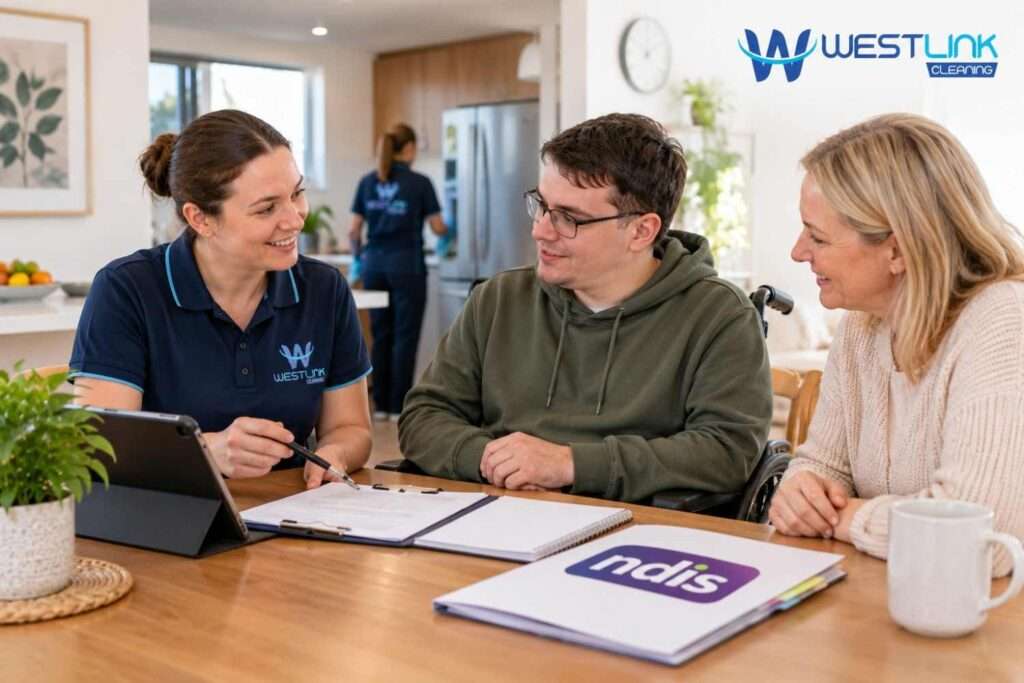
Cleaning assistance is commonly funded through the Core Supports budget, particularly under Assistance with Daily Life, when it is included as an approved disability-related support.
The amount of funding available depends on each participant’s individual plan and support needs. Participants should check their plan details or speak with their plan manager, support coordinator, or NDIS contact to understand how their funding can be used.
The way a participant manages their plan can also affect provider choice:
NDIS funding must always be used in line with the participant’s plan and applicable NDIS requirements.
NDIS eligibility for cleaning support is based on the impact of a person’s disability on their ability to complete daily activities, rather than simply their diagnosis. A participant may be considered for cleaning assistance when their disability creates ongoing barriers that affect their ability to maintain a safe and hygienic home environment.
Disability-related barriers may include difficulty standing, bending, lifting, or moving safely while completing household tasks. Reduced mobility can make cleaning activities unsafe or physically demanding, while chronic fatigue, pain, or medical symptoms may limit the ability to complete essential chores. Some participants may also experience cognitive, neurological, or sensory challenges that affect daily household management. In addition, there may be an increased risk of injury, falls, or health concerns when essential cleaning tasks cannot be completed safely.

Getting cleaning support included in an NDIS plan requires clearly explaining your needs and providing evidence that connects your disability to your household support requirements.
Before requesting support, consider which tasks you cannot complete safely or consistently because of your disability.
Examples include:
Focus on the functional impact rather than simply saying that you need help cleaning.
Explain your household challenges during your planning meeting, plan reassessment, or discussions with your support coordinator or Local Area Coordinator (LAC).
Be specific about:
Strong evidence helps the NDIA understand your daily challenges and functional limitations.
Useful evidence may include:
Evidence should focus on functional impact rather than only describing a medical diagnosis.
The NDIA reviews whether the requested support meets the reasonable and necessary criteria.
If approved, cleaning assistance may be included within the appropriate area of your NDIS plan, allowing you to use your funding according to your plan arrangements.
Once funding is available, choose a provider that understands disability support requirements and can deliver services that match your needs.
Consider:
Regularly consider whether your cleaning support is helping you maintain safety, independence, and quality of life.
If your circumstances change, discuss your needs through the appropriate NDIS review process.

The strongest applications usually explain the connection between a person’s disability and their difficulty completing household tasks.
Evidence may include:
An occupational therapist can assess how your disability affects daily activities, including:
Reports from medical professionals can provide information about:
Real-life examples can help explain your support needs.
For example:
Instead of saying:
“I cannot clean my bathroom.”
A stronger explanation would be:
“Due to balance difficulties and pain when bending, I cannot safely clean my bathroom without an increased risk of falling.”
Specific examples show how the disability creates a functional barrier.
There is no standard number of cleaning hours that every NDIS participant receives. Funding decisions are individual and depend on each participant’s circumstances.
Factors that may influence the amount of support include:
Participants with greater functional limitations may require more assistance with household tasks.
The NDIA may consider:
The amount of assistance needed may vary depending on:
The goal is not to provide a standard cleaning service but to fund reasonable support related to disability needs.

Choosing the right NDIS home cleaning provider is important because support workers enter your personal home environment. A suitable provider should understand your needs, respect your privacy, and provide reliable services that support your independence and comfort.
Participants comparing NDIS cleaning providers in Sydney can also consider Westlink Cleaning Services when reviewing available home cleaning support options.
A good provider should understand that NDIS cleaning support is not just about completing household chores. It should focus on helping participants maintain safety, independence, and dignity while receiving support with daily tasks. Providers should also follow applicable work health and safety requirements when using cleaning products and equipment in a participant’s home.
Choose a provider that clearly explains service costs, available support options, and how billing works under NDIS requirements. Clear pricing helps participants understand their services and manage their funding effectively.
Reliable support workers can make cleaning services more comfortable and effective. Having familiar workers helps them understand your routines, preferences, and individual support needs.
Your needs may change depending on your health, appointments, or daily circumstances. A suitable provider should offer flexible support and adjust cleaning priorities when required to continue meeting your needs.
When requesting NDIS cleaning support, certain mistakes can create challenges during the approval process or affect how effectively your funding is used. Understanding these common issues can help participants better explain their needs and choose suitable support options.
A request based only on wanting extra help around the house may not clearly demonstrate a disability-related need. NDIS support focuses on assistance required because of a person’s disability rather than general household preferences.
Better approach: Explain how your disability affects your ability to complete essential household tasks safely and why additional support is required.
A general medical letter may not clearly explain your daily functional limitations or how your disability affects household activities. Without specific information, it can be difficult to understand your support requirements.
Better approach: Include evidence that connects your disability to specific household barriers, such as difficulty completing cleaning tasks safely or independently.
Not every provider arrangement works for every participant, as options can depend on how your NDIS plan is managed and the type of support you require.
Better approach: Understand your plan management type and choose a provider that meets your funding arrangements and support needs.
NDIS funding must be used according to your approved plan and applicable requirements. Using funds for services that are not related to your disability needs may create issues.
Better approach: Confirm that the cleaning support directly relates to your disability-related needs before arranging services.
NDIS funding for home cleaning may be available when a participant’s disability prevents them from completing essential household tasks safely and independently.
The strongest requests focus on functional impact, clear evidence, and the connection between cleaning support and personal goals.
If you are considering NDIS cleaning support in Sydney, start by understanding your needs, gathering relevant evidence, and choosing a provider that understands disability-focused support.
NDIS may cover essential household cleaning when a participant's disability prevents them from completing these tasks safely, and the support meets NDIS funding requirements.
You need to explain how your disability affects your ability to manage household tasks and provide evidence showing your functional support needs.
NDIS may fund cleaning assistance when it is an approved disability-related support in your plan. The options available depend on your plan management type.
There is no fixed number of cleaning hours. The amount depends on individual circumstances, disability impact, living arrangements, and approved plan funding.
Useful evidence may include occupational therapy assessments, medical reports, and examples showing how your disability affects your ability to complete household tasks.
Cleaning may be considered a disability support when it is required because of a person's disability-related functional limitations.