

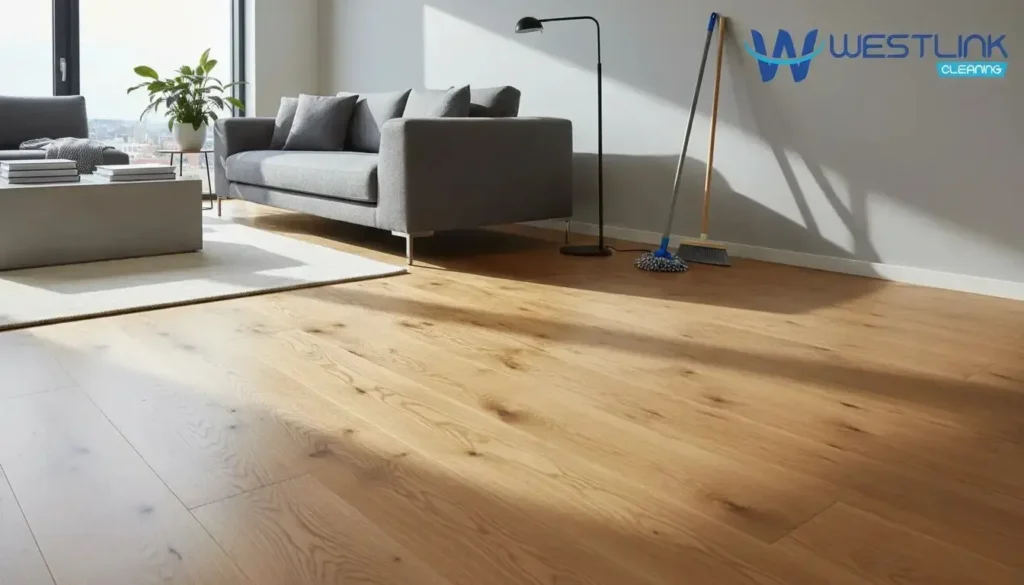
Long-term timber floor care starts with a simple system: remove grit regularly, keep moisture low, protect the finish from wear, and manage the indoor conditions that affect timber over time. Timber floor care is not only about mopping or polishing. It is about preventing the slow damage that comes from dust, foot traffic, sunlight, furniture movement, pet wear, and finish breakdown. If the surface already looks dull, patchy, or harder to maintain, professional hard floor cleaning can help restore a cleaner, more even finish with the right method for the floor type.
That matters because timber floors usually do not fail all at once. Most damage builds gradually. Fine dust scratches the coating. Repeated moisture weakens the finish. Daily traffic wears down the surface. Sunlight changes the colour. Seasonal humidity changes can affect board movement, small gaps, or slight swelling. By the time many people notice a problem, the finish may already be thin in the main traffic lanes.
What does long-term timber floor care actually mean?
Long-term timber floor care means protecting both the timber boards and the protective finish over months and years, not just removing visible dirt today. A proper care plan helps preserve appearance, hygiene, finish integrity, surface safety, and the useful life of the floor.
In practical terms, long-term care comes down to five things: dry soil removal, moisture control, finish-safe cleaning, scratch prevention, and timely maintenance before the finish fails. That matters because the finish is the first protective layer. On many timber floors, the finish wears first, long before the timber itself is badly damaged. When that layer is maintained early, the floor usually lasts longer and needs less aggressive restoration later.
Why do timber floors need a care plan?

Timber is a natural material, so it reacts to real use conditions in a way that many harder surface types do not. It does not behave like tile, sealed concrete, vinyl, or laminate. Timber floors can respond to standing water, abrasive dirt, harsh cleaners, rolling pressure, strong sunlight, and shifting humidity in ways that directly affect both appearance and durability.
Without a long-term care plan, common issues develop faster. These include fine scratches in traffic zones, dull finish in walkways, spill marks, grime near board edges, uneven colour from sunlight, and earlier recoating or refinishing. A care plan reduces guesswork. It tells you what to clean, how to clean it, how often to inspect it, and what warning signs should trigger the next step.
What types of timber floors need long-term care planning?
All timber floors need long-term care planning, but the details depend on the floor structure and the finish system.
1. Solid timber floors
Solid timber floors are made from full timber boards. They often allow more future restoration because they usually have more sanding potential than thinner wear-layer products. At the same time, they can react more noticeably to changing indoor moisture conditions, so stability in the room matters.
2. Engineered timber floors
Engineered timber floors have a real timber top layer over a layered core. They are often more dimensionally stable than solid boards, but the wear layer can be more limited. That makes finish protection especially important. If wear reaches the timber surface too early, repair and refinishing options may be narrower. If you want a more detailed maintenance breakdown for layered timber surfaces, see this engineered timber floor cleaning guide.
3. Parquetry, patterned floors, and timber stairs
Parquetry floors, including herringbone and chevron layouts, need careful long-term planning because they have more joints and stronger pattern visibility. Uneven wear, residue, and patchy scratching can show more clearly. Timber stairs and landings also need special attention because they wear faster than flat floor areas due to concentrated pressure and repeated directional traffic.
Why does the finish type change the care plan?

The finish type changes the care plan because the cleaner, maintenance product, renewal cycle, and wear pattern depend heavily on the coating system.
Polyurethane finishes form a protective surface film and usually respond best to low-moisture cleaning, residue-free maintenance, and timely recoating before the film wears through.
Water-based finishes are often chosen for lower odour, quicker drying, and a more natural timber look. They still need careful product selection because harsh or residue-heavy products can affect how the surface looks over time.
Oiled floors need a different approach. The goal is not only to clean the floor but also to maintain the protective oil layer and refresh the surface when needed. If that step is ignored, the floor can start to look dry, patchy, or uneven faster than a sealed floor.
Waxed or specialty finishes should not be treated with generic products. The safest rule is to match the cleaning and maintenance method to the actual finish, not only to the timber itself.
What affects timber floor lifespan the most?
Timber floor lifespan is shaped by daily conditions more than many people expect. The biggest influences are traffic, grit, moisture, sunlight, furniture movement, pets, and indoor humidity.
High-traffic zones wear faster than quiet rooms. Entry paths, kitchen walkways, corridors, dining routes, office chair zones, and stair landings usually need more frequent cleaning and earlier inspection.
Fine grit is one of the most damaging materials for timber finishes because it acts like an abrasive under shoes, chairs, and repeated movement. That is why sweeping, dust mopping, vacuuming, and entry mat control matter so much.
Spills also play a major role. Water, coffee, juice, pet accidents, and over-wetting during cleaning can all affect the surface if they sit too long. Some spills leave residue. Others weaken the finish or seep into vulnerable edges.
Humidity is another major factor. Timber responds to the surrounding environment. When indoor air becomes too dry or too humid, the boards and finish can both be affected. Stable indoor conditions usually support better long-term performance.
Sunlight can also fade timber, change colour tone, and create uneven ageing between exposed and covered areas. Furniture adds another layer of wear, especially where repeated movement and concentrated pressure occur. Homes with pets and children usually see more dynamic traffic and more small impact marks, so the care plan should reflect actual use, not ideal conditions.
How do you plan long-term timber floor care step by step?
A long-term timber floor plan should be practical, repeatable, and based on the real conditions in the space.

1. Identify the floor and finish
Start by identifying whether the floor is solid timber or engineered timber, the finish type, the approximate age of the floor, and any visible damage or past repairs. This matters because a cleaner that suits one finish may not suit another. A floor that has already been recoated, patched, or partly worn may need a more cautious approach.
2. Divide the floor into care zones
Do not treat the whole property the same. Divide it into high, medium, and low-traffic zones. Entries, hallways, kitchens, stairs, and main living paths usually need the most attention. Bedrooms, dining areas, and home offices often sit in the middle. Guest rooms and occasional-use spaces usually need less frequent care.
This zoning helps you apply the right cleaning frequency, inspection routine, and protection measures to each part of the floor.
3. Build the routine around dry cleaning first
Dry cleaning is the foundation of timber floor care. Remove loose dirt before it becomes abrasive. In busy areas, that usually means sweeping with a soft broom, dust mopping with microfiber, vacuuming on the correct hard-floor setting, and wiping spills straight away.
Full-floor vacuuming should be done regularly, with extra attention to edges, corners, chair zones, and entries where grit and residue build up faster.
4. Keep damp cleaning controlled
A timber floor should never be saturated, flooded, or left with standing water. Use a microfiber mop that is only slightly damp, not wet. The floor should dry quickly after cleaning.
The goal is to lift light residue without pushing moisture into joints, edges, or worn parts of the finish. A timber floor cleaner should suit the finish type and should not leave a heavy film behind.
5. Add protection measures
Long-term care is not only about cleaning. It is also about prevention. Entry mats help stop grit before it spreads across the floor. Felt pads reduce friction under chairs, tables, beds, and other movable furniture. Protective mats can help under desk chairs. Rugs in sunny rooms should be rotated from time to time. Heavy furniture should be lifted, not dragged. Pet nails should be kept trimmed, and spills should be cleaned before they sit too long.
These simple measures reduce scratch load, pressure damage, and dirt transfer far more than many people expect.
6. Monitor the indoor environment
Indoor conditions affect how timber and finish systems perform over time. If a home or office becomes very dry, very humid, or heavily sun-exposed, the floor may show signs of stress more quickly. Pay attention to direct sunlight patterns, seasonal humidity shifts, nearby wet areas, heating and cooling effects, and any new gaps, cupping, movement, or surface dullness. It also helps to understand that prolonged moisture and unresolved water damage can increase indoor dampness risk, which is why the WA Health guidance on mould and dampness and the ABCB condensation handbookare useful references when you are assessing room conditions around timber floors.
7. Inspect the floor regularly
A long-term plan should include regular visual inspection, not just cleaning. Check busy zones monthly and review the wider property every few months. Look for dull finish in walk paths, scratches that collect dirt, rough patches, edge marks near entries or kitchens, local discoloration, furniture drag marks, and signs of moisture-related stress.
Inspection helps you act before the finish fails and before repair options become more expensive.
What is a practical maintenance schedule for timber floors?
A simple maintenance schedule is easier to follow than an overly detailed one.
Daily care should focus on removing dust, grit, crumbs, and tracked-in dirt from busy areas. Clean spills immediately and check wet shoes, pet bowls, and food-preparation zones.
Weekly care should include full-floor vacuuming and a controlled damp clean where needed. This is also a good time to inspect entry areas, kitchen paths, dining zones, and furniture contact points.
Monthly care should include checking felt pads, furniture legs, rugs, and high-wear traffic lines. Clean under movable rugs and furniture where practical, and look for developing dullness or visible wear.
Quarterly care should include reviewing sunlight exposure, humidity, chair-wheel damage, air-conditioning effects, and edge wear. Rotate rugs if fading is uneven.
Annual care should focus on the condition of the finish as a whole. Decide whether the floor only needs routine care, a finish refresh, local repair, or professional recoating advice.
What cleaning methods and products are safest for timber floors?
The safest approach usually follows three steps: dry soil removal first, spot cleaning second, and low-moisture damp cleaning only when needed.
A soft broom, microfiber dust mop, and vacuum with a hard-floor setting are usually the core tools. For damp cleaning, use a timber floor cleaner that suits the finish and a microfiber mop that has been wrung out properly. The mop should clean the surface, not soak it.
The better product choices are usually simple: a microfiber mop, a soft-bristle broom, a vacuum designed for hard floors, a finish-safe cleaner, felt pads, breathable mats, and soft wheel protection for rolling chairs.
The risky options are just as important to recognise. These include soaking wet mops, steam mops, harsh multi-surface chemicals, abrasive scrubbers, strong alkaline or residue-heavy cleaners, and generic polish or wax that does not suit the finish. The wrong product can leave the floor dull, sticky, streaky, or prematurely worn.
How do you prevent scratches, dullness, and premature wear?
The best way to prevent visible timber floor wear is to reduce friction and contamination before they spread across the surface. Stop grit at the entrance, keep traffic paths clean, protect furniture contact points, control rolling pressure from wheels, clean spills before they dry sticky, rotate rugs in sunny spaces, and avoid dragging heavy items.
Most floors wear the fastest where dirt, friction, and repeated pressure combine. That is why prevention usually gives better results than trying to fix a problem after the finish has already started failing.
How do you know when routine cleaning is no longer enough?
Routine cleaning is no longer enough when the problem sits in the finish system or the timber surface itself, not in removable dirt.
Common warning signs include dull walk paths that stay dull after proper cleaning, scratches that remain visible, rough-feeling patches, uneven sheen between traffic zones, local dark marks or stain shadows, worn edges near entries or kitchens, slight lifting, moisture signs, and areas that still look dry, tired, or patchy even when clean.
At that point, stronger cleaning is usually not the answer. The floor may need a finish refresh, local repair, or refinishing instead.
When should a timber floor be recoated, repaired, or refinished?
A timber floor should usually be recoated when the finish is visibly worn but the timber underneath is not yet exposed. This is often the best time to act because recoating restores protection before deeper deterioration starts. Recoating may be appropriate when traffic lanes look dull, light scratches are widespread, the floor cleans up but still looks tired, or the protective layer appears thinner in busy paths.
Repair is often the better option when isolated boards are damaged, there are gouges or local water marks, or one section has abnormal wear.
Refinishing is more likely when the finish has worn through, bare timber is exposed, or damage is deeper than a surface recoat can solve. This is especially important with engineered timber because sanding depth may be more limited than on solid timber floors.
When should you call a professional?
You should call a professional when proper cleaning no longer improves the floor, when traffic lanes are visibly wearing through, when moisture marks or movement appear, when you are unsure of the finish type, or when the floor may need recoating, repair, or refinishing.
Professional assessment is useful because many floor problems look similar from the surface. A dirty floor, a residue-covered floor, and a finish-worn floor can easily be mistaken for each other.
Conclusion
Planning long-term timber floor care is about more than keeping the surface clean. It is about managing the full life of the floor. That includes the timber structure, the finish system, the room environment, the traffic pattern, and the timing of preventive maintenance.
The strongest long-term plan is simple and consistent. Remove grit early, keep moisture low, use finish-safe cleaning methods, protect high-wear zones, watch for sunlight and humidity changes, and inspect the finish before it fails.
If you follow that approach, timber floors usually stay cleaner, wear more evenly, and hold their appearance for much longer.
Frequently Asked Questions
1. How often should timber floors be cleaned?
Ans. Timber floors should usually be dry cleaned as often as needed in busy zones, with regular full-floor vacuuming and low-moisture damp cleaning based on traffic, spills, and finish type.
2. Can steam mops damage timber floors?
Ans. Yes. Steam and heat can stress the finish and introduce unwanted moisture into the floor system.
3. What is the safest way to mop a timber floor?
Ans. Use a microfiber mop that is only slightly damp with a cleaner suited to the finish. The floor should dry quickly after cleaning.
4. Can sunlight affect timber floor colour?
Ans. Yes. Direct sunlight can change timber colour over time and may create uneven fading between exposed and covered areas.
5. Why do timber floors look dull even after cleaning?
Ans. A dull floor may have finish wear, residue buildup, fine scratching, or uneven sheen in traffic zones. The issue is not dirt.


