

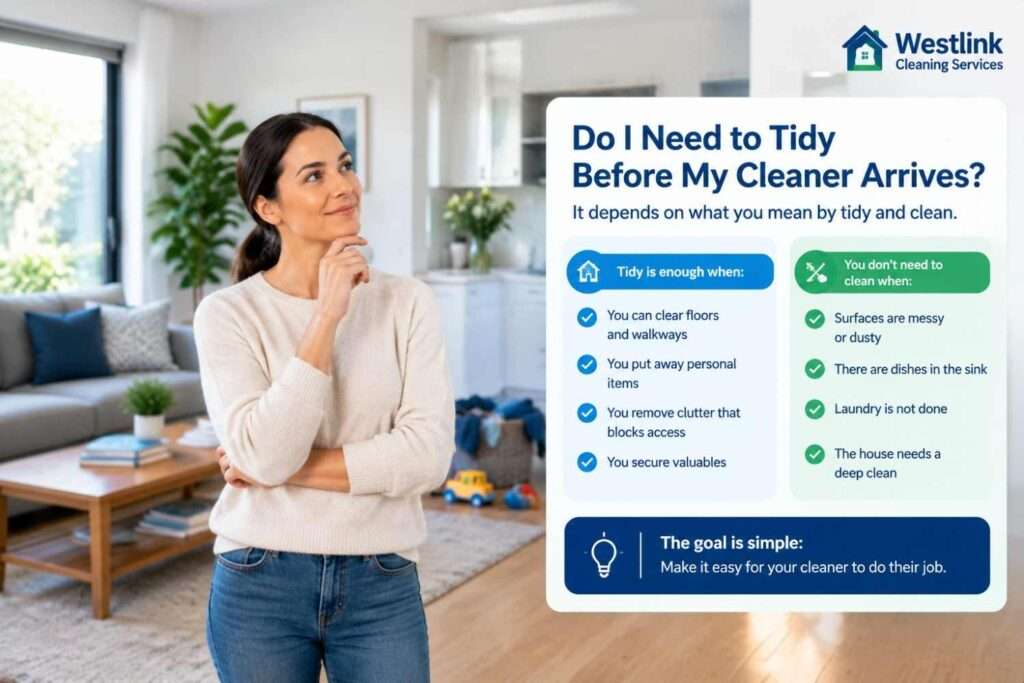
A light tidy helps your house cleaner reach floors and surfaces, but you generally do not need to clean the home first. Putting away loose clothes, toys, and private items gives the professional clearer access to perform their agreed duties. Expectations can vary based on the provider, so clarifying the service scope prevents misunderstandings. Heavy decluttering is usually not included in standard cleaning packages.
Introduction
Hiring a house cleaner in Sydney should reduce your daily stress, yet many people worry about how their home looks before the doorbell rings. Preparation matters primarily because it allows the cleaner to focus their time on removing dirt rather than navigating around daily household items. This guide explains exactly what you should do before a professional arrives, how to handle different levels of clutter, and what tasks are typically left to the cleaner. You absolutely do not need a spotless home before the appointment begins.
A Clear Decision Framework: How Much Should You Tidy?
Your preparation steps depend entirely on the current condition of your home.
The reason this matters is that cleaners need unobstructed access to floors and surfaces to wash them properly. For example, a cleaner can thoroughly mop a clear hallway in minutes, but a hallway covered in shoes and backpacks requires either moving the items or skipping the floor underneath. The main limitation is that standard house cleaners are not professional organisers, meaning they will generally clean around large piles of clutter. You should assess your home and take the following actions based on your situation:
- Light daily clutter: Put away loose items, such as shoes and mail, and leave the scrubbing to the professional.
- Moderate clutter: Prioritise clearing important floors, bathroom vanities, and kitchen work areas first. Let less critical areas remain as they are.
- Heavy clutter: Recognise that heavy clutter may require extra preparation on your end, more booked time, or a separate professional decluttering service before the cleaner arrives.
- Limited mobility, illness, or lack of time: Communicate your situation to the cleaning company before the appointment. Agree on specific priority rooms so the cleaner knows exactly where to focus their efforts.
Read more about: Is Hiring a House Cleaner Worth It for Busy Sydney Families
Task-Boundary Table: Who Does What?
Knowing exactly who handles which chore prevents confusion and ensures you get the most out of a professional house cleaning service. While exact scopes depend on your specific provider and booking agreement, standard responsibilities generally follow this breakdown:

| Task | Usually handled by the customer | Usually handled by the cleaner |
| Picking up clothes | Yes | No |
| Putting away toys | Yes | No |
| Loading dishes | Yes | No (unless specifically agreed) |
| Folding laundry | Yes | No |
| Clearing countertops | Yes | No |
| Dusting surfaces | No | Yes |
| Vacuuming floors | No | Yes |
| Mopping hard floors | No | Yes |
| Scrubbing bathrooms | No | Yes |
| Cleaning kitchen surfaces | No | Yes |
| Changing bed linen | No | Yes (if included in booking) |
| Organising cupboards | Yes | No |
Home Scenarios and How to Handle Them
Every home operates differently, meaning preparation looks different for every family.
The reason practical preparation varies is that the obstacles in a family home are vastly different from the obstacles in a shared apartment. For instance, preparing a family home involves clearing toys, whereas preparing for a deep clean involves emptying cabinets. A limitation to remember is that cleaners cannot make safety assumptions about your belongings, so you must secure sensitive items yourself. Review these practical scenarios and take the recommended actions:

- A family home with toys and school bags: The customer should pack away the toys and hang up the bags. The cleaner will be able to vacuum the floors fully. Confirm beforehand if the cleaner is willing to push a single toy box aside.
- A kitchen with dishes and appliances on the benches: The customer should load the dishwasher and put away toasters or blenders if they want the counter underneath wiped. The cleaner will wipe the exposed surfaces. Heavy appliances will usually not be moved due to safety rules.
- A pet-owning household: The customer should secure the pet in a separate room and pick up chew toys. The cleaner will manage the pet hair on rugs and floors. Leaving a pet loose may limit the cleaner’s ability to use vacuums or open exterior doors.
- A first-time deep-clean appointment: The customer should completely empty out any cabinets or appliances that need internal cleaning. The cleaner will scrub the insides of these spaces. A deep house cleaning takes significantly more time, so confirm the priority areas beforehand.
- A home with private papers, medication, or fragile belongings: The customer must pack away financial documents, secure medication, and move delicate heirlooms to a safe shelf. The cleaner will dust the standard furniture. Cleaners often avoid touching highly valuable or private items to prevent accidental damage or privacy breaches.
The Time and Value Effect
The amount of clutter left out directly reduces the amount of floor or surface area the cleaner can reach within your booked time.
The reason for this is the difference between total elapsed appointment time and actual cleaner hours. If you book two cleaners for two hours, you are paying for four cleaner-hours of labour. If the home is cluttered, part of those four hours is spent carefully wiping around objects rather than performing deep cleaning tasks. For example, a cleaner can sanitise an empty dining table in two minutes. If that same table is covered in magazines and laundry, it may take ten minutes to carefully wipe the edges.
The limitation here is that a cleaning service is not automatically a tidying service. Understanding how long house cleaning takes helps you set realistic expectations. To get the best value for your money, clear your critical surfaces so the professional can spend their time on the heavy scrubbing tasks.
Pre-Arrival Preparation System
Following a structured preparation routine prevents last-minute panic.
The reason a routine helps is that it breaks down the workload, ensuring you do not exhaust yourself trying to pre-clean the house. For example, moving shoes the night before is much easier than rushing to move them while the cleaner is parking their car. One exception is that you do not need to follow this routine perfectly if you are unwell, but communication is key. Use this practical process for preparing a home for professional cleaning:

- The day before: Walk through the main living areas and pick up loose items like clothing, books, and shoes. Secure any fragile items, private documents, or cash.
- Shortly before the appointment: Load dirty dishes into the dishwasher. Wipe up any major, immediate spills that might attract pests. Secure your pets in a comfortable room.
- At the time of arrival: Provide clear access instructions, hand over keys if necessary, and point out any special priority areas for the day.
- Before the cleaner leaves: If you are home, do a quick walk-through to ensure the priority areas were addressed and lock up safely once they depart.
Expert-Level Practical Detail: Safety and Boundaries
There are specific reasons why cleaning companies have strict boundaries regarding what they will and will not do.
The primary reason is workplace safety and liability. For example, cleaners are usually instructed not to move heavy furniture, such as large sofas or oak dining tables, because doing so risks physical injury or floor scratching. Similarly, the Occupational Safety and Health Administration (OSHA) highlights the dangers of trip hazards in the workplace, which is why loose items prevent complete floor vacuuming.
A strict limitation applies to household chemicals. Active cleaning zones often feature strong products or wet floors. Pets and children should stay away from these areas to prevent slipping or chemical exposure, aligning with safe handling practices. Take action by respecting these boundaries, securing your valuables yourself, and agreeing on any special requests well before the appointment date.
Conclusion
A light tidy before your cleaner arrives helps them work more efficiently and achieve better results. By clearing floors, putting away personal belongings, and following a simple home cleaning checklist, you create a safer and more accessible space for professional cleaners.
FAQs
1. What happens if I leave dirty laundry on the floor?
Cleaners will usually sweep or vacuum around the laundry pile, or they may push it gently into a corner to clean the floor space beneath it.
2. Will the cleaner wash a sink full of overnight dishes?
Most standard services do not include washing a large pile of dishes because it consumes a massive portion of the booked time, though washing a single coffee mug is often fine.
3. Do I need to supply commercial cleaning products?
No, professional companies typically bring their own specialized chemicals and equipment unless you have requested they use your specific products for allergy reasons.
4. What if a room is too heavily cluttered to walk through?
If a room poses a safety or trip hazard, the cleaner will likely skip that room entirely and focus their efforts on the accessible areas of your home.
5. Should I strip my bed before the cleaner arrives?
You should only strip the bed if changing the bed linen is explicitly written into your service agreement; otherwise, the cleaner will simply make the bed with the existing sheets.
6. Can I ask the cleaner to organize my pantry instead of mopping?
You must request this swap before the appointment date, as pantry organization requires different skills and time allocations than standard floor mopping.
7. Will the cleaner move my dining chairs to mop underneath?
Yes, cleaners will typically pull out light dining chairs to mop under the table, but they will not move heavy items like sideboards or refrigerators.
8. What should I do if I am working from home during the clean?
You should set up your workspace in a room that requires minimal cleaning, allowing the professional to clean the rest of the house without disturbing your meetings.
9. How do I prepare if I have an infectious illness in the house?
You must contact the cleaning provider immediately to reschedule, as standard residential cleaners are not equipped with the hazardous material suits required for infectious disease control.
10. Do I need to unpack my moving boxes before a clean?
Yes, if you want the floors and baseboards behind the boxes cleaned, you need to move or unpack them, as cleaners will not lift heavy moving boxes.


