

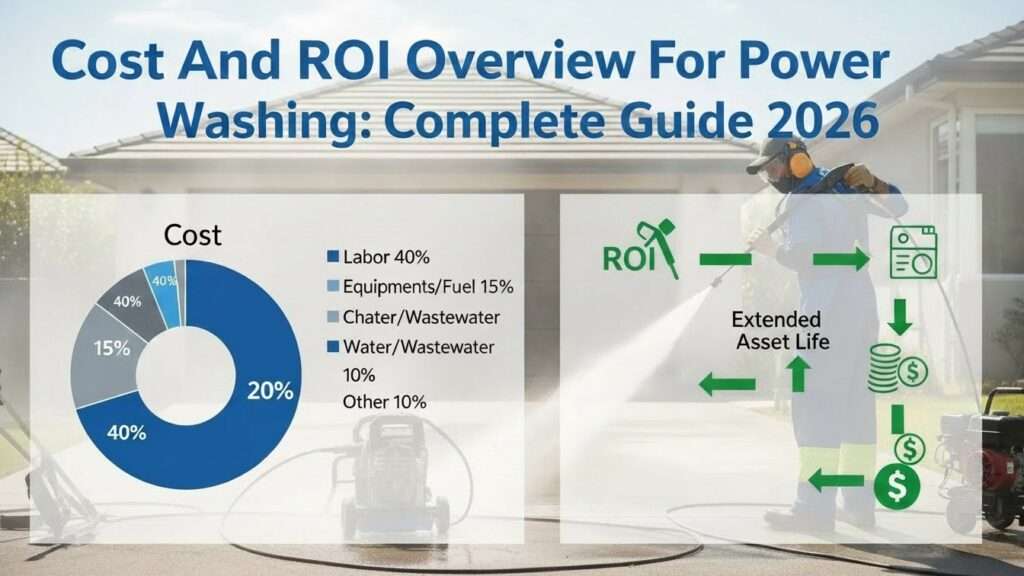
Power washing costs fall into a few main buckets: labour, equipment, water, fuel or electricity, detergents, and wastewater or runoff control. Hiring a pro is commonly priced per square foot or as a flat job rate, while DIY costs are mostly daily machine hire plus supplies. For businesses, the ongoing cost base also includes maintenance, insurance, and compliance.
ROI in power washing is the value of avoided damage and risk compared to the cleaning cost. It is usually measured through prevented repairs, longer asset life, fewer slip incidents, and better property presentation. A simple way to calculate it is:
Payback period is the time it takes for savings to cover the cleaning spend. Power washing is worth it when long-term savings outweigh the total cost, for example, when a small cleaning helps avoid a larger repair bill.
This guide explains what power washing means, the full cost model for pros, DIY, and businesses, how to calculate ROI step by step, how cleaning frequency changes returns, key ROI drivers by surface, wastewater, and compliance risks, safety costs, and DIY vs pro decision-making.
Read More In Detail: WHS Duties For Businesses Using Power Washing In Australia
What Counts as “Power Washing” (and what people confuse it with)
People often mix up power washing with other cleaning methods. Power washing uses hot water under high pressure to blast away dirt, grime, mold, and stains. It heats water to break down tough buildup like oil or grease.
Pressure washing uses cold water at high pressure. It works well for general dirt, but not as strongly on oily spots. Soft washing mixes low pressure with chemicals to kill mold and algae without damaging surfaces.
These differences matter for costs and ROI. Power washing costs more due to heat but gives better results on stubborn stains, boosting ROI by reducing future cleans. Pressure washing saves money upfront, but may need repeats, lowering ROI. Soft washing fits delicate areas, avoiding repair costs that hurt ROI. Choose based on surface needs to maximize value.
The Full Cost Model for Power Washing

is a simple way to calculate the true cost of power washing, not just the quoted price. It breaks the job into every cost bucket that affects profit and ROI, so you can compare DIY vs contractor, and cheap cleans vs proper maintenance.
A) Hiring a Professional Service
Pros handle everything. Costs cover their expertise and tools.
B) DIY Cleaning
You rent or own gear. Add your time as a cost.
C) Running a Power Washing Business
Include startup and ongoing expenses like marketing.
| Cost Bucket | Who Pays It | What Increases It | How to Reduce It Safely |
| Labor | Owner (DIY time), Contractor (hires workers), Business (employees) | Complex jobs, high access, heavy dirt | Plan, clear the area first, and use efficient methods |
| Equipment | Owner (rental/buy), Contractor (owns), Business (fleet) | High-end machines, hot water units | Rent for one-offs, maintain gear for longevity |
| Water | All | Large areas, high flow rates | Use efficient nozzles, recycle where possible |
| Power/Fuel | All | Gas machines, long runtime | Choose electric for small jobs, turn off when idle |
| Chemicals | All | Tough stains, large surfaces | Test water-only first, use eco-friendly options |
| Setup Time | Contractor, Business | Remote sites, poor access | Prep yourself, schedule off-peak |
| Access Equipment | Contractor, Business | Tall buildings, ladders needed | Ground-level jobs only for DIY |
| Wastewater Control | All | Strict rules, large runoff | Contain and reuse, follow best practices |
| Travel/Mobilization | Contractor, Business | Far locations | Choose local pros, batch jobs |
| Insurance/Overheads | Contractor, Business | High-risk areas | Shop rates, train staff on safety |
| Surface Protection/Repairs | Owner, Contractor | Delicate materials, errors | Use the right pressure, inspect before/after |
This table shows key factors. Total costs range from $100 for a small DIY to $500+ for pro house cleaning.
Read More In Detail: Personal Protective Equipment for Power Washing
The ROI Pathways for Power Washing

ROI from power washing shows in many ways. It saves money over time.
Extending coating life cuts repainting needs. Clean surfaces hold paint better. This delays jobs that cost thousands.
Slowing corrosion protects metal parts. Removing salt or acids prevents rust. Structures last longer without fixes.
Preventing slip hazards reduces claims. Clean walks avoid falls. This lowers insurance or legal fees.
Reducing labor hours beats manual scrubbing. Power tools clean faster. Hours saved equal money.
Avoiding premature replacement is key. Dirty surfaces wear out quickly. Cleaning adds years to decks or roofs.
Improving inspection readiness aids planning. Spot issues early during cleans. Fix small problems before they grow.
| Benefit | How It Creates Savings | Where It Shows Up |
| Extending Coating Life | Removes grime that breaks down paint; surfaces stay protected longer. | Repair Avoidance: Fewer repaints; Lifecycle Extension: Coatings last 2-5 extra years. |
| Slowing Corrosion | Clears corrosive elements like salts; materials resist decay. | Repair Avoidance: Fewer rust fixes; Lifecycle Extension: Metal lasts 20-30% longer. |
| Preventing Slip Hazards | Eliminates slick algae; safer surfaces reduce accidents. | Risk: Lower insurance claims; Downtime: Fewer disruptions from incidents. |
| Reducing Labor Hours | Machines replace manual labor; cleans in half the time. | Repair Avoidance: No need for intensive manual cleans; Downtime: Quicker upkeep. |
| Avoiding Premature Replacement | Prevents buildup that erodes materials; extends usability. | Lifecycle Extension: Surfaces endure 3-10 more years; Repair Avoidance: No full swaps. |
| Improving Inspection Readiness | Reveals hidden damage early; allows proactive fixes. | Downtime: Less unplanned maintenance; Risk: Better compliance and safety checks. |
These paths make power washing pay off. Savings often exceed costs in months.
A Practical ROI Calculator You Can Do on a Notepad

Estimate ROI with these steps.
- Define the surface and goal. Example: Clean a 1,000 sq ft driveway to remove mold.
- Choose cleaning frequency. Yearly for high-traffic areas.
- Estimate total cost per clean. Add buckets from the table. Hypothetical: $200.
- Estimate value gained or costs avoided. Include prevented repairs ($500/year) and value boost ($1,000).
- Compute ROI and payback period.
ROI formula: (Value Gained – Cost) / Cost x 100%. Hypothetical example: ($1,500 – $200) / $200 x 100% = 650%. Disclaimer: This is a hypothetical example. Actual results vary.
Payback period: Cost / Annual Savings. Hypothetical: $200 / $500 = 0.4 years.
Use real numbers for your case. Track over time.
Frequency and Timing for Power Washing

Frequency impacts costs and ROI. Clean too little, and damage builds, raising future costs. Clean often, and upfront costs rise, but savings grow.
Mini Decision Guide:
- Clean now: If visible mold or stains threaten damage.
- Monitor: Light dirt, check monthly.
- Schedule routine plan: Yearly for most, more for wet climates.
Time it for dry weather to avoid slips. General seasons work best when surfaces dry fast.
Surface-by-Surface ROI Drivers

Surface-by-Surface ROI Drivers explains how power washing creates real value on different materials by linking common dirt types to practical outcomes like fewer slip risks, longer surface life, and avoided repair or replacement costs. It highlights what can go wrong if pressure is misused, then gives the safer method for each surface, so the cleaning delivers results without causing damage.
Concrete and Pavers
- Why it pays off: Removes slip-causing moss and algae, keeps joints cleaner so weeds return slower, and helps surfaces last longer.
- What can go wrong: Too much pressure can etch lines, widen cracks, or blow sand out of paver joints.
- Safer approach: Medium pressure, wide fan nozzle, steady distance. For pavers, re-sand joints if needed after cleaning.
Painted Surfaces
- Why it pays off: Removes mildew that breaks down paint and helps delay repainting or timber rot behind peeling areas.
- What can go wrong: If you go too close, you strip paint or force water behind it.
- Safer approach: Low pressure, keep distance, spray at a downward angle, test a small spot first.
Timber and Decks
- Why it pays off: Removes algae that holds moisture, reduces slip risk, and helps decking last longer, so you delay replacement.
- What can go wrong: High-pressure cleaning lifts grain, causes splinters, and can warp boards over time.
- Safer approach: Soft wash or low pressure, wider nozzle, gentle passes, let the cleaner do the work.
Brick and Masonry
- Why it pays off: Removes grime and salts that trap moisture, helps prevent long-term staining and water-related damage, and keeps mortar healthier.
- What can go wrong: Too much pressure can erode mortar joints and damage softer brick.
- Safer approach: Even moderate pressure, a wide fan nozzle, and avoid harsh chemicals unless you know the surface.
Roofs and Delicate Exteriors
- Why it pays off: Removes moss and debris that can cause leaks, blocked drainage, and overflow into ceilings or walls.
- What can go wrong: Tiles can crack, water can get under tiles or into laps and flashings, and height work adds risk.
- Safer approach: Low-pressure treatment, controlled rinse, and often best handled by a pro for safety and leak prevention.
Read More In Detail: How Pressure Cleaning Works
Wastewater and Runoff: The Hidden Cost and Compliance Risk

Runoff is often the highest “hidden” cost in power washing because wash water can pick up sediment, detergents, oil, and other pollutants. If that water reaches a storm drain, it can flow straight to creeks and bays, creating a compliance risk and potential penalties.
Where the extra costs come from
- Extra setup time (pre-sweep, protect drains, set flow direction)
- Containment gear (drain covers, berms, mats, tarps)
- Recovery (wet vac, pump, vacuum surface cleaner)
- Filtering solids and managing sludge
- Approved disposal steps, admin, and sometimes disposal fees.
Best-practice workflow (simple)
- Prevent: Dry sweep or vacuum first, use absorbents on oil spots. This reduces both runoff volume and contamination.
- Contain: Cover nearby storm drains and set berms or barriers so water stays in a controlled area.
- Capture: Collect wash water using a wet vac, vacuum recovery surface cleaner, or pump.
- Filter: Screen out solids, and use additional separation if the water is oily or heavily soiled.
- Dispose correctly: Many guidelines direct captured wash water to the sanitary sewer only when allowed, and never to the storm system. Permissions and requirements vary by site and local rules.
Definitions That Prevent Confusion: Power Washing vs Pressure Washing vs Soft Washing

Power washing, pressure washing, and soft washing all clean surfaces with water under pressure. They differ in approach and use.
Pressure washing uses high-pressure cold water to blast away dirt. It works well on hard surfaces like concrete. The force comes from a pump that pushes water at 1,000 to 4,000 PSI.
Power washing adds heat to the mix. Hot water helps break down oils and tough stains. It suits greasy areas or heavy buildup. The added heat raises energy use but cuts cleaning time.
Soft washing relies on low pressure and chemicals. It gently applies solutions to kill mold and algae. This method protects delicate surfaces like roofs or painted wood. It avoids damage from high force.
Choose based on the surface. Hard materials take pressure or power washing. Fragile ones need soft washing. Mixing them wrongly risks harm.
Read More In Detail: Power Washing vs Regular Pressure Cleaning
DIY vs Hire a Pro: Decision Framework People Can Use
Score your job: 1-5 per item (higher = harder).
- Surface sensitivity: Delicate? +3
- Height/access: Ladders needed? +4
- Biological growth level: Heavy mold? +3
- Need for wastewater control: Runoff issues? +4
- Time and skill: No experience? +5
- Risk tolerance: Low? +5
Total under 10: DIY safe zone.
10-20: Pro recommended.
Over 20: Specialist required.
Buying Equipment: ROI for Owners and Small Operators

Ownership costs include maintenance and downtime. Fix the gear fast to avoid losing jobs.
Hot water boosts ROI on grease but adds fuel costs. Higher flow cleans faster, raising efficiency.
| Upgrade | ROI Impact |
| Hot water | Better on oils, 20% faster jobs |
| Higher flow | Covers more area, cuts time 15% |
| Better pumps | Fewer breakdowns, saves repair costs |
Common Mistakes That Destroy ROI (and fixes)
- Too much pressure: Damages surfaces. Fix: Start low, test spot.
- Wrong chemical dwell time: Ineffective cleaning. Fix: Follow labels.
- Ignoring runoff: Fines hit. Fix: Contain water.
- Skipping pre-sweep: Clogs gear. Fix: Dry clean first.
- No post-wash inspection: Misses spots. Fix: Check all areas.
- Poor nozzle choice: Uneven results. Fix: Match to the job.
- Overlooking safety: Injuries cost. Fix: Use PPE.
- Infrequent cleans: Damage builds. Fix: Schedule routine.
- DIY on complex jobs: Errors add repairs. Fix: Hire pros.
- Cheap equipment: Frequent failures. Fix: Invest wisely.
Frequently Asked Question
1. How much does pressure washing cost per hour?
Pressure washing costs depend on the model and variables. Hourly rates cover labor and equipment. They provide flexibility for varying jobs.
2. How much does it cost to pressure wash a driveway?
Driveway costs are tied to size and condition. Concrete is common and straightforward. Prices reflect square footage.
3. What are reasonable rates to charge for pressure washing?
Reasonable rates balance costs and the market. They cover expenses while staying competitive. Models include per foot or per hour.
4. How much does pressure washing cost?
Overall costs vary by scope. They include direct and hidden items. Quotes help estimate.
5. Is a pressure washing subscription service worth the cost for a first-time home buyer?
Subscriptions offer regular cleans at fixed rates. They suit new owners for maintenance.Weigh pros like convenience.
6. Is powerwashing your house a good idea?
Power washing refreshes exteriors. It removes grime effectively. Done right, it boosts appeal.
7. Is pressure washing worth it for improving the curb appeal of my home before selling?
Curb appeal draws buyers. Cleaning shines surfaces. It signals care.
8. Are pressure washers worth the money?
Washers pay off for frequent use. They save time over manual. Quality ones last.
9. Is DIY Power Washing A Good Idea Versus Hiring A Professional?
DIY fits small tasks with tools. It cuts costs. Pros handle big jobs safely.
10. Is pressure washing a house worth the water cost?
Water use is moderate. It varies by flow rate. Benefits often outweigh.


