

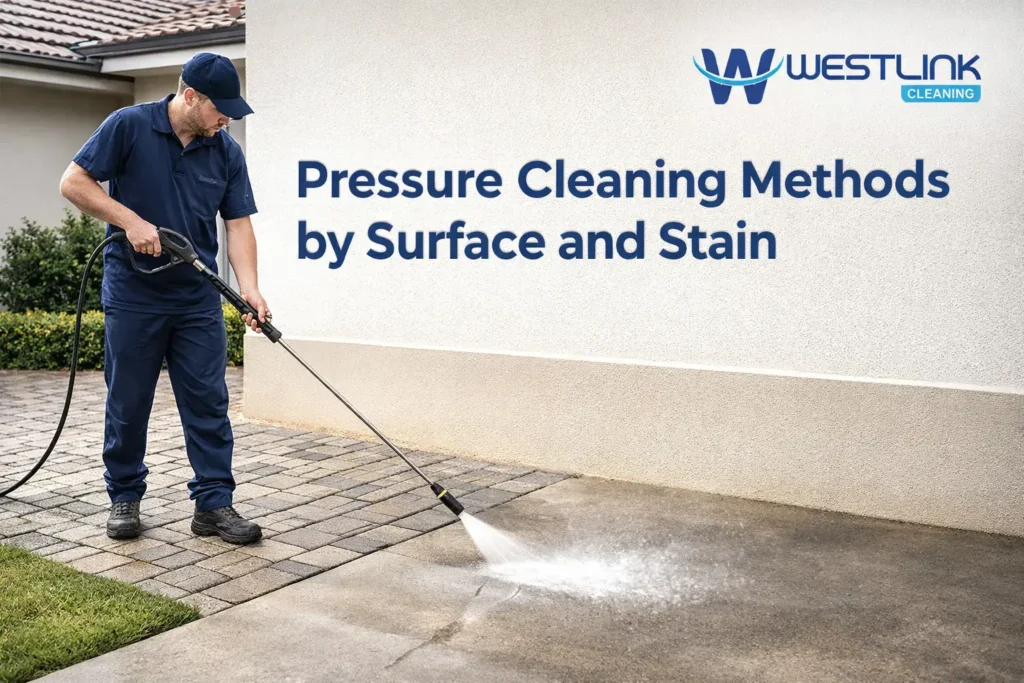
Pressure cleaning methods are surface-specific cleaning approaches that use different pressure levels, heat, and treatment dwell time to remove dirt, algae, oil, mould, and stains without damaging the material.
Pressure cleaning methods are cleaning systems selected by surface type, contamination type, pressure level, water temperature, and site risk.
Pressure cleaning is not one single process. It is a group of methods used for different surfaces, different contaminants, and different access conditions. Common methods include high-pressure cleaning, low-pressure cleaning, soft washing, and steam or heat-assisted cleaning. Each method has a different role.
A concrete driveway, a painted wall, a roof membrane, a rendered façade, and an interlocking paver surface do not respond to water force in the same way. For example, concrete can often tolerate stronger mechanical cleaning, while roof membranes and asphalt roofing require lower pressure or non-aggressive treatment methods. GAF guidance for EverGuard roof systems specifies low-pressure washing at 2,000 psi or lower, and ARMA states that power washers should not be used on asphalt roofing because high-pressure washing can damage the surface.
Why does the pressure cleaning method matter?
The method matters because the wrong combination of pressure, nozzle angle, temperature, and chemical dwell time can clean poorly or damage the surface.
The objective is not only to remove visible dirt. The objective is to remove contamination without creating a second problem, such as etching, paint loss, timber fiber damage, disturbed paver joints, water ingress, or fast regrowth of biological matter. Your source text already frames this correctly as surface care, not random blasting.
This matters more on exterior surfaces that hold different contaminants. Porous hard surfaces, including concrete driveways, concrete paths, pavers, and car parks, can trap dirt, grease, tyre marks, algae, and mineral staining. More delicate surfaces, including painted walls, render, cladding, awnings, and roof finishes, need lower force and tighter process control. On pavers, the Concrete Masonry & Hardscapes Association notes that after cleaners are applied and allowed to dwell, the final rinse depends more on water volume than on extreme pressure.
What types of contamination affect exterior surfaces?

Exterior surfaces collect soil types that require different treatment methods.
The most common contamination groups include:
- General soil, such as dust, loose dirt, cobwebs, and traffic film
- Organic growth, such as algae, moss, mould, and mildew
- Oil-based residue, such as grease, fuel marks, and food-service residue
- Mineral or chemical marks, such as efflorescence, oxidation marks, and some stain residues
Organic growth is strongly linked to damp and shaded conditions. University of Maryland Extension notes that algae and moss grow in moist shady sites and can colonise hard surfaces such as rock and brick. That is why roofs, shaded walls, damp corners, and low-sun outdoor areas often need a treatment method that addresses growth, not only appearance.
What are the four main pressure cleaning methods?

The four main pressure cleaning methods are high-pressure cleaning, low-pressure cleaning, soft washing, and steam or heat-assisted cleaning.
1) What is high-pressure cleaning?
High-pressure cleaning uses concentrated water force to break apart and lift heavy dirt, algae, mud, and bonded surface grime from durable materials.
This method is commonly used on hard-wearing surfaces, including:
- concrete driveways
- concrete paths
- some brick surfaces
- some stone surfaces
- certain pavers
- car parks
- loading zones
- hardstand areas
On suitable surfaces, high-pressure cleaning improves appearance and removes bonded contamination. It is often used where soil load is heavy, such as tyre-marked driveways, algae-affected paths, garage entries, and strata common areas.
It is not a universal method. Excessive force can mark softer materials, strip paint, loosen unstable mortar, disturb jointing material, and create visible cleaning lines. That is why high pressure should follow surface identification, not guesswork.
2) What is low-pressure cleaning?
Low-pressure cleaning uses lower force and a wider rinse pattern to clean lighter contamination on more sensitive surfaces.
Low-pressure cleaning is often used on:
- painted exterior surfaces
- delicate wall finishes
- some cladding systems
- awnings
- light exterior fixtures
- surfaces with water-ingress risk
This method works best when the cleaning goal is surface refresh, not aggressive restoration. It removes loose dirt, light grime, dust, and surface film while reducing the chance of peeling, etching, or forcing water into weak points. Your source draft correctly positions this as controlled cleaning rather than reduced-quality cleaning.
Manufacturer guidance for render finishes also supports this approach. PRB Systems recommends starting on the lowest setting, testing an inconspicuous area first, and keeping the nozzle at least 300 mm from the surface finish to reduce damage risk.
3) What is soft washing?
Soft washing is a low-pressure cleaning method that relies on treatment chemistry and dwell time rather than raw force.
Soft washing is commonly used on surfaces such as:
- roofs
- painted walls
- render
- weatherboards
- delicate exterior finishes
- damp, shaded sections with biological growth
This method is selected when the main problem is mould, mildew, moss, algae, or black streaking. A basic rinse may remove part of the visible layer, but it may not address the growth as effectively as a treatment-based process. That is why soft washing is typically the safer option on sensitive surfaces affected by recurring biological contamination.
Roof guidance supports this distinction. ARMA states that power washers should not be used on asphalt roofing. GAF recommends low-pressure washing on certain roof membranes at 2,000 psi or lower, followed by careful rinsing and runoff control.
4) What is steam or heat-assisted cleaning?
Steam or heat-assisted cleaning uses elevated temperature and usually lower mechanical force, to loosen grease, heavy grime, and stubborn residue.
This method can be useful on:
- greasy hard surfaces
- grout lines
- commercial kitchen-adjacent exterior areas
- industrial work zones
- detail cleaning zones
- surfaces where a lower water force is preferred
Heat improves the breakdown of oily residue and some stubborn contamination. It is not required on every site, but it can improve cleaning performance where cold water cleaning is less effective. Your source draft correctly limits this method to selected heavy-soil and grease-related jobs rather than treating it as a default option.
Which pressure cleaning method suits each common surface?

The best method depends on material strength, contamination type, surface finish, joint condition, and runoff sensitivity.
| Surface Type | Common Contaminants | Usual Best Method | Main Control Point |
| Concrete driveways and paths | dirt, algae, tyre marks, grime | high-pressure cleaning | avoid patchy passes and surface wear |
| Pavers and paved areas | dirt, algae, stains, joint contamination | controlled pressure, sometimes with treatment | protect joint sand and edge stability |
| Painted walls and render | dust, cobwebs, mildew, traffic film | low-pressure cleaning or soft washing | reduce stripping and water ingress risk |
| Roofs | algae, black streaks, moss, mould | soft washing or roof-safe low pressure | protect roofing material and manage slip risk |
| Commercial entries and car parks | oil, grime, traffic film, slip hazards | high-pressure or heat-assisted cleaning | match the method to each adjacent surface |
This table follows the same logic as your source draft, but in a tighter decision format. It also aligns with external guidance that roof systems and rendered finishes need lower pressure and more controlled application. Paver guidance likewise supports treatment-led cleaning and notes that regular aggressive cleaning can justify joint sand stabilisation.
What is usually best for concrete driveways and paths?

High-pressure cleaning is usually best for concrete driveways and paths when the contamination is dirt, algae, traffic film, or normal outdoor buildup.
Concrete is usually more tolerant of mechanical cleaning than painted or membrane-based surfaces. Where the contamination includes grease or heavy oily residue, heat-assisted cleaning may improve removal. The method still needs consistent passes, correct standoff distance, and controlled runoff.
What is usually best for pavers and paved outdoor areas?
Controlled pressure is usually best for pavers, but the operator must protect the joint condition, joint sand, and edge stability.
Pavers need more control than many owners expect. The Concrete Masonry & Hardscape Association states that paver cleaning often involves cleaner application, dwell time, and rinsing, and that a large amount of water is more important to rinsing than high pressure. The same guidance notes that stabilisation can help pavements exposed to aggressive, regular cleaning and concentrated water flow.
What is usually best for painted walls, render, and delicate finishes?

Low-pressure cleaning or soft washing is usually best for painted walls, render, and other delicate finishes.
These surfaces are more vulnerable to finish damage and water ingress. PRB Systems recommends starting on the lowest setting first, testing a trial area, and keeping the nozzle at least 300 mm from the render surface. That numeric limit supports the same practical rule already present in your draft: sensitive finishes need control, not force.
What is usually best for roofs and high-organic-growth areas?
Soft washing is usually best for roofs and damp areas affected by algae, moss, mould, or black streaking.
This is because the surface often needs biological treatment, not only mechanical stripping. For some membrane systems, manufacturers permit low-pressure washing within stated limits. For asphalt roofing, ARMA advises against power washing. Those two points show why roof cleaning cannot be treated as one generic category.
What is usually best for commercial entries, strata zones, and car parks?

A mixed-method approach is usually best for strata and commercial sites because different surfaces on the same property have different risk profiles.
Public-facing entries, ramps, car parks, and shared walkways often hold traffic film, slip hazards, oil spotting, and presentation-related grime. Durable hard surfaces may need stronger cleaning, while nearby painted trims, signage bases, drains, and sensitive finishes need a gentler approach. Your source draft is correct to treat these sites as method-selection jobs, not single-machine jobs.
How should the correct method be selected?
The correct method should be selected through a surface-first, contamination-first, risk-first process.
Use this sequence:
- Identify the material
Confirm whether the surface is concrete, paver, render, painted cladding, roof membrane, brick, stone, or timber. - Identify the contamination
Confirm whether the problem is dirt, algae, mould, grease, tyre marks, mineral staining, or surface film. - Check the finish condition
Look for paint weakness, unstable mortar, damaged joints, cracking, old coatings, and previous repairs. - Assess surrounding risks
Check drains, stormwater paths, plants, neighbouring property edges, public access, pets, and slip zones. - Choose the least aggressive effective method
Start with the safest method that can still produce the required result. - Test where needed
Run a trial area first on sensitive finishes or non-uniform surfaces.
That sequence reflects the logic in your original draft and also aligns with manufacturer guidance that calls for test areas, low initial settings, and runoff planning.
How does Westlink Services choose the right method?
Westlink Cleaning Services selects the method after checking the surface, stain type, access, drainage, nearby risk areas, and the required cleaning outcome.
According to your source draft, the process begins with surface and stain identification. It then considers access restrictions, neighboring properties, balcony drains, garden edges, painted trims, public-facing zones, operating hours, and disruption control. That approach is technically sound because similar-looking areas can require different methods once material condition and contamination type are checked properly.
What mistakes happen when the wrong pressure cleaning method is used?
The most common mistake is using more force before understanding the surface.
That mistake can cause:
- etched surfaces
- paint damage
- disturbed paver joints
- timber fibre damage
- patchy cleaning lines
- incomplete stain removal
- fast regrowth of biological matter
- overspray into gardens or drains
- wasted labour and water
This section is already strong in your source draft because it identifies process failure, not only cosmetic failure. The best rewrite is not to soften it, but to make it more direct and more structured.
Why do runoff control and safety matter in pressure cleaning?

Runoff control and safety matter because pressure cleaning can injure workers and move polluted wash water into stormwater systems.
The NSW EPA states that when any washing activity is carried out, runoff water must not enter stormwater drains. It recommends designated wash-down areas and collection or treatment controls where needed. That makes runoff management a compliance issue, not only a neatness issue.
Safety also requires direct attention. The CDC warns that people with high-pressure spray wounds should get medical attention as soon as possible. Roof guidance adds that wet membranes become slippery, and trained professionals should handle those jobs.
High-pressure cleaning vs soft washing: what is the real difference?
High-pressure cleaning removes contamination mainly through mechanical force, while soft washing removes contamination mainly through treatment chemistry and dwell time.
| Comparison Point | High-Pressure Cleaning | Soft Washing |
| Main cleaning action | mechanical force | chemical action plus dwell time |
| Best for | durable hard surfaces | delicate surfaces with organic growth |
| Typical surfaces | concrete, some brick, some stone, car parks | roofs, render, painted walls, weatherboards |
| Main risk if misused | etching, line marks, joint disturbance, finish damage | plant damage, runoff issues, residue risk if unmanaged |
| Ideal use case | heavy soil and bonded grime | algae, moss, mould, mildew, black streaking |
This comparison is necessary because many users confuse the two methods and assume the stronger-looking method is always better. Your original draft already rejects that assumption, and the evidence supports that distinction.
Definitive answer
The right pressure-cleaning method is the least aggressive that can safely, completely, and properly remove the target contamination, with proper runoff control.
That means:
- use high pressure for durable hard surfaces when soil load is heavy
- use low pressure for sensitive surfaces that still need a wash-down
- use soft washing for biological growth on delicate finishes
- use steam or heat-assisted cleaning where grease or stubborn residue needs thermal help
Conclusion
Pressure cleaning works best when the method matches the surface, the stain type, and the site condition.
That is the central rule for this page. High-pressure cleaning suits many durable, hard surfaces. Low-pressure cleaning suits more delicate exterior areas. Soft washing suits roofs, painted finishes, and organic growth. Steam or heat-assisted cleaning suits selected heavy-soil and grease-related jobs. The best result comes from matching the method to the material instead of forcing one method onto every surface.
People Also Ask
What is the difference between pressure cleaning and soft washing?
Pressure cleaning is a broad category of water-based exterior cleaning, while soft washing is a specific low-pressure method that relies on treatment chemistry and dwell time.
Is high-pressure cleaning safe for all surfaces?
No, high-pressure cleaning is suitable only for surfaces that can safely tolerate that force level.
What method is usually best for driveways?
High-pressure cleaning is usually best for concrete driveways, especially where dirt, algae, and traffic-related buildup are present.
What method is usually best for roofs?
Soft washing or roof-safe low-pressure cleaning is usually best for roofs, depending on the roofing material and manufacturer guidance.
Can pressure cleaning remove slippery algae?
Yes, the correct method can remove slippery algae, but the method must match both the surface and the severity of the growth.
Why do some surfaces get dirty again quickly?
Surfaces often get dirty again quickly when the method removes only the visible layer and does not address the source of organic contamination.
Do pavers need special care during cleaning?
Yes, pavers need controlled pressure and joint protection because aggressive cleaning can affect joint condition and long-term stability.
Can one property need more than one cleaning method?
Yes, one property often needs more than one method because driveways, walls, roofs, pavers, and trims do not share the same cleaning tolerance.


