

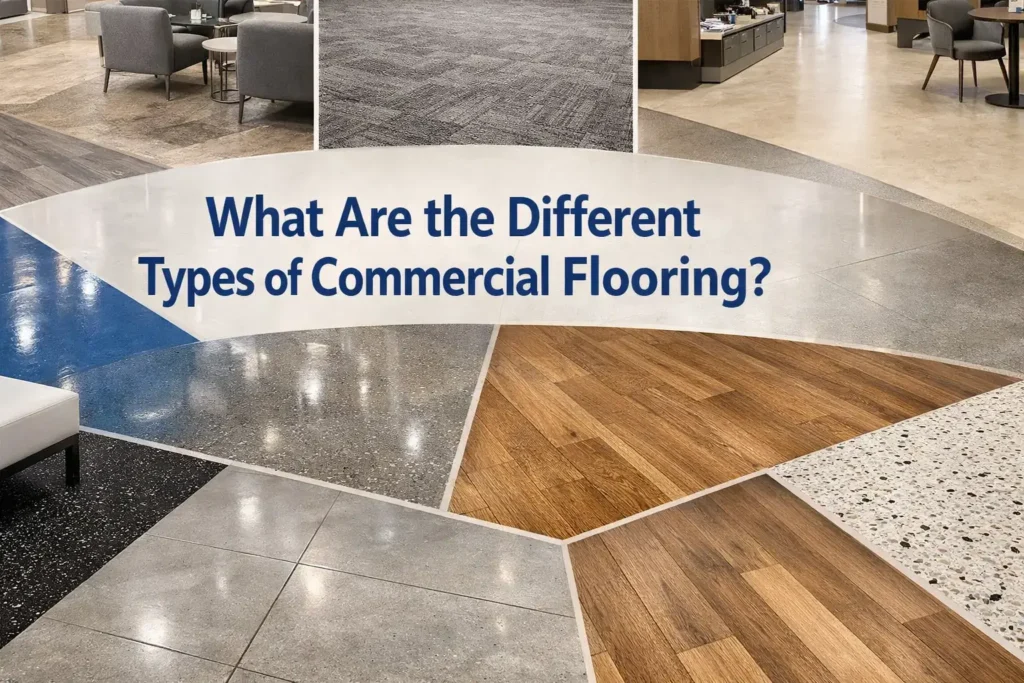
The best commercial flooring type is the one that matches traffic level, moisture exposure, slip risk, cleaning load, and presentation standards. Common commercial flooring types include luxury vinyl tile, luxury vinyl plank, vinyl sheet flooring, carpet tiles, epoxy flooring, polished concrete, engineered timber, rubber flooring, porcelain tile, laminate, and terrazzo.
Commercial flooring types are materials used in business environments, including offices, retail stores, warehouses, healthcare facilities, hospitality venues, and educational buildings. These materials affect cleaning time, maintenance cost, slip control, wear patterns, restoration frequency, and long-term visual presentation.
Commercial flooring is not only a design choice. It is an operating decision. A floor must be suitable for foot traffic, rolling loads, moisture and chemical exposure, and cleaning frequency. It must also support safe movement and practical maintenance. That is why the next step is to understand why flooring type matters operationally before comparing the most common options.
Why does commercial flooring type matter?
The type of commercial flooring matters because each surface reacts differently to traffic, moisture, soil, and cleaning chemicals. The wrong cleaning method can reduce appearance, shorten service life, increase residue build-up, or create slip risk.
A carpet tile floor, a polished concrete slab, and an engineered timber floor do not fail in the same way. Carpet tiles trap dry soil, dust, and staining matter. Resilient floors such as vinyl can show residue, traffic-lane dullness, and surface scuffing. Wood-based floors can react to excess moisture. Porcelain tile may look acceptable on the surface, but grout lines can darken under routine mopping. Terrazzo can lose visual value if its polished finish is not maintained correctly.
This means the right flooring decision must take into account the material type, site conditions, and cleaning method. To make that connection easier, the next section lists the most common commercial flooring types, where they are used, the problems they can cause, and the service that usually fits each one best.
Which commercial flooring types are most common?

| Commercial flooring type | Common business settings | Main cleaning issue | Best professional service fit |
| Luxury vinyl tile or plank | Grease, dust, and slip risk when contaminated | Scuffs, dull traffic lanes, residue | Hard floor cleaning, machine scrubbing, buffing |
| Vinyl sheet flooring | Healthcare, kitchens, labs, education | Residue build-up, dullness, neglected lanes | Deep cleaning, machine scrubbing |
| Carpet tiles | Offices, co-working spaces, admin areas, corridors | Embedded soil, stains, dark traffic paths | Commercial carpet cleaning, stain treatment |
| Epoxy flooring | Warehouses, garages, production areas | Warehouses, showrooms, retail, and modern offices | Degreasing, scrub-and-recover cleaning |
| Polished concrete | Swelling, edge wear, residue, and moisture damage | Flat appearance, grit abrasion, oil marks | Periodic hard floor cleaning, burnishing support |
| Engineered timber | Executive offices, boutique retail, hospitality | Scratches, moisture marks, uneven dullness | Floor-safe low-moisture cleaning, finish-safe maintenance |
| Rubber flooring | Gyms, healthcare, kitchens, labs | Wrong chemical damage, dull marking | Surface-safe deep cleaning |
| Porcelain tile | Restaurants, lobbies, bathrooms, retail | Dark grout lines, soil in joints | Tile and grout cleaning |
| Commercial-grade laminate | Offices, education, low-moisture retail | Swelling, edge wear, residue, moisture damage | Low-moisture maintenance only |
| Terrazzo flooring | Airports, hospitals, hotels, premium entries | Dull finish, residue, loss of polish | Restoration-style cleaning and finish care |
The table shows a clear pattern. Flooring type not only determines how a site looks. It also determines what kind of dirt it holds, how it wears, and which cleaning service becomes relevant over time. That is why each flooring type should be reviewed individually, starting with resilient options that are common in commercial interiors.
What makes luxury vinyl tile and luxury vinyl plank suitable for commercial spaces?

Luxury vinyl tile and luxury vinyl plank suit commercial spaces because they combine strong appearance control with easier daily maintenance. They are widely used in offices, healthcare facilities, educational institutions, and retail stores because they deliver a timber- or stone-look finish without the full maintenance burden of natural materials.
From a cleaning perspective, LVT and LVP perform best with regular dry soil removal, controlled damp cleaning, and neutral-pH products. Their appearance usually declines gradually rather than suddenly. The most common early issues are scratches, scuffs, sticky residue, and dull walkways caused by tracked grit, poor entrance matting, or routine mopping that no longer removes build-up properly.
For commercial sites, the main concern is the loss of appearance before structural failure. That is why professional hard-floor cleaning is useful when the finish starts looking uneven across traffic lanes. While LVT and LVP balance appearance and maintenance well, some commercial environments need an even more seamless surface with better moisture control. That leads directly to vinyl sheet flooring.
What makes vinyl sheet flooring useful in commercial buildings?

Vinyl sheet flooring is useful because it reduces seams and makes it easier to control moisture across larger areas. It is common in healthcare settings, kitchens, laboratories, and educational buildings where continuity and ease of washability are important.
Its maintenance advantage is its fewer joints. Fewer seams mean fewer collection points for moisture, soil, and contamination. Its maintenance risk is residue build-up from the wrong product, poor rinsing, or neglected traffic lanes. Like other resilient floors, sheet vinyl responds better to controlled damp cleaning and the correct choice of chemicals than to heavy wet cleaning or film-forming detergents.
When traffic lanes stay dull after routine cleaning, repeated mopping is usually not enough. Machine scrubbing and periodic deep cleaning become more effective at that stage. While resilient floors manage surface soil differently, soft commercial floors behave differently again because they hold soil below the surface. That is why carpet tiles need separate attention.
Why are carpet tiles common in offices and administrative areas?

Carpet tiles are common because they improve acoustics, support modular replacement, and provide softer underfoot comfort. They are widely used in offices, meeting rooms, education sites, corridors, administrative areas, and co-working spaces.
Their main maintenance issue is soil retention. Unlike resilient flooring, carpet tiles trap dust, tracked grit, moisture, and stains within the pile. That is why they can look worn early, even when the backing and tile structure remain usable. Dark traffic lanes, spill marks, and uneven color are usually the first visible signs of poor maintenance rhythm.
For commercial carpet tiles, professional carpet cleaning is not only about stain removal. It is also about keeping appearance retention stable across high-use zones. Carpet shows how a floor can trap soil within its material. By contrast, some industrial flooring types are chosen because they create a more sealed surface. That is where epoxy flooring becomes relevant.
Why is epoxy flooring used in industrial and operational areas?

Epoxy flooring is used because it creates a seamless, hard-wearing surface that is suitable for wash-down cleaning and demanding operational zones. It is common in warehouses, garages, production areas, food environments, and selected service corridors.
Its main advantages are durability, chemical resistance, and ease of cleaning when correctly specified. Its main maintenance risks are grease contamination, residue build-up, and wear in forklift paths or trolley lanes. Epoxy often looks easier to maintain than porous flooring, but contamination can still reduce traction and create a patchy or slippery appearance.
Professional cleaning is important when grease film, industrial dust, or neglected residue begin to affect safety and appearance. Epoxy shows the value of a sealed industrial surface, but many businesses want a harder architectural finish with a different visual profile. That is why polished concrete is one of the most common alternatives.
Why is polished concrete a common commercial flooring choice?
Polished concrete is common because it handles high traffic well and suits large open commercial spaces. It is widely used in warehouses, distribution centers, retail stores, showrooms, and modern office environments.
Its day-to-day maintenance burden is usually lower than that of many-layered floor systems, but that does not mean it is maintenance-free. Tracked grit, fine dust, oil marks, and poor cleaning chemistry can reduce surface clarity and make the floor look flat over time. In large sites, this change often happens slowly, so the floor loses presentation before decision-makers realize how much visual sharpness has dropped.
Professional cleaning helps when the surface has lost brightness, developed obvious traffic patterns, or no longer presents evenly under lighting. Polished concrete offers strong utility and a clean visual presentation, but some commercial interiors need a warmer, more premium surface finish. That shifts the focus to engineered timber.
Why is engineered timber used in premium commercial interiors?

Engineered timber is used because it provides a warmer and more premium visual finish than most resilient flooring materials. It is commonly used in executive offices, boutique retail stores, reception areas, and hospitality interiors where presentation has a stronger branding role.
Its main limitation is moisture sensitivity. Wet cleaning, delayed spill response, abrasive soil, and inconsistent maintenance habits can reduce the quality of the finish. In most commercial interiors, engineered timber begins to show visual deterioration before structural deterioration. Common problems include scratches, patchy dullness, edge wear, and moisture-related marks.
That is why engineered timber requires floor-safe low-moisture cleaning rather than generic hard-floor treatment. It represents the premium end of commercial interior finishes, but some specialist environments prioritise resilience, comfort, and slip support over visual warmth. That brings rubber flooring into the comparison.
Why is rubber flooring chosen for specialist commercial zones?
Rubber flooring is chosen for its slip resistance, resilience, and comfort in functional work areas. It is commonly used in gyms, healthcare rooms, kitchens, laboratories, and selected workstation zones.
Its key risk is chemical mismatch. Rubber is durable, but using the wrong cleaning products can damage it and alter its appearance. Heavy-use areas may develop dull patches, marking, or a tired finish if cleaning is inconsistent or if unsuitable chemicals are used repeatedly.
That means rubber needs surface-appropriate maintenance rather than standard hard-floor treatment. Professional deep cleaning becomes useful when the floor needs visual improvement without exposing the material to aggressive methods. While rubber is often selected for function-first zones, other public-facing areas need a harder surface with stronger water resistance and cleaner visual lines. That is where porcelain tile fits.
Why does porcelain tile perform well in public-facing commercial spaces?

Porcelain tile performs well because it is durable, water-resistant, and visually consistent in high-use public areas. It is common in restaurants, hotel lobbies, retail stores, bathrooms, and healthcare settings.
The tile surface itself is usually not the main maintenance problem. The grout lines are. Soil, spill residue, and cleaning-product film can build up in the joints and make the floor look older than it is. This is why tiled floors often remain visually disappointing after normal mopping. The main visible issue is not always on top of the tile. It is often between the tiles.
In commercial settings, professional tile and grout cleaning is often the service that restores the floor’s real appearance. Porcelain tile shows how a surface can stay durable while the joints become the weak visual point. A different issue appears in lower-cost wood-look commercial floors, where the main weakness is not grout but moisture. That leads to laminate.
Why is commercial-grade laminate used in some business interiors?
Commercial-grade laminate is used because it gives a wood-look finish at a lower material cost. It is often used in budget-conscious offices, educational spaces, and low-moisture retail interiors where appearance matters but the cost of premium materials is impractical.
Its main maintenance weakness is moisture. Too much water, poor spill management, steam cleaning, or the wrong detergent can cause swelling, edge wear, or premature finish decline. Laminate does not respond well to aggressive wet cleaning. It performs better when dry soil is removed consistently and spills are dealt with quickly.
For businesses, laminate requires control rather than force. Low-moisture maintenance protects the finish better than repeated wet mopping. Laminate shows how lower-cost wood-look options trade moisture tolerance for price efficiency. At the opposite end of the spectrum, some properties use a premium hard surface that offers long service life and strong architectural impact. That is terrazzo.
Why is terrazzo a premium commercial flooring material?

Terrazzo is a premium commercial flooring material because it combines long service life with strong visual impact. It is common in airports, hospitals, institutional buildings, hotels, and premium retail entrances where durability and image both matter.
Its value comes from both performance and finish quality. Even though terrazzo is long-lasting, its appearance still depends on correct care. Residue, dullness, and neglected maintenance can reduce the polished look that gives terrazzo much of its architectural value. In these spaces, the floor is not only functional. It is part of the property standard.
That is why terrazzo should be treated as a high-value surface and maintained with restoration-style care when needed. Once a business understands how each material behaves, the next decision is not which floor looks best in theory but how to choose the right floor based on real operating conditions.
How should a business choose the right commercial flooring?

A business should choose commercial flooring by matching the floor to operating conditions, not only to design preference. The practical decision depends on five core factors: traffic level, moisture exposure, cleaning demands, slip risk, and appearance expectations.
These five factors matter because they connect the flooring material to real use conditions. A surface that performs well in a quiet office may fail quickly in a wet hospitality zone or a high-traffic retail entry. That is why each decision factor should be reviewed separately.
How much traffic will the floor carry?
Traffic level determines how quickly a floor shows wear, dullness, and appearance decline. High-footfall areas such as retail entries, public corridors, reception zones, and waiting areas usually need harder-wearing materials than private offices or low-use meeting rooms.
Traffic also changes maintenance frequency. The higher the footfall, the faster grit, dry soil, scuffing, and traffic-lane wear become visible. Traffic therefore connects directly to cleaning rhythm, which leads into the next condition: moisture exposure.
How much moisture will the floor face?
Moisture exposure determines whether a flooring material can maintain its condition under spills, wash-down cleaning, or wet operational use. Wet zones, food areas, wash-down rooms, kitchens, bathrooms, and spill-prone spaces usually need moisture-tolerant materials such as vinyl sheet, porcelain tile, rubber, or correctly specified epoxy.
By contrast, laminate and engineered timber are more sensitive to frequent or poorly controlled water exposure. Moisture affects material suitability and the cleaning method itself. That is why the next factor is the demand for daily and periodic cleaning.
How will the floor be cleaned daily and monthly?
Cleaning demand determines whether a flooring type is practical after installation, not just attractive on day one. Some floors need low-moisture cleaning. Others may later need machine scrubbing, buffing, grout restoration, stain treatment, or periodic deep cleaning.
A flooring material that looks suitable at purchase can still become inefficient if its maintenance burden does not match the site’s staffing, cleaning schedule, or soil load. Cleaning practicality, then, links directly to safety, especially where contamination or moisture can affect traction.
What slip and safety risk exists?
Slip risk matters because flooring must support safe movement under real working conditions, not only under display conditions. Entrances, kitchens, healthcare settings, industrial work areas, and spill-prone zones require flooring that remains manageable during normal use.
A floor that becomes slippery when wet, contaminated, or badly maintained creates both safety and maintenance problems. Safety also overlaps with appearance standards because customer-facing areas often require surfaces that look clean while remaining functionally reliable. That is why the final selection factor is presentation.
What visual standard must the site maintain?
Appearance expectations determine how consistent the finish and visual control a flooring material must deliver over time. A showroom, hotel lobby, premium reception area, boutique retail floor, or executive office usually needs stronger appearance retention than a back-of-house workspace.
This means flooring must be chosen for both function and presentation, where customer perception matters. Once those five decision factors are clear, the next step is to avoid the maintenance mistakes that shorten floor life after installation.
What cleaning mistakes damage commercial floors?

The biggest cleaning mistake is using the same method on every commercial floor type. Different materials respond differently to water, chemicals, machine pressure, and soil conditions.
Too much water can damage laminate and engineered timber. Wrong chemistry can affect rubber and leave residue on resilient flooring. Soap-based or oily cleaners can create film on tile and grout. Delayed vacuuming and deep cleaning can shorten the appearance life of the carpet. In each case, the mistake is the same in principle: the cleaning method does not match the flooring material.
The second major mistake is delay. A floor that already looks heavily dull, patchy, stained, residue-covered, or darkened usually needs more than routine cleaning. That makes the next question practical rather than theoretical: when should a business bring in professional floor cleaning?
When does professional commercial floor cleaning make sense?

Professional commercial floor cleaning makes sense when routine cleaning no longer restores appearance, traction, or hygiene standards. It becomes relevant when the floor still looks dirty after routine maintenance or when the material shows clear signs of deterioration.
The most common triggers are visible traffic lanes, dark grout, scuffs, sticky residue, embedded carpet soil, uneven shine, spill staining, and post-fit-out dust or soil. It also makes sense before inspections, before handover, before client visits, and as part of planned maintenance in high-traffic buildings.
The goal is not one isolated clean result. The goal is to maintain the correct rhythm for the flooring type. That may mean hard-floor cleaning for vinyl or polished surfaces, carpet cleaning for carpet tiles, tile and grout cleaning for tiled areas, or low-moisture maintenance for engineered timber and laminate. Once that logic is clear, the page naturally shifts from information to service relevance, where Westlink fits.
How does Westlink support different commercial flooring types?
Westlink should position this page as a service-connected decision guide, not only as a general information article. The page should help businesses identify which flooring they have, what maintenance issues they are seeing, and which professional cleaning service best addresses those issues.
That service path is practical and easy to follow. Dull vinyl or polished floors indicate hard-floor cleaning. Dark grout lines indicate the need for tile and grout cleaning. Embedded carpet soil points toward commercial carpet cleaning. Worn presentation zones point toward periodic machine cleaning or finish-focused maintenance.
This structure keeps the article informative, transactional, and relevant to the service intent. After the main body content explains flooring behaviour and cleaning logic, the final step is to answer short-form search questions clearly.
Frequently asked questions
1. What are the most common commercial flooring types?
The most common commercial flooring types are LVT, vinyl sheet, carpet tiles, epoxy, polished concrete, porcelain tile, rubber, laminate, engineered timber, and terrazzo.
2. Which commercial flooring is best for offices?
Offices usually perform well with carpet tiles, LVT, laminate, or engineered timber, depending on traffic, noise control, and appearance goals.
3. What flooring is best for retail stores?
Retail stores often use LVT, polished concrete, porcelain tile, or terrazzo because these surfaces handle foot traffic and presentation demands well.
4. What flooring is best for warehouses?
Warehouses usually rely on polished concrete or epoxy because these surfaces suit rolling loads, dust control, and heavy wear.
5. Which commercial flooring is easiest to clean?
Polished concrete, epoxy, vinyl, and porcelain tile are usually easier to clean than carpeted or moisture-sensitive flooring.
6. How does flooring type affect cleaning?
Flooring type affects the correct product, moisture level, machine choice, cleaning frequency, and maintenance plan needed to avoid damage.
7. How often should commercial floors be professionally cleaned?
Professional cleaning frequency depends on traffic, soil load, site use, and flooring material, but busy public sites usually need it more often than low-traffic offices.
8. What are signs a commercial floor needs professional cleaning?
Common signs include dull traffic lanes, sticky residue, scuffs, dark grout, embedded soil, stains, and an uneven finish after routine cleaning.
9. Can the wrong cleaning method damage commercial floors?
Yes, excess water, wrong chemicals, poor rinsing, or the wrong machine can damage appearance, traction, and finish quality.
10. What floor cleaning services help maintain commercial floors?
Common services include hard floor cleaning, commercial carpet cleaning, tile and grout cleaning, machine scrubbing, buffing, and finish-reset maintenance where needed.


