

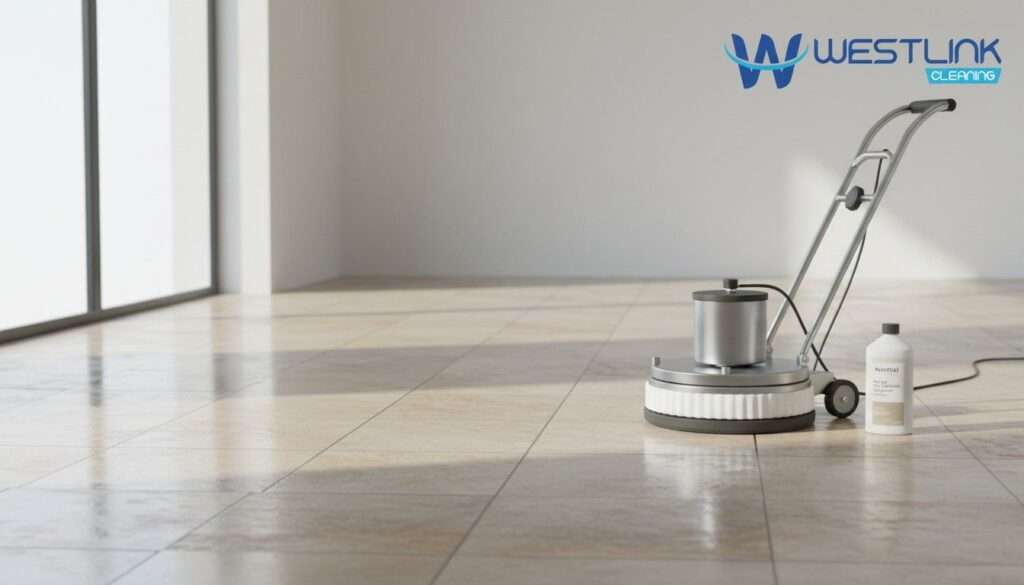
Stone and tile floor restoration involves cleaning, correcting, repairing, and sealing worn hard floors so the surface, grout, and finish perform properly again. Natural stone and tile surfaces respond differently to soil, acids, moisture, and abrasion, so the method must match the material and the defect.
What is stone and tile floor restoration?
Stone and tile floor restoration is a corrective floor-care process, not routine cleaning. It is used when a hard floor has visible wear, embedded soil, damaged grout, scratches, etch marks, uneven finish, or reduced stain resistance. In restoration practice, the work may include deep cleaning, grout correction, stain treatment, honing, polishing, sealing, and minor repair, depending on the material and condition.
Regular cleaning removes loose and surface-level contamination. Restoration addresses defects below that level, including subsurface soil, worn protective treatments, finish damage, and grout deterioration. For example, restoration may target scratches, etch marks, contaminated grout joints, and isolated chips, while ordinary mopping does not correct those defects.
When does a stone or tile floor need restoration?

A floor needs restoration when appearance problems remain after correct cleaning. The most common signs are dull traffic lanes, dark grout lines, recurring stains, residue haze, visible scratches, etch marks, patchy gloss, and small defects such as chipped edges or loose grout. These signs indicate that the problem is in the surface, the joints, or the protective layer, not only on top of the floor.
Common restoration triggers include:
- dull walkways, for example entries, corridors, and kitchen routes
- dark grout joints, for example bathroom grout, kitchen grout, and foyer grout
- surface marks, for example scratches, scuffs, and acid etching
- finish inconsistency, for example patchy shine and cloudy residue
- local damage, for example chipped tile edges, cracked grout, and minor pits
Why does material identification matter before restoration?

Material identification determines the safe method, the correct chemical, and the right abrasive. Calcareous stones, including marble, limestone, and travertine, contain calcium carbonate and are attacked by acids. Neutral stone cleaners are preferred because acidic products such as vinegar or lemon-based cleaners can dull or etch these surfaces, while abrasive powders can scratch some finishes.
This is why one method cannot be used across all hard floors. Ceramic tile, porcelain tile, terrazzo, marble, limestone, travertine, granite, and slate differ in porosity, hardness, and chemical sensitivity. A correct inspection checks the floor type, finish type, stain source, grout condition, scratch depth, and slip-risk context before any corrective work begins.
What is the first restoration method?
Inspection is the first restoration method because the floor must be diagnosed before it is treated. A proper assessment identifies the surface category, such as calcareous stone or dense tile, and the actual defect, such as etching, staining, residue, scratched finish, or failing grout. This prevents misapplication of acids, incorrect pads, or unnecessary grinding.
A sound inspection usually records:
- material type, for example marble, travertine, limestone, terrazzo, ceramic, or porcelain
- finish type, for example honed, satin, textured, or polished
- wear pattern, for example traffic lanes, edge build-up, or wet-area deterioration
- defect type, for example stains, etching, scratches, residue, cracks, or grout loss
What does deep cleaning do in floor restoration?

Deep cleaning removes built-up soil and residue so the real condition of the floor becomes visible. Dry soil, such as sand, grit, and dust is abrasive and can damage stone surfaces, so it should be removed before wet restoration steps. Stone-care guidance recommends neutral cleaners, frequent rinse-water changes, and thorough rinsing because excess cleaner can leave film and streaking.
This step is essential because a floor can look damaged when the main problem is contamination. It is also essential because later stages, including stain treatment, honing, and sealing, perform poorly when residue remains on the surface. In practice, deep cleaning is often the stage that separates a dirty floor from a genuinely worn floor.
What is the role of grout cleaning and grout restoration?

Grout cleaning restores visual definition and removes contamination from the joints between tiles. Tile Council of North America guidance states that the best way to clean grout is to apply cleaner, then vacuum up the dirty water, apply rinse water, and vacuum again, because this lifts soil instead of forcing it deeper into the joint.
Grout restoration may go further than cleaning. It can include color correction, selective removal of failed sections, regrouting, and sealing. For cementitious grout, sealers are generally recommended to reduce future staining, while epoxy grout follows different maintenance rules.
How are stains treated correctly?
Stain treatment must match both the stain source and the floor material. Oil, rust, soap residue, food spills, hard-water deposits, and tracked-in dirt behave differently, so one general-purpose treatment is not sufficient for every stain. On porous stone and cementitious grout, the treatment must also account for absorption depth and chemical sensitivity.
This is why localised spot treatment is usually more accurate than applying aggressive chemistry to the whole floor. It limits surface risk and improves control, especially on marble, limestone, and travertine, where acid sensitivity is a known issue.
What is honing, and when is it needed?
Honing is the abrasive correction of a worn stone surface to reduce scratches, etch marks, and finish unevenness. In restoration guidance, honing and polishing are distinct refinishing stages that use abrasives and controlled machine work; deep etching may require honing before polishing can restore the final appearance.
Honing is most relevant for natural stone floors, especially marble, limestone, travertine, and terrazzo, when the defect is in the surface itself. Acid contact changes calcium-carbonate-based stone chemically, so cleaning alone does not reverse etching. Conservation literature explains that calcareous materials, including marble, limestone, and travertine, are attacked by acids.
What is polishing or buffing in restoration?

Polishing refines the surface after correction and improves clarity, reflectivity, or finish consistency. In stone restoration practice, polishing follows the abrasive correction stage and uses finer abrasives or polishing systems to improve gloss or visual uniformity. The exact finish can be polished, satin, or honed, depending on the floor’s use, slip-risk requirements, and design intent.
This distinction matters because not every floor should be restored to high gloss. In wet areas and heavy-use areas, the target finish may be a lower sheen if slip risk and maintenance practicality are more important than reflectivity. Research reviewed by Monash University identifies flooring surfaces, contaminants such as water or oil, and slip resistance as major safety variables.
Why is sealing part of restoration?
Sealing improves stain resistance and makes maintenance easier, but it does not make the floor stain-proof. Natural Stone Institute guidance states that sealing should be understood as improving stain resistance, not eliminating risk, and that stone still requires correct cleaning.
Sealing is most relevant for porous materials and absorbent joints. Examples include marble, limestone, travertine, some terrazzo, and cementitious grout. TCNA also notes that sealing is generally a good idea for cementitious grout, while stone-care guidance recommends following the product and material specifications rather than applying the same sealer everywhere.
What minor repairs are included in restoration?

Minor repairs correct isolated defects that cleaning and polishing cannot fix. These repairs may include replacing damaged grout, filling small chips, correcting localised defects, and blending repaired areas into the surrounding floor. Restoration guidance from the Marble Institute framework also includes the removal of degraded grout and deeper blemishes as part of restoration work.
Without this step, a floor may look cleaner but still appear inconsistent. A complete result depends on both surface correction and local defect correction.
Which restoration methods fit which floor types?

The floor type should determine the restoration sequence. The matrix below reflects published guidance on acid sensitivity, sealing, grout treatment, and stone refinishing.
| Floor type | Common issues | Primary restoration methods | Technical note |
| Marble, limestone, travertine | etching, dullness, scratches, staining | deep cleaning, stain treatment, honing, polishing, sealing | acid-sensitive, calcium-carbonate-based |
| Terrazzo | traffic wear, dull finish, staining | deep cleaning, honing, polishing, sealing | refinishing often improves uniformity |
| Slate | embedded soil, surface dullness, sealer wear | deep cleaning, spot treatment, sealing | finish varies by slate type |
| Ceramic tile | residue, grout staining, patchy appearance | deep cleaning, grout cleaning, spot treatment, grout sealing | tile may be dense, grout is often the weak point |
| Porcelain tile | grout staining, residue haze, traffic dullness | deep cleaning, grout restoration, local treatment | tile is dense, joints often need the work |
How is restoration different from routine cleaning?

Routine cleaning removes daily soil, while restoration corrects damage, contamination, and finish failure. The two processes are related, but they are not interchangeable.
| Scope | Routine cleaning | Restoration |
| Main purpose | remove loose soil and recent residue | correct wear, staining, etching, and finish defects |
| Depth | surface level | surface plus joint and finish correction |
| Typical methods | sweeping, vacuuming, damp mopping | deep cleaning, honing, polishing, sealing, repair |
| Result | cleaner floor | cleaner, more even, more maintainable floor |
| Best use case | floor is still in good condition | floor looks poor after correct cleaning |
When is DIY maintenance enough, and when is professional restoration necessary?
DIY maintenance is enough when the floor is structurally sound, and the problem is only light soil. Sweeping, vacuuming, prompt spill control, and correct cleaner use are appropriate for floors with no etching, no serious grout contamination, no patchy finish, and no local damage.
Professional restoration is necessary when the defect is on the surface, in the grout, or in the finish. Examples include deep staining, etched marble, widespread grout darkening, uneven gloss, recurring residue haze, and localised chips or grout loss. TCNA guidance also notes that difficult grout problems can require steam, grout removal, or regrouting and that experienced professionals are often needed when acids or corrective methods are involved.
How should a restored stone or tile floor be maintained?

A restored floor should be maintained with dry soil control, neutral cleaning, fast spill response, and scheduled re-protection. This preserves appearance and reduces avoidable abrasion.
Follow this sequence:
- Remove dry soil daily with a soft broom, dust mop, or vacuum safe for hard floors. Sand and grit are abrasive.
- Blot spills immediately instead of wiping them across the surface. This reduces the spread into grout and porous stone.
- Wash with a neutral cleaner when natural stone is present. The Marble Institute guidance identifies neutral cleaners as pH 7.
- Rinse thoroughly and change rinse water often to prevent film and streaking.
- Avoid acids and abrasives on calcareous stone such as marble, limestone, and travertine.
- Use entrance mats inside and outside doorways to reduce tracked-in grit and moisture.
- Re-seal when required if the material and grout type need ongoing stain protection.
Conclusion
Stone and tile floor restoration methods are used to correct the problems that ordinary cleaning cannot fix. Deep cleaning, grout restoration, stain treatment, honing, polishing, sealing, and minor repairs all serve different purposes, and the right process depends on the floor material and the type of damage present. When the method matches the surface, restoration improves appearance, supports easier maintenance, and helps the floor perform better over time.
People Also Ask
1. What is stone and tile floor restoration?
Stone and tile floor restoration improves hard floors that look dull, scratched, stained, or worn. It may include deep cleaning, grout work, honing, polishing, sealing, and minor repairs.
2. How is floor restoration different from regular cleaning?
Regular cleaning removes daily dirt and dust. Restoration corrects deeper issues such as stains, scratches, etched stone, worn sealers, and dark grout.
3. What are the signs that a floor needs restoration?
Common signs include dull areas, dark grout, scratches, etch marks, patchy shine, and stains that keep coming back. These problems usually mean basic cleaning is no longer enough.
4. Which floor types can be restored?
Many hard floors can be restored, including marble, travertine, limestone, terrazzo, slate, ceramic tile, and porcelain tile. Each material needs the right method.
5. Why is grout cleaning important in floor restoration?
Dirty grout can make the whole floor look old and unclean. Grout cleaning removes trapped soil, soap film, and stains from between tiles.
6. What does honing do on a stone floor?
Honing smooths the stone surface to reduce scratches, light etching, and dull patches. It is often used on marble, limestone, travertine, and terrazzo.
7. Is sealing necessary after restoration?
Sealing is often recommended because it helps reduce absorption and staining. It also makes the floor easier to maintain.
8. Can I restore a stone or tile floor myself?
Basic cleaning can be done yourself. Deeper problems, such as etched stone, heavy staining, or worn grout, usually need professional treatment.
9. How long does a restored floor stay in good condition?
That depends on traffic, moisture, cleaner choice, and daily care. With proper maintenance, the result can last much longer.
10. How should a restored stone or tile floor be maintained?
Maintain it with regular dust removal, quick spill cleanup, and the correct cleaner. Entrance mats, soft tools, and resealing also help protect the floor.


