

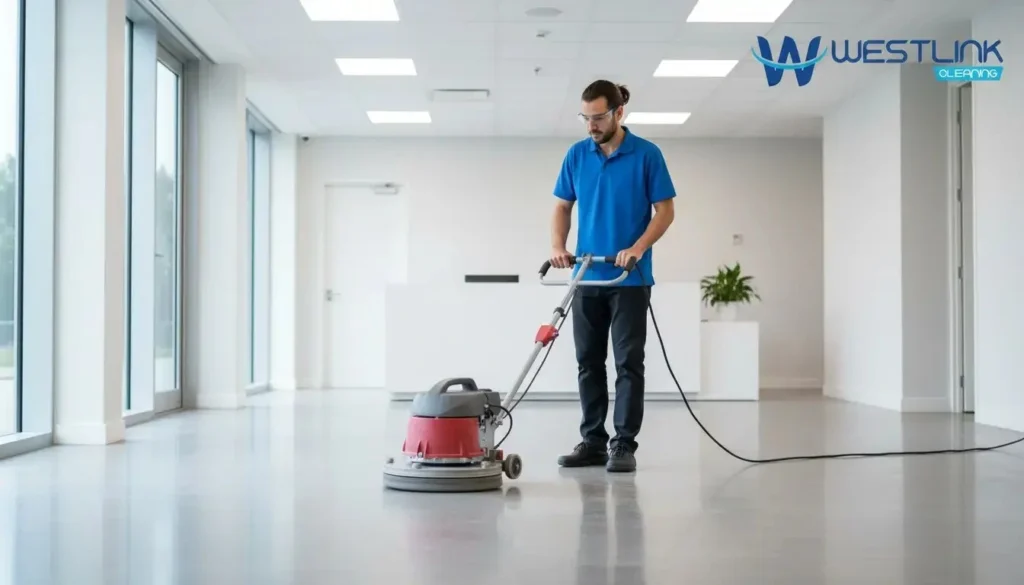
Floor buffing is a machine-based floor maintenance process that reduces light scuffs, dullness, black heel marks, and minor surface wear on a floor with a usable finish. It improves appearance, but it does not replace sanding, stripping, or full refinishing when the damage is deeper.
A floor can start to look tired long before it is badly damaged. Busy foot traffic, light scratches, surface haze, and worn traffic lanes can make the floor look flat and dirty even after normal hard floor cleaning. In that situation, buffing is often the right next step because it refreshes the surface without moving straight to heavier restoration.
The simplest way to understand floor buffing is this: it is a light corrective maintenance method for floors that are visually worn but still maintainable.
What does floor buffing mean?
Floor buffing means using a rotary floor machine with the correct pad to improve the appearance of the upper surface of a floor or its finish. It is designed to correct light visual wear, not deep structural damage.
That distinction matters. Buffing sits between routine cleaning and heavy restoration. It does more than mopping or dust removal, but it is much less aggressive than sanding, stripping, or refinishing.
In practical terms, buffing is used when a floor still has enough finish left to respond well, but no longer looks clean, even, or clear after standard maintenance.
Why is floor buffing done?
Floor buffing is done to improve appearance and extend the useful life of the existing finish. It helps delay heavier corrective work when the floor is dull, lightly marked, or visually worn, but not yet damaged beyond maintenance.
Buffing is commonly used to:
- reduce light scuffs and black heel marks
- improve gloss or surface clarity
- refresh dull traffic lanes
- improve presentation in occupied spaces
- extend the life of the current floor finish system
So the purpose of buffing is not only to make the floor shinier. Its real value is restoring a cleaner, more even appearance before deeper restoration becomes necessary.
How does floor buffing work?
Floor buffing works by moving a rotating pad across a clean floor in controlled, overlapping passes. The machine creates the movement, but the final result depends on the pad, machine speed, floor type, surface finish, and how well the floor was cleaned first.
This is why buffing should never be explained as simply running a buffer over the floor. The result depends on the full maintenance setup.
If loose grit, sticky residue, or the wrong pad is left in the system, the process can produce poor results or create avoidable wear. Good buffing starts with correct preparation, not just machine use.
What machine is used for floor buffing?
A floor buffer usually refers to a lower-speed rotary floor machine used for maintenance tasks such as light scrubbing, buffing, and surface correction.
A burnisher is different. Burnishers operate at much higher speeds and are mainly used to create a stronger gloss effect on suitable finished floors. That is why buffing and burnishing should not be treated as the same process.
If someone says “buffing” when they really mean “high-gloss burnishing,” the explanation becomes inaccurate. Good floor care content should keep those terms separate.
What does the floor pad do during buffing?
The pad is the part that actually touches the floor, so pad choice has a major effect on the result. The machine provides motion, but the pad controls how gentle or aggressive the process becomes.
In simple terms:
- lighter or softer pads are used for light correction and shine improvement
- more aggressive pads provide stronger surface action
- the wrong pad can reduce finish quality or create unnecessary wear
This is one of the main reasons floor identification matters before buffing begins.
What is the basic floor buffing process?
The basic floor buffing process is simple, but each step matters.

1. Remove loose grit and dust
Sweep, dust mop, or vacuum the floor first. Grit should never stay under the machine because it can scratch the surface and reduce finish quality.
2. Clean the floor properly
Buffing should be done on a clean floor, not a dirty one. Soil, grease, and residue can interfere with the result and may be spread further during machine work. On larger sites, this preparation often overlaps with routine commercial floor cleaning services that keep the surface ready for corrective maintenance.
3. Match the machine and pad to the floor
The floor type, finish system, site use, and manufacturer care guidance should shape the method. A one-size-fits-all approach is not reliable.
4. Make controlled overlapping passes
Move the machine evenly so the surface is corrected consistently. Uneven passes can create patchy results.
5. Remove dust or residue after buffing
Any fine dust or residue left after buffing should be removed so the floor looks clean and remains safe to use.
The key rule is simple: buff clean floors with the correct setup.
Which floors can often be buffed?
Some hard floors can respond well to buffing, but suitability depends on the exact product and finish system.
Buffing may be appropriate for some:

- finished resilient commercial floors such as certain vinyl or VCT systems
- some sealed or finished stone floors
- some hard-surface commercial floors that are maintained through regular machine care
- some polished or coated floor systems where the manufacturer allows maintenance buffing
For example, a commercial vinyl floor in an office corridor may benefit from buffing when it has light traffic dullness and black marks but still has an intact finish. A sealed stone foyer may also respond well when the issue is surface haze rather than deep wear. In tiled spaces, the floor may also need related tile and grout cleaning if soil has built up in the joints and is affecting the overall look of the surface.
The accurate answer is never that all hard floors can be buffed. Floor type alone is not enough. The exact product and its care guidance matter.
Which floors should not be buffed or need extra caution?
Some floors should not be machine buffed at all, while others require strict caution.
This is where many weak articles become misleading. The correct rule is to check the care instructions for the exact floor product before buffing it.
That matters because:

- some laminate products specifically warn against buffing or polishing machines
- some hardwood products restrict machine buffing, especially if the finish system is sensitive
- some modern low-maintenance floors are designed around no-buff care programs
- some surfaces may have warranty conditions linked to approved maintenance methods
For example, a laminate floor with worn joins or edge swelling is not a suitable buffing candidate. A timber floor with finish wear may need screening, recoating, or a different restoration method rather than surface buffing.
What can floor buffing improve?
Floor buffing can improve light surface problems that make a floor look worn before it needs deeper restoration.
This usually includes:
- light scuffs
- black heel marks
- mild surface haze
- dull traffic lanes
- reduced visual clarity
- minor finish marks on maintainable floors
It works best when the floor still has a usable finish and the wear is limited to the upper visible layer.
For example, if a school corridor, office entry, retail floor, or lobby floor looks dull after normal cleaning but has no deep damage, buffing may help restore a cleaner and more even appearance.
What can floor buffing not fix?
Floor buffing does not reliably fix deeper floor problems. It is not the right solution for:
- deep scratches
- peeling or failed finish
- swollen laminate
- cracked surfaces
- open joints
- severe absorbed staining
- major wear or structural damage
This is the most important limitation to understand. Buffing improves appearance when the floor is still maintainable. It does not replace restoration when the problem goes beyond the surface.
How is buffing different from polishing, burnishing, scrubbing, and sanding?
These floor-care processes are related, but they do different jobs.
Cleaning removes everyday soil and contamination.
Scrubbing removes heavier soil, residue, or build-up.
Buffing reduces light scuffs and dullness to improve surface appearance.
Burnishing is mainly used to increase gloss on suitable finished floors.
Polishing is a broader term that can mean refining or improving the surface depending on the floor system.
Sanding removes more material to correct deeper wear and is used in restoration or refinishing work.
The easiest way to understand buffing is this: it is a light corrective maintenance step, not a deep corrective process.
Is floor buffing the same as polishing?
No. Buffing and polishing are connected, but they are not always the same in practical floor-care language.
Buffing usually refers to lighter maintenance-level correction for appearance improvement on an existing finish. Polishing is a broader term that may refer to shine improvement, surface refinement, or a system-specific process depending on the floor. In many cases, deeper appearance correction may sit closer to professional floor polishing services than standard buffing.
So while the terms are sometimes used loosely, they should not be treated as automatic synonyms.
Is floor buffing the same as burnishing?
No. Burnishing is usually a higher-speed process used to create a stronger gloss effect on suitable finished floors. Buffing is a lighter corrective maintenance process used to reduce dullness and light surface wear.
That difference matters because the machine speed, pad selection, and expected finish level are not the same.
Can floor buffing remove scratches, stains, or dullness?
Floor buffing can improve very light surface scratches, finish marks, minor scuffs, and dull areas caused by everyday wear. It works best when the issue is close to the top surface.
It does not reliably remove deep scratches or absorbed stains. If the damage has penetrated deeper into the floor or finish system, buffing usually will not solve the root problem.
Buffing can also improve dullness caused by traffic haze or surface wear, but it should not be described as full floor renewal.
Can floor buffing make floors slippery?
Yes, it can contribute to slip risk if the wrong method, the wrong product, or poor residue control leaves the floor unsafe. A floor that looks shinier is not automatically a safer floor. Good floor maintenance should improve presentation without reducing safe use. OSHA’s walking-working surface requirements state that floors should be kept clean and, where feasible, dry, and that hazardous conditions should be corrected before people use the surface again.
What safety points matter during or after buffing?
Several safety points matter:
- correct floor identification
- correct pad and product selection
- removal of residue after buffing
- traffic control while the floor is being maintained
- warning signs where needed
- checking that the floor is safe before reopening the area
A successful buffing result is not just a better-looking floor. It is a floor that looks better and remains safe for everyday use.
How often should a floor be buffed?
A floor should be buffed when its appearance has dropped but the surface is still maintainable. There is no single schedule that suits every site.
The right timing depends on:
- traffic level
- contamination
- finish wear
- floor type
- entry dirt control
- maintenance quality between visits
For example, a high-traffic commercial corridor may need more frequent appearance correction than a low-use residential room. A retail floor near an entrance may dull faster than an office with controlled foot traffic.
The best way to decide frequency is by floor condition, not by calendar alone.
When is buffing not enough?

Buffing is not enough when the floor has deep scratches, finish failure, swelling, cracks, severe staining, or major wear. At that point, the floor usually needs a deeper corrective process.
That may involve scrubbing, floor stripping and sealing, recoating, floor polishing, repair work, or refinishing depending on the floor system.
The key decision is whether the floor still has a workable surface. If it does, buffing may help. If it does not, the correct solution changes.
When should you hire a professional for floor buffing?

Professional floor buffing is usually the better option when the floor type is unclear, the finish system is unknown, the site is large, slip risk matters, or the floor may need more than buffing.
This is especially important in commercial settings such as offices, schools, medical sites, retail areas, strata buildings, and hospitality spaces, where appearance, safety, downtime, and finish life all matter.
A professional service does more than operate a machine. It helps identify the floor correctly, choose the right method, avoid damage, and decide whether buffing is actually the right process.
If the floor has patchy wear, uncertain coating history, or manufacturer restrictions, expert assessment is usually the safer option.
How should you maintain a floor after buffing?
Good aftercare is what turns buffing from a short-term visual improvement into a longer-lasting maintenance result. That includes removing grit regularly, using the correct cleaner for the floor system, and following manufacturer-specific care guidance rather than using generic products across every surface. For wood floors, the NWFA’s consumer maintenance guidance recommends routine dust removal and using a cleaner recommended by the installer or floor manufacturer.
Conclusion
Floor buffing is a light machine-based maintenance process that improves the appearance of a floor with minor surface wear, dullness, and scuffing. It is best used when the floor still has a usable finish and only needs surface-level correction.
The clearest way to decide whether buffing is suitable is to ask one question: does the floor only look worn, or is it actually damaged? If the problem is mostly visual and the surface is still maintainable, buffing may be the right next step. If the floor has deeper wear or finish failure, a different process is usually needed.
Frequently asked questions about floor buffing
1. What does floor buffing do?
Ans. Floor buffing reduces light scuffs, black marks, dullness, and minor surface wear while improving the appearance of a maintainable floor. It is a surface-improvement method, not a full restoration process.
2. Does floor buffing remove scratches?
Ans. It can reduce the appearance of very light surface scratches or finish marks. It does not reliably remove deep scratches.
3. Does floor buffing remove stains?
Ans. It may improve some surface marks, but it is not a dependable fix for deep or absorbed stains. If the stain has penetrated deeper into the floor or finish, buffing is usually not enough.
4. Is buffing the same as polishing?
Ans. No. Buffing is usually the lighter maintenance term and focuses on surface appearance. Polishing is broader and may refer to a different finish-improvement method depending on the floor.
5. Is buffing the same as burnishing?
Ans. No. Burnishing is a higher-speed gloss process for suitable finished floors. Buffing is a lighter maintenance-level correction.
6. Can laminate floors be buffed?
Ans. Some laminate manufacturers say no. That is why the exact product guidance matters more than broad advice.
7. Can hardwood floors be buffed?
Ans. Some hardwood floors can only be treated in limited ways, depending on the finish system. Always check the product and finish guidance before using machine buffing.
8. How often should floors be buffed?
Ans. There is no universal schedule. The right frequency depends on traffic, finish wear, dirt load, and how the floor is maintained between services.
9. Can buffing make a floor more slippery?
Ans. Yes, it can if the wrong products, residue build-up, or unsuitable methods reduce surface safety. Appearance should never be improved at the cost of safe use.
10. When is buffing not enough?
Ans. Buffing is not enough when the floor has deep scratches, finish failure, swelling, structural damage, or major wear. In those cases, the floor usually needs a heavier corrective or restorative process.


